Home
Class 12
PHYSICS
The inclined surface is rough mu = (1)/(...

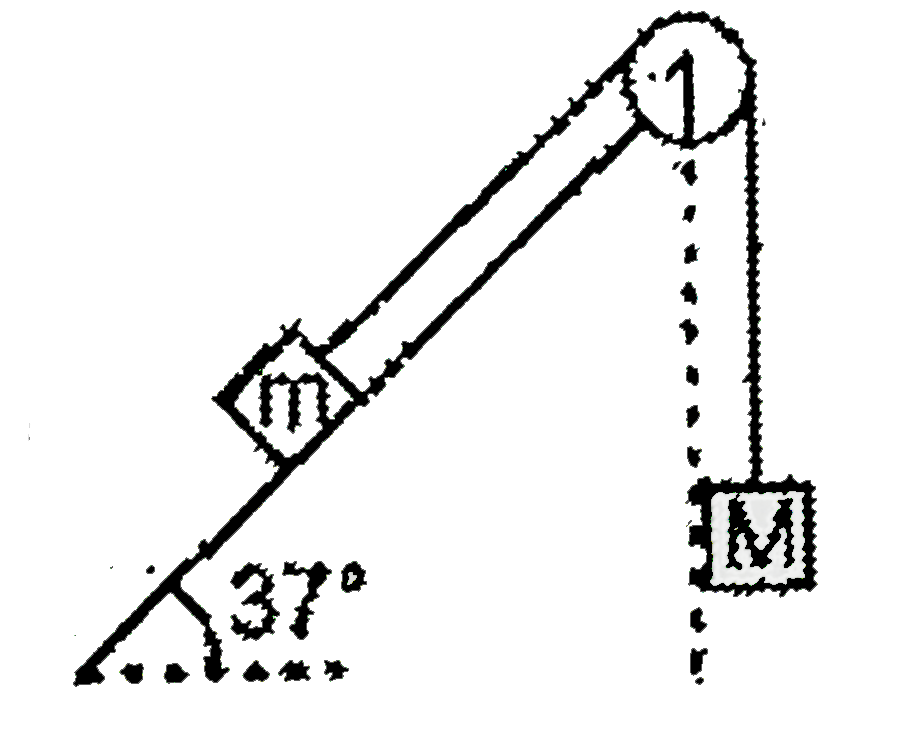
The inclined surface is rough `mu = (1)/(2)`. For different values of m and M system slides down or up the plane or remains stationary. Match the appropriate entries of column-1 with those of column-2

`{:(,"Column-1",,"Column-2"),("(A)","Minimum value of " (m)/(M) "so theta m slides down","(P)",(5)/(3)),("(B)","Minimum valie of " (M)/(m)"so that m slides up","(Q)",1),("(C)","Value of" (m)/(M) "so that friction force on m is zero","(R)",(3)/(5)),("(D)",underset("and acceleration of M")"Ratio of vertical component of acceleration of m","(S)",5):}`

Text Solution

Verified by Experts

The correct Answer is:
A, B, C, D

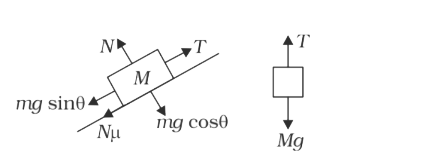
`implies T = mg`
`T + N mu = mg sin theta`
`N = m g cos theta`
`implies Mg + mg cos theta mu = m g sin theta`
`implies (m)/(M) = (1)/(sin theta - mu cos theta) = 5`
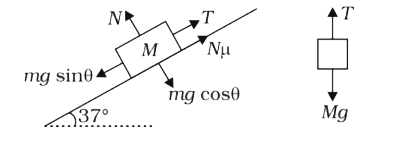
(B) `implies M = m (sin theta + mu cos theta)`
`implies M = m (sin theta + mu cos theta)`
`implies (M)/(m) = (3)/(5) + ((1)/(2)) (4)/(5) = 1`
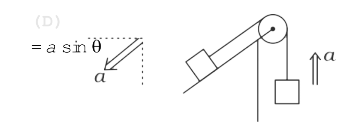
(C ) `T = m g sin theta = Mg implies m//M = (1)/(sin theta) = (5)/(3)` `implies` vertical component of acceleration of m
(D ) `= a sin theta` And vertical acc of M = a
`implies` ratio `= sin theta = (3)/(5)`
Promotional Banner

Similar Questions

Explore conceptually related problems

Two blocks of mass 2m and m slide down the slope AB having same friction coefficient Then:

A block of mas m begins to slide down on an inclined plane of inclination theta . The force of friction will be

A body of mass m slides down a rough plane of inclination alpha . If mu is the coefficient of friction, then acceleration of the body will be

A body of mass m slides down a rough plane of inclination alpha . If mu is the coefficient of friction, then acceleration of the body will be

Match the corresponding entries of column 1 with column 2. [where m is the magnification produced by the mirror

A body weighing 20 kg just slides down a rough inclined plane that rises 5 m in every 13 m. What is the coefficient of friction?

Trajectory of a particle in a projectile motion is given by y=x-x^(2)/80 where x and y are in meters. Match the column-1 and column-2. {:(,"Column-I",,"Column-II"),("(A)","x coordinate at height of 15 m",,"(P) 20 m"),("(B)",underset("point of projection at x= 100 m")"vertical distnce of particle from",,"(Q) 80 m"),("(C)","Horizontal range",,"(R) 60 m"),(,,,"(S) 25 m"):}

The coefficent of friction between the masses 2m and m is 0.5. All other surfaces are frictionless and pulleys are massless. Column I given the different values of m_(1) and column II gives the possible acceleration of 2m and m. Match the following : {:(,"Column I",,"Column II",),((A),m_(1) = 2m,(P),"Accelerations of 2m and m are same",),((B),m_(1) = 3m,(Q),"Acceleration of 2m and m are different",),((C ),m_(1) = 4m,(R ),"Acceleration of 2m is greater than m",),((D),m_(1) = 6m,(S),"Acceleration of 2m is less than 0.6 g",),(,,(T),"Acceleration of 2m is greater than 0.6 g",):}