Home
Class 12
PHYSICS
Two beads A and B move along a semicircu...

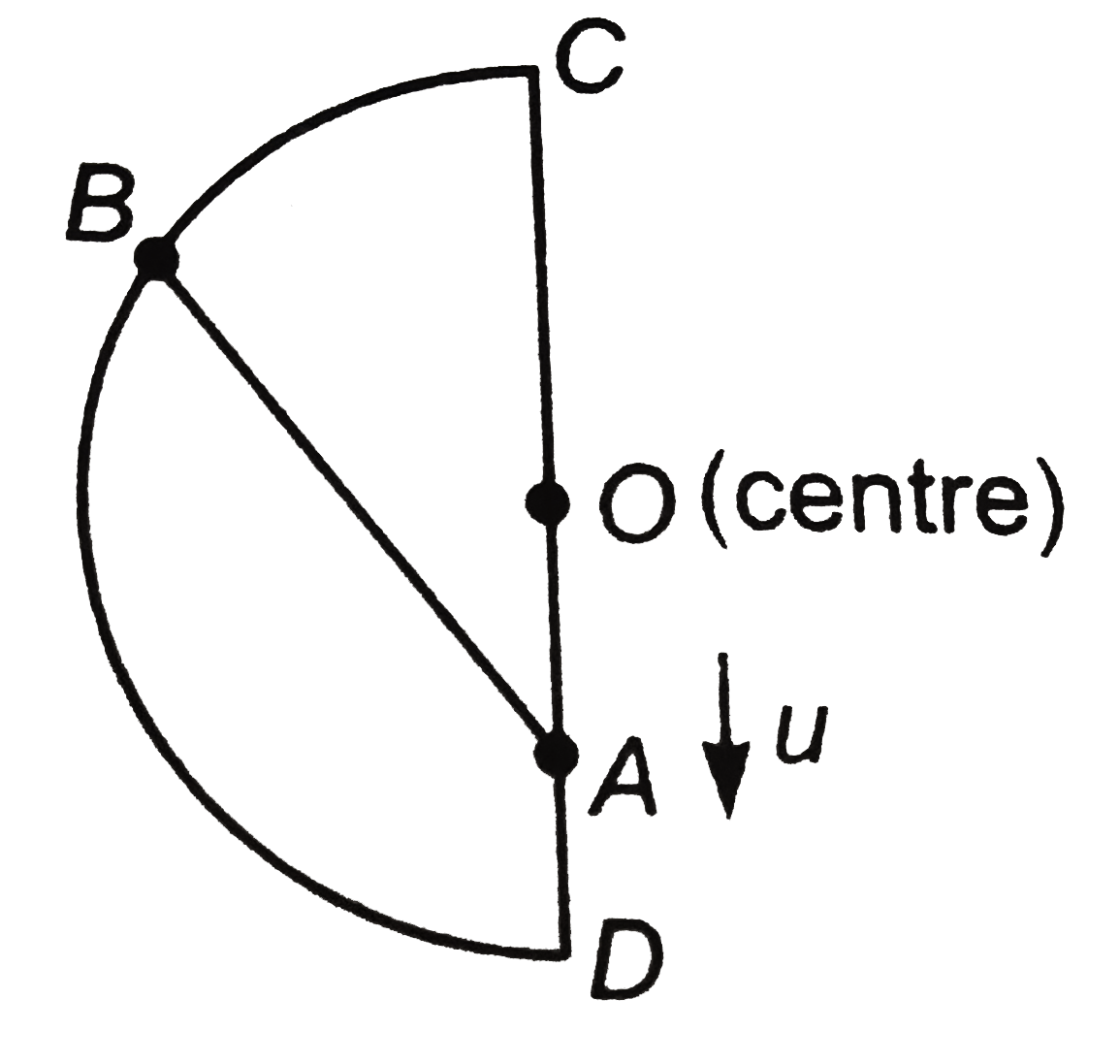
Two beads `A` and `B` move along a semicircular wire frame as shown in figure. The beads are connected by an inelastic string which always remains tight . At an instant the speed of `A` is `u,/_BAC = 45^(@) and BOC = 75^(@)`,where `O` is the centre of the semicircular arc. The speed of bead `B` at that instant is

A

`sqrt(2u)`

B

u

C

`(u)/(2sqrt(2))`

D

`sqrt((2)/(3)) u`

Text Solution

Verified by Experts

The correct Answer is:
A

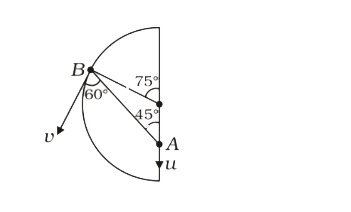
Distance AB - constant
`:.` Component of v along
BA = component of u along BA
or `v cos 6^(@) = u cos 45^(@)`
or `v = sqrt(2) u`
Promotional Banner

Similar Questions

Explore conceptually related problems

Two block A and B move along a semicircular wire frame as shown in figure. The beads are connected by an inelastic string wich always remains tight . At an instant the speed of A is u,/_BAC = 45^(@) and BOC = 75^(@) ,where O is the center of the semicircular are. The speed of bead B at that instant is

A bead C can move freely on a horizontal rod. The bead is connected by blocks B and D by a string as shown in the figure. IF the velocity of B is v. find the velocity of block D.

A thin insulating wire is stretched·along the diameter of an. insulated circular hoop of radius R. A small bead of mass m and charge-q is threaded onto the wire. Two small identical charges are tied to the hoop at points opposite to each other, so that the diameter passing through them is perpendicular to the thread as shown in figure. The bead is released at a point which.is located at a distance x_(0) from the centre of the hoop. Assume that x_(0) lt lt R . (a) What is the resultant force acting on the charged bead? (b) Describe the motion of the bead after it is released X (c) Use the assumption that (x)/(R) lt lt 1 to obtain an approximate equation of motion, and find the displacement and velocity of the bead as functions of time (d) When will the velocity of the bead will bcome zero for the first time?

A rod AB is moving on a fixed circle of radius R with constant velocity 'v' as shown in figure. P is the point of intersection of the rod and the circle. At an instant the rod is at a distance x=(3R)/(5) from centre of the circle. The velocity of the rod is perpendicular to the rod and the rod is always parallel to the diameter CD . (a) Find the speed of point of intersection P (b) Find the angular speed of point of intersection P with respect to centre of the circle.

Two wire loop PQRSP formed by joining two semicircular wires of radii R_(1) and R_(2) carries a current i as shown in the figure given below. What is the magnetic field induction at the centre O in cases (A) and (B) ?

A fixed U -shaped smooth wire has a semi-circular bending between A and B as shown in the figure. A bead of mass 'm' moving with uniform speed v through the wire enters the semicircular bend at A and leaves at B . The magnitude of average force exerted by the bead on the part AB of the wire is

A bead C can move freely on a horizontal rod. The bead is connected by blocks B and D by a string as shown in the figure. If the velcoity of B is v The velcoity of block D is 4v//x find the value of x .

Two blocks are connected by an inextensible string as shown. The pulley is fixed. If block A moves down with speed v, find the velocit of block B at instant.

A meter stick AB of length 1 meter rests on a frictionless floor in horizontal position with end A attached to the string as shown. Assume that string connecting meter stick with pulley always remains vertical. If block 1 and 2 are given constant speeds as shown then the distance moved by end B over the floor in the period for which speed of B is less than A .

Two blocks A and B of masses m and 2m respectively are placed on a smooth floor. They are connected by a spring. A third block C of mass m moves with a velocity v_0 along the line joing A and B and collides elastically with A, as shown in figure. At a certain instant of time t_0 after collision, it is found that the instantaneous velocities of A and B are the same. Further, at this instant the compression of the spring is found to be x_0 . Determine (i) the common velocity of A and B at time t_0 , and (ii) the spring constant.

