Home
Class 12
PHYSICS
In figure shown if m(A) = 20 kg and m(B)...

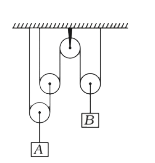
In figure shown if `m_(A) = 20` kg and `m_(B) = 80` kg. The acceleration of block A if the system is set free to move is `beta m//s^(2)` . Find the value of `beta` . (Take `g = 10 ms^(-2)`)

Text Solution

Verified by Experts

The correct Answer is:
A, B, D

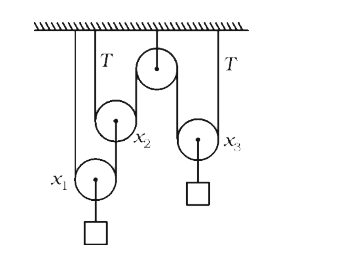
Let `x_(1), x_(2)` and `x_(3)` be the displacement of the three bodies as shown, measured downwards from the ceiling:
Also, let us assume acceleration of each body in the downward direction.
`(a_(1), a_(2), a_(3))`
From newton 's law
(1) `20 g - 4T = 20 a_(1)` (2) `80 g- 2T = 80 a_(2)`
From constraint equation
`x_(1) + x_(1) - x_(2)` = constant `implies 2a_(1) - a_(2) = 0`
`2x_(2) + 2x_(3)` = constant `implies a_(2) + a_(3) = 0`
combining the equation to get (3) `a_(3) = - 2a_(1)`
Solve to get `a_(1) = (-7 g)/(17)` and `a_(2) = (14 g)/(17)`
Acceleraion of 20 kg, `(7 g)/(17) m//s^(2)` upwards acceleration of 80 kg, `(14 g)/(17) m//s^(2)` downwards
Promotional Banner

Similar Questions

Explore conceptually related problems

If the acceleration of the block B in the following system is a ( in m//s^(2)) then find out value of 2a//5(g=10m//s^(2)) :

If m_(1) =10kg,m_(2)=4kg,m_(3) =2kg , the acceleration of system is .

Two block A and B are arrenged as shown in figure (m_(A) = 5 kg and m_(B) = 10 kg) Find the acceleration of blocks if F = 40 N

In the figure shown, the acceleration of block of mass m_(2) is 2m//s^(2) . The acceleration of m_(1) :

In the figure ( g = 10 m//s^(2) ) .Acceleration of 2kg block is :

In the figure-2.205 shown in blocks A, B and C has masses m_(A)= 5 kg, m_(B) = 5 kg and m_(C )= 10kg respectively, find the acceleration of the three blocks. Assume all pulleys and strings are ideal. (Take g = 10m//s^(2) )

In the arrangement shown in figure m_(A) = 4.0 kg and m_(B) = 1.0 kg. The system is released from rest and block B is found to have a speed 0.3 m/s after it has descended through a distance of 1m. Find the coefficient of friction between the block and the table. Neglect friction elsewhere. (Take g = 10 m/ s^(2) )

In the system shown in the adjoining figure, the acceleration of the 1 kg mass is m//s^(2) . (take g = 10 m//s^(2) )

