Home
Class 12
PHYSICS
A block A of mass 4 kg is placed on anot...

A block A of mass 4 kg is placed on another block B of mass 5 kg , and the block B rests on a smooth horizontal table . For sliding block A on B , a horizontal force of 12 N is required to be applied on A How much maximum force can be applied on B so that both A and B move togrther ? Also find out acceleration produced by this force .

A

15 N

B

25 N

C

27 N

D

48 N

Text Solution

Verified by Experts

The correct Answer is:
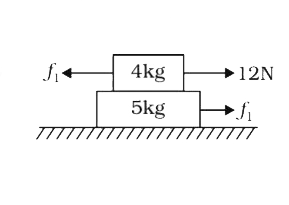
A


`a_("system") = (12)/(9) =(4)/(3) m//s^(2)`
`implies f_(1) = mu 4 g = 5 xx (4)/(3) implies mu = (1)/(6)`
`f_("max", 5kh) = (m_(A) + m_(B)) mu g = 9 xx (1)/(6) xx 10 = 15 N`
Promotional Banner

Similar Questions

Explore conceptually related problems

A block the of mass 4kg is placed on another block of mass 5kg and the block B rests on a smooth horizontal table for sliding the block A on B a horizontal force 12N is required to be applied force on it How much maximum horizontal force can be applied on 'B' s that both A and B move together? Also find out the accleration proudced by this force .

12N of force required to be applied on A to slip on B. Find the maximum horizontal force F to be applied on B so that A and B moves together.

A 4 kg block A is placed on the top of 8 kg block B which rests on a smooth table. A just slips on B when a force of 12 N is applied on A. Then the maximum horizontal force F applied on B to make both A and B move together, is

A block A of mass 2 kg is placed over smooth block B of mass 4 kg which is placed over a smooth horizontal floor The coefficient of friction between A and B is 0.4 when a horizontal forces of magnitude 10 N is applied on A the acceleration of block of A and B are

Two blocks of masses 1 kg and 2 kg are placed in contact on a smooth horizontal surface as shown in fig. A horizontal force of 6N is applied d(a) on a 1-kg block. Find the force of interaction of the blocks. .

A small block B is placed on another block A of mass 5 kg and length 20 cm. Initially, the block B is near the right end of block A. A constant horizontal force of 10 N is applied to the block A. All the surfaces are assumed frictionless. Find the time elapsed before the block B separates from A.

A force of 75 N is applied to a block of mass 25 kg, resting on a smooth horizontal surface. In how much time, the block will acquire a speed of 12 m/s?

A block A of mass 2 kg rests on another block B of mass 8 kg which rests on a horizontal floor. The coefficient of friction between A and B is 0.2 while that between B and floor is 0.5. when a horizontal force of 25 N is applied on the block B. the force of friction between A and B is

Two block A and B of masses 5 kg. and 3 kg. respectively rest on smooth horizontal surface with B over A. The coefficient of friction between A and B. 0.5 the maximum horizontal force that can be applied to A so that there will be motion of A and B without separation is :-

