Home
Class 12
PHYSICS
In the figure masses m1, m2 and M are 20...

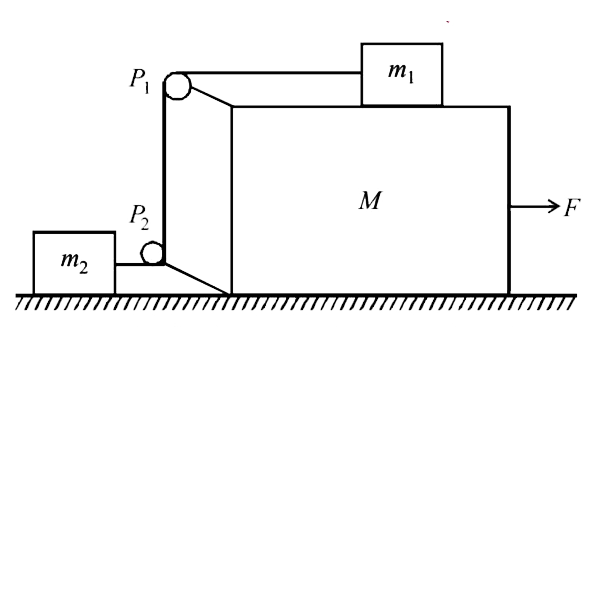
In the figure masses `m_1`, `m_2` and M are 20 kg, 5kg and 50kg respectively. The coefficient of friction between M and ground is zero. The coefficient of friction between `m_1` and M and that between `m_2` and ground is 0.3. The pulleys and the strings are massless. The string is perfectly horizontal between `P_1` and `m_1` and also between `P_2` and `m_2`. The string is perfectly vertical between `P_1` and `P_2`. An external horizontal force F is applied to the mass M. Take `g=10m//s^2`.

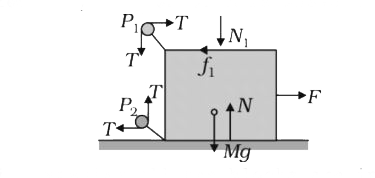
(a) Draw a free body diagram for mass M, clearly showing all the forces.
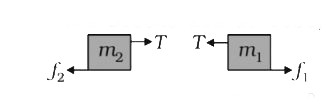
(b) Let the magnitude of the force of friction between `m_1` and M be `f_1` and that between `m_2` and ground be `f_2`. For a particular F it is found that `f_1=2f_2`. Find `f_1` and `f_2`. Write equations of motion of all the masses. Find F, tension in the spring and acceleration of masses.

Text Solution

Verified by Experts

The correct Answer is:
(i) 30 (ii) 15 (iii) 60 (iv) 18 (v) 0.6

Free body diagram of M is shown in the figure below.

(i) Supposing all the blocks are in motion
`f_(1_("max")) = mu_(1) N_(1) = mu_(1) m_(1) g = 0.3 xx 20 xx 10 = 60 N` and `f_(2_("max")) = mu_(2) N_(2) = mu_(2) m_(2) g = 0.3 xx 5 xx 10 = 15 N`
Friction between `m_(2)` and ground will be maximum which is 15 N. Given that
`f_(1) = 2 f_(2)`, so `f_(1) = 2 xx 15 = 30 N`
The block `m_(1)` can not move on M.
Let all the blocks are at rest, then

For M : `F - f_(1) = 0` for `m_(1) : T - f_(1) = 0` and for `m_(2) : T - F_(2) = 0` which gives `f_(1) = f_(2)` which does not satisfy the given condition
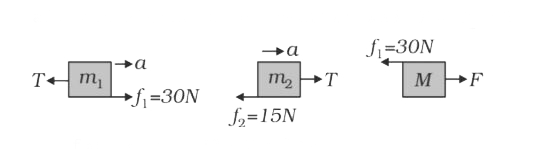
Since `m_(1)` cannot move over the block M so `m_(2)` can't move relative to M, therefore all the blocks move together and `T = f_(1) = 30 N` and `f_(2) = 15 N`

for `m_(1) : 30 - T = 20 a`
for `M : F - 30 = 50 a`
and for `m_(2) : T - 15 - 5a`
After solving these equations we get , `a = (3)/(5) m//s^(2), T = 18 N` and F = 60 N
Promotional Banner