Home
Class 12
PHYSICS
A particle of mass 10^-2kg is moving alo...

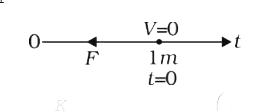
A particle of mass `10^-2kg` is moving along the positive x axis under the influence of a force `F(x)=-K//(2x^2)` where `K=10^-2Nm^2`. At time `t=0` it is at `x=1.0m` and its velocity is `v=0`.
(a) Find its velocity when it reaches `x=0.50m`.
(b) Find the time at which it reaches `x=0.25m`.

Text Solution

Verified by Experts

The correct Answer is:
(i) -1m/s (ii) `((pi)/(3) + (sqrt(3))/(4)) s`

(i) -1m/s (ii) `((x)/(3) + (sqrt(3))/(4))s`
The particle of mass `(m = 10^(-2) kg)` is moving along positive x-axis

(i) `F(x) = - (K)/(2x^(2))` or `mv ((dv)/(dx)) = - (K)/(2x^(2))`
Now integrating both side, `m int_(0)^(v) vdv = - int_(1)^(x) (K)/(2x^(2)) dx`
or `(m upsilon^(2))/(2) = [(K)/(2x)]_(1)^(x) = (K)/(2) ((1)/(x) - 1)`
or `v^(2) = (K)/(m) ((1)/(x) - 1)` or `V = sqrt((K)/(m) ((1)/(x) - 1))`
When x = 0.5 m, `v = sqrt((k)/(m)((1)/(0.5) - 1)) = sqrt((k)/(m)) = sqrt((10^(-2))/(10^(-2))) = +- 1`
As the force is acting along negative x-direction, therefore, the velocity will be in -x direction. Hence v = - 1m/s and `vec(v) = - 1 i m //s`
(ii) As `(k)/(m) = 1 m//s`, hence from (1) `V = (dx)/(dt) = - sqrt((1 - x)/(x))` [we have chosen -sign becuase velocity is in -x direction `sqrt((x)/(1 - x)) dx = - dt` `implies int_(1)^(0.25) sqrt((x)/(1 -x)) dx = int_(0)^(t) dt`
Put `x = sin^(2) theta, dx = 2 sin theta cos theta d theta`
So `int_(pi//2)^(pi//6) 2 sin^(2) theta d theta = - t cos 2 theta = 1 - 2 sin^(2) theta, 2 sin^(2) theta = 1 - cos 2 theta`
`int_(pi//2)^(pi//6) (1 - cos 2 theta) d theta = - t` `[ theta - (sin 2 theta)/(2)]_(pi//2)^(pi//6) = - t`
`((pi)/(6) - (1)/(2) sin (pi)/(3)) - ((pi)/(2) - (1)/(2) sin pi) = - t` `:.` `t = ((pi)/(3) + (sqrt(3))/(4)) sec`
Promotional Banner

Similar Questions

Explore conceptually related problems

A particle moves along the X-axis x=0 to x=5 m under the influence of a force given by F=10-2x+3x^(2) . Work done in the process is

A particle moves along the X-axis from x=0 to x=5m under the influence of a force given by F=(7-2x+3x^(2)). Find the work done in the process.

A particle moves along the X-axis from x=0 to x=5 m under the influence of a force given by F=7-2x+3x^(2). Find the work done in the process.

A particle A of mass 10//7kg is moving in the positive direction of x-axis . At initial position x=0 , its velocity is 1ms^-1 , then its velocity at x=10m is (use the graph given)

A particle moves along X-axis from x=0 to x=1 m under the influence of a force given by F=3x^(2)+2x-10. Work done in the process is

A particle moves along x-axis from x=0 to x=2 m under the influence of a force F (in N) given by F=3x^(2)+2x-5. Calculate the work done

A particle moves along the x-axis from x=0 to x=5m under the influence of a given by F =7-2x + 3x^(2) . The instantaneous power applied to the particle is.

A body of mass m , moving along the positive x direction is subjected to a resistive force F = Kv^(2) (where K is a constant and v the particle n velocity). If m = 10 kg v = 10 m//s at t = 0, " and " K = 2N (m//s)^(-2) the velocity when t = 2s is:

A particle is moving along the x-axis with an acceleration a = 2x where a is in ms^(–2) and x is in metre. If the particle starts from rest at x=1 m, find its velocity when it reaches the position x = 3.

A particle starts moving along the x-axis from t=0 , its position varying with time as x=2t^3-3t^2+1 . a. At what time instants is its velocity zero? b. What is the velocity when it passes through the origin?

