Home
Class 12
PHYSICS
A planet travels in an elliptical orbit ...

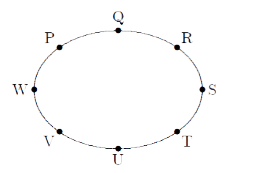
A planet travels in an elliptical orbit about a star as shown. At what pair of points is the speed of the planet the same?

A

W and S

B

P and T

C

P and R

D

Q and U

Text Solution

Verified by Experts

The correct Answer is:
D

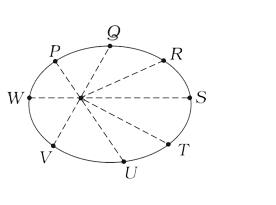
In planetary motion,
Area velocity remain constant
So, `L/(2m)` = const `rArr (mwr^2)/(2m)` =const `rArr (mvr)/(2m)` = const
Hence, the velocity of the planet will be equal at the position which are at the same distance from the star.
Promotional Banner

Similar Questions

Explore conceptually related problems

In elliptical orbit of a planet

What is the shape of planet's orbits?

If a satellite is revolving around a planet of mass Min an elliptical orbit of semi-major axis a. Show that the orbital speed of the satellite when it is at a distance are from the planet will be given by v^(2)=GM[2/r-1/a]

A planet revolves in elliptical orbit around the sun. (see figure). The linear speed of the planet will be maximum at

A planet orbits the sun in an elliptical path as shown in the figure. Let v_(p) " and " v_(A) be spped of the planet when at perohelion and aphelion respectively. Which of the following relations is correct ?

A planet of mass m is moving in an elliptical orbit about the sun (mass of sun = M). The maximum and minimum distances of the planet from the sun are r_(1) and r_(2) respectively. The period of revolution of the planet wil be proportional to :

A planet revolves in an elliptical orbit around the sun. The semi-major and minor axes are a and b , then the time period is given by :

A planet revolves around the sun in elliptical orbit of eccentricity 'e'. If 'T' is the time period of the planet then the time spent by the planet between the end of the minor axis and close to the sun is

A planet is revolving in an elliptical orbit around the sun as shown in the figure. The areal velocity (area swapped by the radius vector with respect to sun in unit time) is:

In the figure shown a planet moves in an elliptical orbit around the sun. Compare the speeds, linear and angular momenta at the points A and B .

