Home
Class 12
PHYSICS
A planet of mass m moves along an ellips...

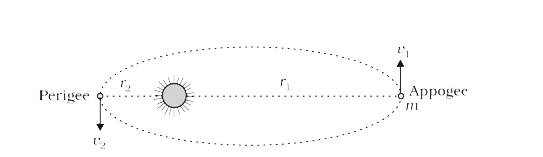
A planet of mass m moves along an ellipse around the Sun so that its maximum and minimum distances from the Sun are equal to `r_1` and `r_2` respectively. Find the angular momentum M of this planet relative to the centre of the Sun.

Text Solution

Verified by Experts

The correct Answer is:
A

If `v_1` and `v_2` are the velocities of planet at its aphelion and perihelion respectively then according to conservation of angular momentum, we have `mv_1r_1 =m v_2r_2`
or `v_1r_1=v_2r_2`
As the total energy of the planet is also constant, we have `-(GM m)/r_1 + 1/2m v_1^2 =-(GM m)/r_2 + 1/2m v_2^2`
Where M is the mass of the sun.
or `GM[1/r_2-1/r_1]=v_2^2/2-v_1^2/2`
or `GM((r_1-r_2)/(r_1r_2))=(v_1^2 v_1^2)/(2r_2^2)-v_1^2/2`
or `GM((r_1-r_2)/(r_1r_2))=v_1^2/2 (r_1^2/r_2^2-1)=v_1^2/2 ((r_1^2-r_2^2)/r_2^2)`
or `v_1^2=(2GM(r_1-r_2)r_2^2)/(r_1r_2(r_1^2-r_2^2))=(2G r_2)/(r_1(r_1+r_2))` or `v_1=sqrt([(2GM r_1r_2)/(r_1+r_2)])`
`L=m v_1r_1 " " therefore " " L=msqrt((2GMr_1r_2)/(r_1+r_2)) " " therefore ` P=16
Promotional Banner

Similar Questions

Explore conceptually related problems

A planet of mass m moves along an ellipse around the sun so that its maximum and minimum distance from the sun are equal to r_(1) and r_(2) respectively. Find the angular momentum of this planet relative to the centre of the sun. mass of the sun is M .

A planet of mass moves alng an ellipes around the sun so that its maximum distance from the sum are equal to r_(1) and r_(2) respectively . Find the angular momenture L of this planet relative to the centre of the sun. [Hint :L Rember that at the maximum and minimum distance velocity is perpendicular to tthe position vectors of the planet . Apply the princples of conservation of angula r momenture and energy .]

A planet of mass m moves along an ellipse around the sum of mass M so that its maximum and minimum distances from sum are a and b respectively. Prove that the angular momentum L of this planet relative to the centre of the sun is L=msqrt((2GGMab)/((a+b)))

A planet of mass m revolves in elliptical orbit around the sun of mass M so that its maximum and minimum distance from the sun equal to r_(a) and r_(p) respectively. Find the angular momentum of this planet relative to the sun.

A planet of mass m moves around the Sun of mass Min an elliptical orbit. The maximum and minimum distance of the planet from the Sun are r_(1) and r_(2) , respectively. Find the relation between the time period of the planet in terms of r_(1) and r_(2) .

A comet of mass m moves in a highly elliptical orbit around the sun of mass M the maximum and minium distacne of the comet from the centre of the sun are r_(1) and r_(2) respectively the magnitude of angular momentum of the comet with respect to the centre of sun is

A planet of mass m is moving in an elliptical orbit about the sun (mass of sun = M). The maximum and minimum distances of the planet from the sun are r_(1) and r_(2) respectively. The period of revolution of the planet wil be proportional to :

A planet of small mass m moves around the sun of mass M along an elliptrical orbit such that its minimum and maximum distance from sun are r and R respectively. Its period of revolution will be:

A planet of mass M moves around the Sun along an ellipse so that its minimum distance from the Sun is equal to r and the maximum distance to R. Making use of Kepler's laws, find its period of revolution around the Sun.

