Home
Class 12
PHYSICS
Four particles, each of mass M and equid...

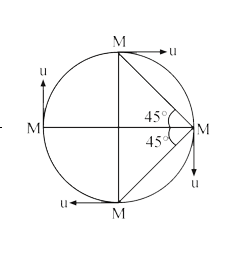
Four particles, each of mass M and equidistant from each other, move along a circle of radius R under the action of their mutual gravitational attraction. The speed of each particle is:

A

`sqrt((GM)/R (1+2sqrt2))`

B

`1/2sqrt((GM)/R (1+2sqrt2))`

C

`sqrt((GM)/2)`

D

`sqrt(2sqrt(2)(GM)/2)`

Text Solution

Verified by Experts

The correct Answer is:
B

Net force on any one particle
`=(GM^2)/(2R)^2+(GM)^2 (Rsqrt2)^2 cos 45^@ + (GM^2)/(Rsqrt2)^2 cos 45^@ =(GM^2)/R^2 [1/4+1/sqrt2]`
This force will be equal to centripetal force so
`(Mu^2)/R=(GM^2)/R^2 [(1+2sqrt2)/4] u =sqrt((GM)/R[(1+2sqrt2)/4])=1/2sqrt((GM)/R (2sqrt2+1))`
Promotional Banner

Similar Questions

Explore conceptually related problems

Two particles each of mass M and equidistant from each other move along a circle of radius R under the action of their mutual gravitional attraction the speed of each particle is

Four particles each of mass M move along a circle of radius R under the action of their mutula gravitational attraction the speed of each paritcles is

Two particles of same mass m go around a circle of radius R under the action of their mutual gravitational attraction. The speed of each particle is ,

Four particles each of mass M, move along a circle of radius R under the action of their mutual gravitational attraction as shown in figure. The speed of each particle is :

For particles of equal massses M move along a circle of radius R under th action of their mutual gravitational attraction. Find the speed of each particle.

Two particles of equal mass m go around a circle of radius R under the action the of their mutual gravitational attraction . The speed v of each particle is

Two particles of equal mass go round a circle of radius R under the action of their mutual gravitational attraction. Find the speed of each particle.

Two particles of equal mass (m) each move in a circle of radius (r) under the action of their mutual gravitational attraction find the speed of each particle.

