Home
Class 12
PHYSICS
The mass density of a spherical body is ...

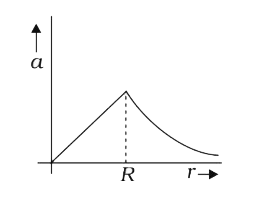
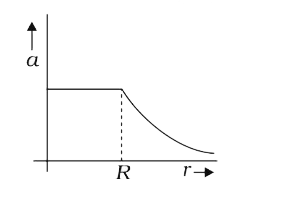
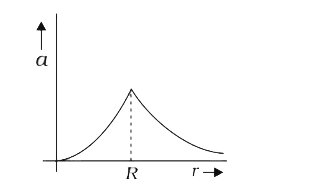
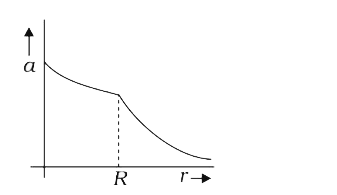
The mass density of a spherical body is given by `rho(r)=k/r` for `r le R` and `rho (r)=0`for r > R , where r is the distance from the centre. The correct graph that describes qualitatively the acceleration, a, of a test particle as a function of r is :

A

B

C

D

Text Solution

AI Generated Solution

The correct Answer is:

To solve the problem, we need to analyze the mass density of the spherical body and how it affects the acceleration of a test particle at different distances from the center of the sphere. ### Step-by-Step Solution: 1. **Understanding the Mass Density**: The mass density is given by: \[ \rho(r) = \frac{k}{r} \quad \text{for } r \leq R \] \[ \rho(r) = 0 \quad \text{for } r > R \] This indicates that the mass density decreases as we move away from the center of the sphere until we reach the radius \( R \). 2. **Finding the Mass Inside Radius \( r \)**: To find the total mass \( M \) within a radius \( r \) (where \( r \leq R \)), we need to integrate the density over the volume: \[ M = \int_0^r \rho(r) \, dV \] The volume element in spherical coordinates is \( dV = 4\pi r^2 dr \). Thus, \[ M = \int_0^r \frac{k}{r} \cdot 4\pi r^2 \, dr = 4\pi k \int_0^r r \, dr \] Evaluating the integral: \[ M = 4\pi k \left[\frac{r^2}{2}\right]_0^r = 2\pi k r^2 \] 3. **Calculating the Gravitational Field (Acceleration)**: The gravitational field \( g \) (which is equal to the acceleration \( a \) of the test particle) at distance \( r \) is given by: \[ g = \frac{GM}{r^2} \] Substituting \( M \): \[ g = \frac{G(2\pi k r^2)}{r^2} = 2\pi G k \] Thus, for \( r \leq R \), the acceleration \( a \) is constant: \[ a = 2\pi G k \] 4. **Finding the Mass Outside Radius \( R \)**: For \( r > R \), the total mass \( M_1 \) of the sphere can be found by integrating from \( 0 \) to \( R \): \[ M_1 = \int_0^R \frac{k}{r} \cdot 4\pi r^2 \, dr = 2\pi k R^2 \] 5. **Calculating the Gravitational Field for \( r > R \)**: The gravitational field for \( r > R \) is: \[ g = \frac{GM_1}{r^2} = \frac{G(2\pi k R^2)}{r^2} \] Thus, for \( r > R \): \[ a = \frac{2\pi G k R^2}{r^2} \] This shows that the acceleration decreases with the square of the distance \( r \). 6. **Graphing the Acceleration**: - For \( r < R \), the acceleration \( a \) is constant. - For \( r > R \), the acceleration \( a \) decreases as \( \frac{1}{r^2} \). ### Conclusion: The correct qualitative graph of acceleration \( a \) as a function of distance \( r \) will show a constant value for \( r < R \) and a decreasing curve for \( r > R \).

To solve the problem, we need to analyze the mass density of the spherical body and how it affects the acceleration of a test particle at different distances from the center of the sphere. ### Step-by-Step Solution: 1. **Understanding the Mass Density**: The mass density is given by: \[ \rho(r) = \frac{k}{r} \quad \text{for } r \leq R ...
Promotional Banner

Similar Questions

Explore conceptually related problems

Find the gravitational potential due to a spherical shell of mass M and radius R at r lt R and r gt R , where r is the distance from the centre of the shell.

Let there be a spherical symmetric charge density varying as p(r )=p_(0)(r )/(R ) upto r = R and rho(r )=0 for r gt R , where r is the distance from the origin. The electric field at on a distance r(r lt R) from the origin is given by -

Draw a graph of electric field E(r) with distance r from the centre of the shell for 0 le r le 0 .

The potential energy function of a particle is given by U(r)=A/(2r^(2))-B/(3r) , where A and B are constant and r is the radial distance from the centre of the force. Choose the correct option (s)

Let there be a spherically symmetric charge distribution with charge density varying as rho(r)=rho(5/4-r/R) upto r=R , and rho(r)=0 for rgtR , where r is the distance from the origin. The electric field at a distance r(rltR) from the origin is given by

The density inside a solid sphere of radius a is given by rho=rho_0/r , where rho_0 is the density ast the surface and r denotes the distance from the centre. Find the graittional field due to this sphere at a distance 2a from its centre.

The density inside a solid sphere of radius a is given by rho=rho_(0)(1-r/a) , where rho_(0) is the density at the surface and r denotes the distance from the centre. Find the gravitational field due to this sphere at a distance 2a from its centre.

The mass density of a spherical galaxy varies as (K)/(r) over a large distance 'r' from its centre . In that region , a small star is in a circular orbit of radius R . Then the period of revolution , T depends on R as :

Charge density of a sphere of radius R is rho = rho_0/r where r is distance from centre of sphere.Total charge of sphere will be
