Home
Class 12
PHYSICS
A thin uniform disc (see figure) of mas...

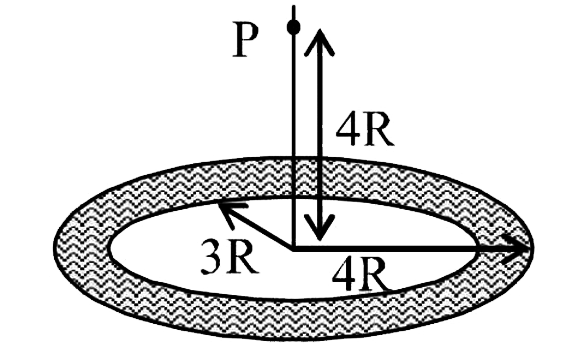
A thin uniform disc (see figure) of mass M has outer radius 4R and inner radius 3R. The work required to take a unit mass for point P on its axis to infinity is

A

`(2GM)/(7R)(4sqrt2-5)`

B

`-(2GM)/(7R)(4sqrt2-5)`

C

`(GM)/(4R)`

D

`(2GM)/(5R)(sqrt2-1)`

Text Solution

Verified by Experts

The correct Answer is:
A

Work required to take unit mass from infinity to point P =`V_P` br> `therefore` Work required to take it from P to infinity =`-V_P`
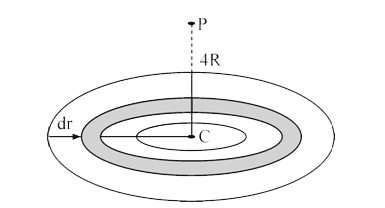
To calculate `V_P` , consider a ring element of radius r and width dr . Gravitational potential due to this ring at P is :
`dV_P =(-G(dm))/sqrt(r^2+(4R)^2)=(-G)/sqrt(r^2+16R^2) (M(2prdr))/((16pR^2-9pR^2)) =(-2GM)/(7R^2) (rdr)/sqrt(r^2+16R^2)`
`therefore V_P=intdV_P =(-2GM)/(7R^2) int_(3R)^(4R) (rdr)/sqrt(r^2+16R^2)`
Let `r^2+16R^2 =t^2 rArr 2r(dr)/(dt) = 2t rArr rdr = tdt`
`therefore int(rdr)/sqrt(r^2+16R^2) = int(tdt)/sqrt(t^2) =intdt=t =sqrt(r^2+16R^2)`
`therefore V_P=(-2GM)/(7R^2) [sqrt(r^2+16R^2)]_(3R)^(4R) =(-2GM)/(7R^2) [sqrt(32R^2) - sqrt(25R^2)]`
`=(-2GM)/(7R) (4sqrt2-5) therefore W_"reqd"=-V_P =(2GM)/(7R) (4sqrt2-5)`
Promotional Banner

Similar Questions

Explore conceptually related problems

The energy required to move a body of mass m from an orbit of radius 3R to 4R is

For a uniform ring of mass M and radius R at its centre

A thin annular disc of outer radius R and R/2 inner radius has charge Q uniformly distributed over its surface. The disc rotates about its axis with a constant angular velocity omega . Choose the correct option(s):

A thin uniform circular disc of mass M and radius R is rotating in a horizontal plane about an axis passing through its centre and perpendicular to its plane with an angular velocity omega . Another disc of same dimensions but of mass (1)/(4) M is placed gently on the first disc co-axially. The angular velocity of the system is

A uniform disc of mass M and radius R is pivoted about the horizontal axis through its centre C A point mass m is glued to the disc at its rim, as shown in figure. If the system is released from rest, find the angular velocity of the disc when m reaches the bottom point B.

Consider a thin spherical shell of uniform density of mass M and radius R :

A thin uniform circular disc of mass M and radius R is rotating in a horizontal plane about an axis perpendicular to the plane at an angular velocity omega . Another disc of mass M / 3 but same radius is placed gently on the first disc coaxially . the angular velocity of the system now is

