Home
Class 12
PHYSICS
An ideal gas is kept in two adjacent cha...

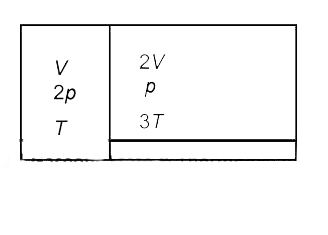
An ideal gas is kept in two adjacent chambers of volume V and 2V, separated by a thin partition, under initial conditions as shown in figure. The chamber is adiabatic i.e., no heat flows in or out. Now the partition is removed and the gas is allowed to stabilize. If `P_f` and `T_f` are the values of final pressure and temperature, then :

A

`P_f = 5/3 P`

B

`P_f = p `

C

`P_f/T_f = 8/9 P/T`

D

`T_f = 3/2 T`

Text Solution

Verified by Experts

The correct Answer is:

C, D

`P_1 V_1 + P_2 V_2 = P_f V_f rArr 2 PV + 2PV = P_f (3V) rArr P_f=(4P)/3`
`n_1 = (2 PV)/(RT) & n_2 = (2 PV)/(R(3T)) rArr n_1 + n_2 = (8 PV)/(3RT)`
`P_fV_f =(n_1 +n_2) "R T"_f rArr(4P)/3 (3V) =(8 PV)/(3RT) .(RT_f) rArr T_f =(3T)/2 " "rArr" "P_f/T_f = (8P)/(9T)`
Promotional Banner

Similar Questions

Explore conceptually related problems

An insulated container of gas has two chambers separated by an insulating partition. One of the chmabers has volume V_1 and contains ideal gas at pressure P_1 and temperature T_1 .The other chamber has volume V_2 and contains ideal gas at pressure P_2 and temperature T_2 . If the partition is removed without doing any work on the gas, the final equilibrium temperature of the gas in the container will be

The variation of pressure P with volume V for an ideal diatomic gas is parabolic as shown in the figure. The molar specific heat of the gas during this process is

A cylindrical container having nonconducting walls is partitioned in two equal parts such that the volume of the each parts is equal to V_(0). A movable nonconducting piston is kept between the two parts. Gas on left is slowly heated so that the gas on right is compressed upto volume (V_(0))/(8). Find pressure and temperature on both sides if initial pressure and temperature, were P _(0) and T_(0) respectively. Also find heat given by the heater to the gas. (number of moles in each part is n)

An insulated cylindrical vessel is divided into three identical parts by two partitions 1 and 2. The left part contains O_(2) gas, the middle part has N_(2) and the third chamber has vacuum. The average molecular speed in oxygen chamber is V_(0) and that in nitrogen chamber is sqrt((8)/(7)) V_(0) . Pressure of the gases in two chambers is same. Partition 1 is removed and the gases are allowed to mix. Now the stopper holding the partition 2 is removed and it slides to the right wall of the container, so that the mixture of gases occupy the entire volume of the container. Find the average speed of O_(2) molecules now.

The variation of pressure P with volume V for an ideal monatomic gas during an adiabatic process is shown in figure . At point A the magnitude of rate of change of pressure with volume is

An ideal gas having initial pressure P, volume V and temperature T is allowed to expands adiabatically until its volume becomes 5.66V while its temperature falls to T/2. (i) How many degrees of freedom do the gas molecules have? Obtain the work done by the gas during the expansion as a function of the initial pressure P and volume V.

A thermally insulating cylinder has a thermally insulating and frictionless movable partition in the middle, as shown in the figure below. On each side of the partition, there is one mole of an ideal gas , with specific heat at constant volume, C_v=2R . Here, R is the gas constant. Initially, each side has a volume V_0 and temperature T_0 . The left side has an electric heater, which is turned on at very low power to transfer heat Q to the gas on the left side. As a result the partition moves slowly towards the right reducing the right side volume to V_0/2 . Consequently, the gas temperature on the left and the right sides become T_L and T_R , respectively. Ignore the changes in the temperatures of the cylinder, heater and the partition. Value of T_R/T_0

An ideal gas having initial pressure p, volume V and temperature T is allowed to expand adiabatically until its volume becomes 5.66V, while its temperature falls to T//2 . (a) How many degrees of freedom do the gas molecules have? (b) Obtain the work done by the gas during the expansion as a function of the initial pressure p and volume V. Given that (5.66)^0.4=2
