Home
Class 12
PHYSICS
An ideal gas is taken from the state A (...

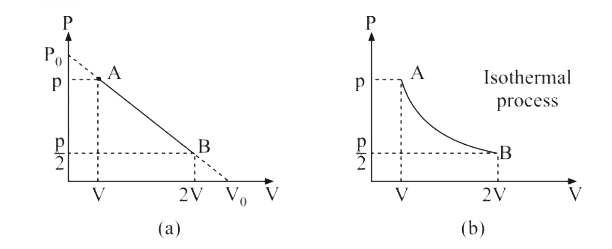
An ideal gas is taken from the state A (pressure P, volume V) to the state B (pressure `p//2`, volume 2V) along a straight line path in the P-V diagram. Select the correct statement (s) from the following :

A

The work done by the gas in process A to B exceeds the work that would be done by it if the system were taken from A to B along the isotherm

B

In the T-V diagram, the path AB becomes a part of a parabola

C

In the P-T diagram, the path AB becomes a part of a hyperbola

D

In going from A to B, the temperature T of the gas first increases to a maximum value and then decreases

Text Solution

Verified by Experts

The correct Answer is:
A, B, D

Work done by the gas in the process A to B exceeds the work that would be done by it if the system were taken from A to B along the isotherm. This is because the work done is the area under the P – V indicator diagram. As shown, the area under the graph in the first diagram will be more than that in the second diagram. When we extrapolate the graph shown in figure (a), let `p_0` be the intercept on the P-axis and `V_0` be the intercept on the V-axis. The equation of the line AB can be written as

`p= -P_0/V_0 V+P_0" "[because y = mx + c]" ...(i)"`
To find a relationship between P and T, we use
`PV = RT rArr V = (RT)/P" ...(ii)"`
From Eqs (i) and (ii),
`P = P_0/V_0 xx(RT)/P + p_0 " "rArr" "p^2 v_0 - pp_0 V_0= -P_0 RT`
Relation between P and T is the equation of a parabola.
Also PV = RT
`:." "P = (RT)/V " ...(iii)"`
From Egs (i) and (ii).
`(RT)/V = - P_0 /V_0 + P_0 " "rArr" "RT = - P_0/V_0 V^2 + P_0 V" ...(iv)"`
The above equation is of a parabola (between T and V)
`T = -P_0/(V_0 R) V^2 + P_0/ V`
Differentiating the above equation w.r.t. V we get
`(dT)/(dV) = -P_0/(V_0 R)xx2 V + P_0/R`
when `(dt)/(dV) =0`
then `p_0/(V_0R) xx2V = P_0/R rArr V = V_0/2`
Also ` (d^2 T)/(d^2 V) = (-2P_0)/(V_0 R) = -Ve`
`rArr" "V = V_0 //2` is the value of maximum of temperature
Also `P_A V_A = P_B V_BrArr T_A = T_B" (From Boyle’s law)"`
`rArr" "` In going from A to B, the temperature of gas first increases to a maximum ( at `V = V_0 //2`) and the decreases and reaches back of the same value.
Promotional Banner

Similar Questions

Explore conceptually related problems

An ideal gas is taken form the state A(P,V) to the state B((P)/(2),2V) along a straight line path in the P-V diagram. Select the correct options (i) The work done by the gas in the process A to B exceeds the work that would be done by it if the system were taken from A to B along the isotherm (ii) In the T-V diagram, the path AB becomes part of a hyperbola (iii) In the P-T diagram, the path AB becomes part of a hyperbola (iv) In going from A to B, the temperature T of the first increases to maximum value and then decreases

An ideal gas taken from state A(P,V) to the state B(P//2,2V) along a straight path in PV diagram. Select the correct option(s).

An ideal gas is taken from the state A (P, V) to the state B (P//2, 2 V) along a st. line path as shown in Fig. Select the correct statement from the following:

One mole of an ideal gas is expanded from the state A(P_(0), V_(0)) to final state B having volume V. The process follows a path represented by a straight line on the P–V diagram (see figure). Up to what volume (V) the gas shall be expanded so that final temperature is half the maximum temperature during the process.

An ideal gas has pressure P, volume V and temperature T. Select the correct option.

