Home
Class 12
PHYSICS
The volume V versus temperature T graphs...

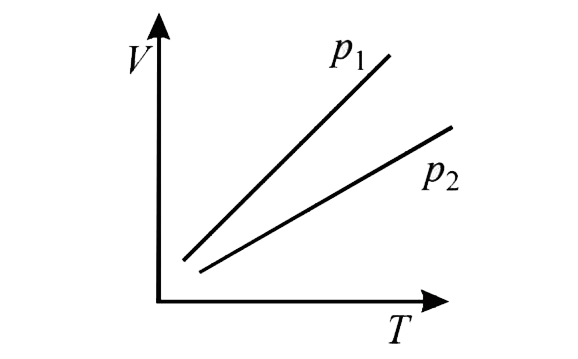
The volume V versus temperature T graphs for a certain amount of a perfect gas at two pressure `p_1 and p_2` are as shown in Fig. It follows from the graphs that `p_1` is greater than `p_2.`

Text Solution

Verified by Experts

`"pV = nRT"`
`:." "V = ((nR)/(p))T`
Comparing this with `Y = m x, V - T`. Graph is a straight line passing through origin with slope` = (nR)/P`
or slope `prop 1/p("slope")_1 gt ("slope")_2" ":." "P_1 lt P_2`
Promotional Banner

Similar Questions

Explore conceptually related problems

The volume V versus temperature T graphs for a cetain amount of a perfect gas at two pressure p_1 and p_2 are as shown in Fig. It follows from the graphs that p_1 is greater than p_2.

For V versus T curves at constant pressure P_1 and P_2 for and ideal gas shown in figure-

For an ideal gas V - T curves at constant pressure P_(1) & P_(2) are shown in figure, from the figure

Figure shows the pressure P versus volume V graphs for a certains mass of a gas at two constant temperature T_(1) and T_(2) . Which of the following interface is correct?

Figure shows graphs of pressure versus density for an ideal gas at two temperatures T_1 and T_2 Then

Volume versus temperature graphs for a given mass of an ideal gas are shown in Fig. at two different values of constant pressure. What can be inferred about relation between P_(1) and P_(2) ?

Figure shows the volume versus temperature graph for the same mass of a gas (assumed ideal) corresponding to two different pressure P_(1) and P_(2) . Then

Pressure p, volume V and temperature T for a certain gas are related by p=(alphaT-betaT^2)/(V) where, alpha and beta are constants. Find the work done by the gas if the temperature changes from T_1 to T_2 while the pressure remains the constant.

Volume versus temperature graphs for a given mass of an ideal gas are shown in figure. At two different values of constant pressure. What can be inferred about relation between P_(1) and P_(2) ?
