Home
Class 12
PHYSICS
A bead of mass m slides down a frictionl...

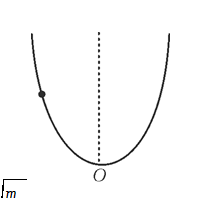
A bead of mass m slides down a frictionless thin fixed wire held on the vertical plane and then performs small oscillations at the lowest point O of the wire. The wire takes the shape of a parabola near O and potential energy is given by U (x)=`cx^(2)`, where c is a constant. The period of the small oscillations will be :

A

`T =2pisqrt((m)/(2c))`

B

`T =pisqrt((m)/(c))`

C

`T =2pisqrt((2m)/(c))`

D

`T =2pisqrt((m)/(c))`

Text Solution

Verified by Experts

The correct Answer is:

A

Potential energy =`U(x)=cx^(2)`
Hence, force`F=-(dU(x))/(dx)=-2cx`
The equation of motion is `m(d^(2)x)/(dt^(2))=-2cx therefore omega^(2)=(2c)/(m) Rightarrow T=2pisqrt((m)/(2c))`
Promotional Banner

Similar Questions

Explore conceptually related problems

The potential energy of a particle of mass m is given by U(x)=U_0(1-cos cx) where U_0 and c are constants. Find the time period of small oscillations of the particle.

A bead of mass m can side on a frictionless wire as shown in figure Bacause of the given shape of the wire near p the bottom point , it can be approximatedd as abola near p the potential energy of the bead is given U = cx^(2) where c is a constant and x is measured from p The bead if displacvement slighly from point p will oscillate about p The period of oscillation is

The potential energy of a particle of mass 1kg in motion along the x- axis is given by: U = 4(1 - cos 2x) , where x in metres. The period of small oscillation (in sec) is

A particle of mass m is located in a potential field given by U (x) = U_(o) (1-cos ax) where U_(o) and a are constants and x is distance from origin. The period of small oscillations is

A body of mass m is situated in a potential field U(x) = V_(0)(1-cos ax) when U_(0) and alpha are constants. Find the time period of small oscillations.

A body of mass m is situated in potential field U(x)=U_(o)(1-cospropx) when, U_(o) and prop are constants. Find the time period of small oscillations.
