Home
Class 12
PHYSICS
m1 & m2 are connected with a light ine...

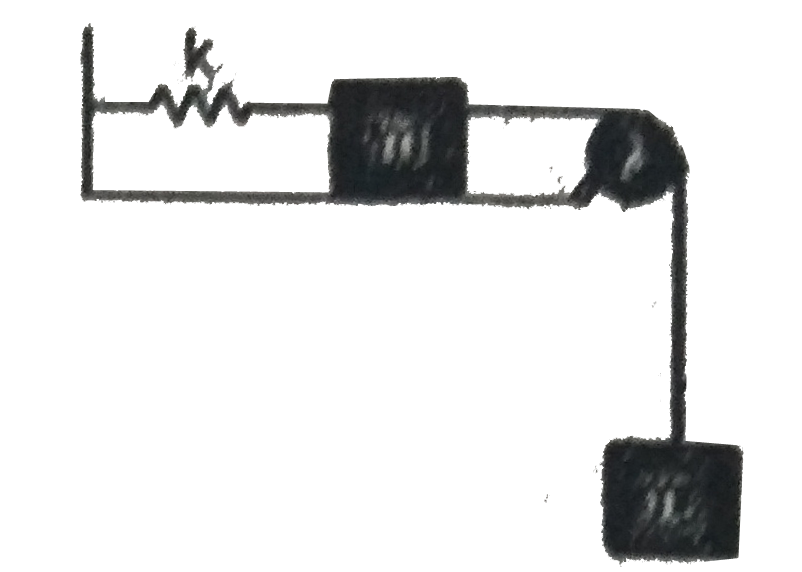
`m_1 ` & `m_2` are connected with a light inextensible string with `m_1` lying on smooth table and `m_2` hanging as shown in figure. `m_1` is also connected to a light spring which is initially unstretched an the system is released from rest.

A

system performs SHM with angular frequency given by `sqrt((K(m_(1)+m_(2)))/(m_(1)m_(2)))`

B

system performs SHM with angular frequency given by `sqrt((K)/(m_(1)+m_(2)))`

C

tension in string will be 0 when the system is released

D

maximum displacement of `m_(1)` will be `(m_(2)g)/(K)`

Text Solution

Verified by Experts

The correct Answer is:
B

After the system is released, `m_(2)` moves down . The extension in the spring becomes:
`(m_(2)g)/(k)(m_(2)g=kx_(0))`,
which is the new equilibrium position of the system. For small `x`: restoring force on the system is F=kx
`Rightarrow a=(kx)/(m_(1)+m_(2)) `(For ` (m_(1)+m_(2)+`spring)system)
`T=2pisqrt((x)/(a))=2pisqrt((x(m_(1)+m_(2))/(kx))=2pisqrt((m_(1)+m_(2))/(k))`
`Rightarrow` Angular frequency =`omega=(2pi)/(T)=sqrt((k)/(m_(1)+m_(2)))`
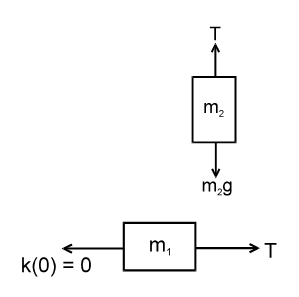
F.B.D.of `m_(1)` and `m_(2)`just after the system is released :
From above: `T=(m_(1)+m_(2))/(m_(1)+m_(2))g`
Hence (c) is incorret.
After `x=(m_(2)g)/(k)`:`m_(1)` moves towards right till the total kinetic energy acquired does not converted to potential energy.
Hence(D) is also incorrect.
Hence (B)is the answer.
Promotional Banner

Similar Questions

Explore conceptually related problems

Consider the case of two bodies of masses m_(1) and m_(2) which are connected by light inextensible string passing over a light smooth pulley as shown in the figure. The expression for acceleration of the system and tension of the string are expressed below under different situations: (i) when m_(1) gt m_(2) . In this case a=((m_(1)-m_(2))/(m_(1)+m_(2)))g and T=((2m_(1)m_(2))/(m_(1)+m_(2)))g (ii) when m_(2) gt m_(1) . In this case a=((m_(2)-m_(1))/(m_(1)+m_(2)))g and T=((2m_(1)m_(2))/(m_(1)+m_(2)))g (iii) When m_(1)=m_(2)=m . In this case a = 0, T = mg What is the tension in the string?

Two blocks of mass m_(1) and m_(2) (m_(1) lt m_(2)) are connected with an ideal spring on a smooth horizontal surface as shown in figure. At t = 0 m_(1) is at rest and m_(2) is given a velocity v towards right. At this moment, spring is in its natural length. Then choose the correct alternative :

Two masses m_1 = 1 kg and m_2 = 2 kg are connected by a light inextensible string and suspended by means of a weightness pulley as shown in the figure. Assuming that both the masses start from rest, the distance travelled by the centre of mass in two seconds is (Take g = 10 ms^-2 . .

A lift can move upward or downward. A light inextensible string fixed from ceiling of lift when a frictionless pulley and tensions in string T_(1) . Two masses of m_(1) and m_(2) are connected with inextensible light string and tension in this string T_(2) as shown in figure. Read the questionbs carefully and answer If m_(1) is very small as compared to m_(2) and lift is moving with constant velocity then value of T_(2) is nearly :

Two blocks A and B of masses m_(1) and m, are connected by an inextensible string rest on two smooth planes inclined at angle alpha and beta as shown. The tension in string is -

Two masses m_(1) and m_(2) are connected by light inextensible string passing over a smooth pulley P . If the pulley moves vertically upwards with an acceleration equal to g then .

A block of mass m_(1)=2 kg is kept on a smooth horizontal table. Another block of mass m_(2)=1 kg is connected to m_(1) by a light inextensible string passing over a smooth pulley as shown in the figure. If the blocks are released, what will be the (a) acceleration of each block (b) tension in the string?

Two blocks of masses m and M connected by a light spring of stiffness k, are kept on a smooth horizontal surface as shown in figure. What should be the initial compression of the spring so that the system will be about to break off the surface, after releasing the block m_1 ?

