Home
Class 12
PHYSICS
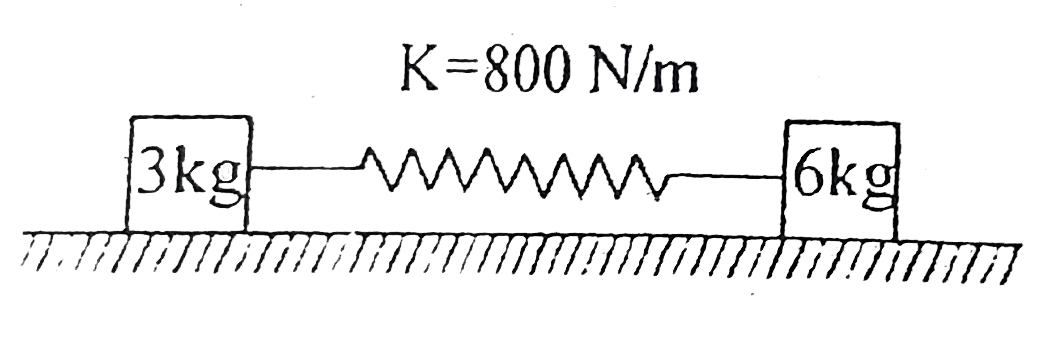
The system shown in the figure can move ...

The system shown in the figure can move on a smooth surface. The spring is initially compressed by 6 cm and then released.

A

The system performs, SHM with time period `(pi)/(10)s`

B

The block of mass 3 kg perform SHM with amplitude 4 cm

C

The block of mass 6 kg will have maximum momentum of 2.40 kg m//s

D

The time periods of two blocks are in the ratio `1:sqrt2`

Text Solution

Verified by Experts

The correct Answer is:

ABC

`T=2pisqrt((mu)/(k))`: `mu=((m_(1)m_(2))/(m_(1)+m_(2)))` : `A=6cmxx((mm_(2))/(m_(1)+m_(2)))`
Promotional Banner

Similar Questions

Explore conceptually related problems

The system shown in the figure can move on a smooth surface. They are initially compressed by 6cm and then released, then choose the correct options. (a) The system performs, SHM with time period (pi)/(10)s (b) The block of mass 3kg perform SHM with amplitude 4 cm ( c) The block of mass 6kg will have maximum momentum of 2.40kg - m//s (d) The time periods of two blocks are in the ratio of 1:sqrt(2)

For the arrangement shown in figure, the spring is initially compressed by 3 cm . When the spring is released the block collides with the wall and rebounds to compress the spring again. (a) If the coefficient of restitution is (1)/sqrt(2) , find the maximum compression in the spring after collision. (b) If the time starts at the instant when spring is released, find the minimum time after which the block becomes stationary.

Two blocks of masses m_(1) and m_(2) are connected by a massless spring and placed on smooth surface. The spring initially stretched and released. Then :

For the system shown in fig., initially the spring is compressed by a distance 'a' from its natural length and when released, it moves to a distance 'b' from its equillibrium position, the decrease in amplitude for half cycle (-a to +b) is :

In the arrangements as shown, blocks A and B of the masses as shown move in the direction with velocities as indicated on a smooth surface. The spring constant is 300 N/m. find the maximum compression in the spring (approx).

In the figure shown, all surfaces are smooth and force constant of spring is 10N//m . Block of mass (2 kg) is attaced with the spring. The spring is compressed by (2m) and then released. Find the maximum distance d travelled by the block over the inclined plane. Take g=10m//s^(2) . .

In the system shown in figure, all surfaces are smooth, pulley and strings are massless. Mass of both A and B are equal. The system is released from rest. (a) Find the veca_(A). veca_(B) immediately after the system is released. veca_(A) "and" veca_(B) are accelerations of block A and B respectively. (b) Find veca_(A) immediately after the system is released.

A block is attached to a spring and is placed on a horizontal smooth surface as shown in which spring is unstretched. Now the spring is given an initial compression 2x_(0) an block is released from rest. Collision with the wall PQ are elastic. Find the time period of motion of the block:

A block is attached to a spring and is placed on a horizontal smooth surface as shown in which spring is unstretched. Now the spring is given an initial compression 2x_(0) an block is released from rest. Collision with the wall PQ are elastic. Write its equation of motion indicating position as a function of time:
