Home
Class 12
PHYSICS
A block of mass 2M is attached to a mass...

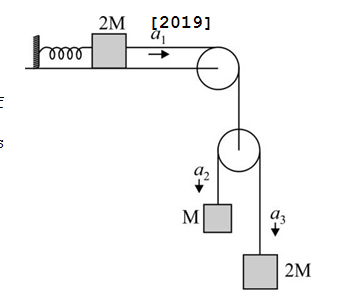
A block of mass 2M is attached to a massless spring with spring-constant k. This block is connected to two other blocks of masses M and 2M using two massless pulleys and strings. The accelerations of the blocks are `a_(1)a_(2)` and `a_(3)` as shown in the figure. The system is released from rest with the spring in its unstretched state. The maximum extension of the spring is `x_(0)` Which of the following option(s) is(are) correct? [g is the acceleration due to gravity. Neglect friction]

A

`a_(2)-a_(1)=a_(1)-a_(2)`

B

At an extension of `(x_(0))/(4)`of the spring, the magnitude of acceleration of the block connected to the spring is `(3g)/(10)`

C

`x_(0)=(4Mg)/(k)`

D

When spring achieves an extension of `(x_(0))/(2)` for the first time, the speed of the block connected to the spring is `3g(M)/(5K)`

Text Solution

Verified by Experts

The correct Answer is:
A

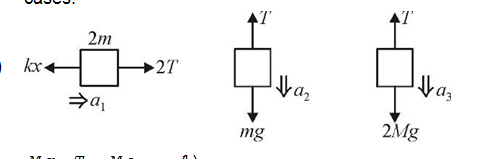
`Mg-T=Ma_(2)` ...(1)
`2Mg-T=3Ma_(3)` ...(2)
`2T-Kx=2Ma_(1)` ...(3)
From (1) and
`M(a_(2)+a_(3))="Mg-T+Mg"(-T)/(2)=2Mg-(3T)/(2)|`
implies `ubrace(2Ma_(1)=2Mg-(3T)/(2))_(xx(4)/(3)) implies(8Ma_(1))/(3)=(3Ma)/(3)=(3Ma)/(3)-2T` ...(4)
`(3)+(4)implies(8Mg)/(3)-kx=(2M+(8M)/(3))a_(1)`
`implies (14M)/(3)a_(1)=-K[x-(8Mg)/(3K)] implies a_(1)=-(3K)/(14M)[x-(8Mg)/(3K)]`
`omega=sqrt((3K)/(14M))`,`A=(8Mg)/(3K)(x_(0))/(2)=2A`[Maximum elongation=2A]
`V_(max)=Aomega=(8Mg)/(3K)sqrt((3K)/(14M))` `a_(1)atx=(x_(0))/(4)=-(3K)/(14M)xx(4Mg)(3K)=(2g)/(7)` Correct answer is (A)

Promotional Banner

Similar Questions

Explore conceptually related problems

An ideal spring with spring constant k is hung from the ceiling and a block of mass M is attached to its lower end. The mass is released with the spring initially unstretched. Then the maximum extension in the spring is

The block of mass m is released when the spring was in its natrual length. Spring constant is k. Find the maximum elongation of the spring.

The system of the wedge and the block connected by a massless spring as shown in the figure is released with the spring in its natural length. Friction is absent. Maximum elongation in the spring will be

Blocks A and B shown in the figure are having equal masses m. The system is released from rest with the spring unstretched. The string between A and ground is cut, when there is maximum extension in the spring. The acceleration of centre of mass of the two blocks at this instant is

A 2 kg block is connected with two springs of force constants k_(1)=100 N//m and k_(2)=300 N//m as shown in figure. The block is released from rest with the springs unstretched. The acceleration of the block in its lowest postion is (g=10 m//s^(2))

A block of mass m is attached with a massless spring of force constant k . The block is placed over a fixed rought inclined surface for which the coefficient of friction is mu=(3)/(4) . The block of mass m is initially at rest . The block is mass M is released from rest with spring in unstretched state. The minimum value of M required to move the block up the plane is ( neglect mass of string and pulley and friction in pulley )

In the figure shown, the system is released from rest with both the springs in unstretched positions. Mass of each block is 1 kg and force constant of each spring is 10 N/m. Maximum speed of the block placed horizontally is:

The system is released from rest with both the springs in unstretched positions. Mass of each block is 1 kg and force constant of each spring is 10 N//m . Extension of horizontal spring in equilibrium is

The system is released from rest with both the springs in unstretched positions. Mass of each block is 1 kg and force constant of each spring is 10 N/m. Extension of horizontal spring in equilibrium is:

A block of mass m is connected to another block of mass M by a massless spring of spring constant k . the blocks are kept of a smooth horizontal plane and are at rest. The spring is unstretched when a constant force F starts acting on the block of mass M of pull it. Find the maximum extension of the spring