Home
Class 12
PHYSICS
Two loudspeaker M and N are located 20m ...

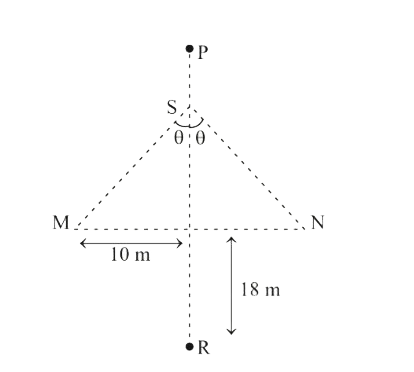
Two loudspeaker `M` and `N` are located `20m` apart and emit sound at frequencies `118Hz` and `121Hz`, respectively. A car is intially at a point `P`, `1800m` away from the midpoint `Q` of the line `MN` and moves towards `Q` constantly at `60 km//hr` along the perpendicular bisector of `MN`. It crosses `Q` and eventually reaches a point `R`, `1800m` away from `Q`. Let `v(t)` represent the beat frequency measured by a person sitting in the car at time `t`. let `v_(P)`, `v_(Q)` and `v_(R)` be the beat frequencies measured at locations `P`,`Q` and `R`, respectively. The speed of sound in air is `330ms^(-1)`. Which of the following statement (s) is (are) true regarding the sound heard by the person?

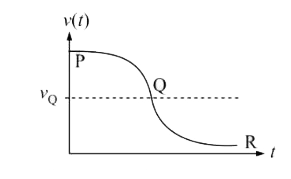
A

The plot below represents schematically the variation of beat frequency with time

B

`v_(P)+v_(R)=2v_(Q)`

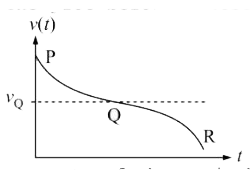
C

The plot below represents schematically the variation of beat frequency with time

D

The rate of change in beat frequency is maximum when the car passes through Q

Text Solution

Verified by Experts

The correct Answer is:
A, B, D

Sped of car, `V=60 km//h`
`(500)/(3) m//s`
At a point S,between P & Q
`v_m=v_m((c+v costheta)/(c)),v_n=v_n((v+v costheta)/(c))`
`implies trianglev=(v_n-v_n)(1-(v costheta)/(c))`
similarly between Q & R
`implies trianglev=(v_n-v_n)(1-(v costheta)/(c))`
`(d (trianglev))/dt=pm(v_n-v_n)v/csintheta(d theta)/dt`
`theta approx 0^(@)` at P & R as they are large distance apert
`implies` slope of graph is zero
at Q,`theta=90^(@)`
`implies sin theta` is max
also valued of `(d theta)/(dt)` is max
as `(d theta)/(dt)=v/x` where V is its velocity and r is length of kine joining P & S
and r is minimum at Q
`implies` slope is maximum at Q
`implies` (A) & (B) are correct
At p,`triangle v=(v_n-v_n)(1+(v)/(c)) ( theta=0^(@)`
At R, `triangle v=(v_n-v_n)(1-(v)/(c)) ( theta=0^(@)`
At Q, `triangle v=(v_n-v_n) (theta=90^(@))`
`implies trianglev_p+trianglev_R=2(v_n-v_n)=2trianglev_Q` Hence (B) is correct.
Promotional Banner

