Home
Class 12
PHYSICS
A metallic rod of length 1m is rigidly c...

A metallic rod of length 1m is rigidly clamped at its mid point. Longirudinal stationary wave are setup in the rod in such a way that there are two nodes on either side of the midpoint. The amplitude of an antinode is `2 xx 10^(-6) m`. Write the equation of motion of a point 2 cm from the midpoint and those of the constituent waves in the rod, (Young,s modulus of the material of the rod `= 2 xx 10^(11) Nm^(-2)` , density `= 8000 kg-m^(-3)`). Both ends are free.

Text Solution

Verified by Experts
(i) `y=2xx10^(-6)cos5pi(0.5+-0.02)sin25000pit`,
(ii) `y_(1)=10^(-6)sin(25000pit-5pix),y_(2)=10^(-6)sin(25000pit+5pix)`
`y,y_(1),y_(2)`& x are in m & t is in sec
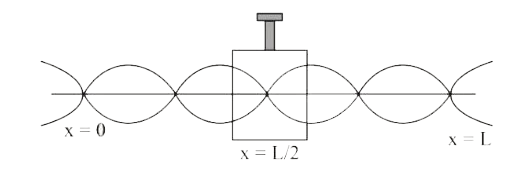
As found in case of strings, in case of rods also the clamped point behave as a node while the free end antinode. The situation is shown in the figure

Because the distance between two consecutive nodes is `(lamda//2)` while between a node and antinode is `lamda//4`, hence
`4xx[(lamda)/(2)]+2[(lamda)/(4)]=L or lamda=(2xx1)/(5)=0.4m`
Further, it is given that `Y=2xx10^(11)N//m^(2) and rho=8xx10^(3)kg//m^(3)`
`v=sqrt((Y)/(rho))=sqrt((2xx10^(11))/(8xx10^(3)))=5000m//s`
Hence, from `v=nlamda, n=(v)/(lamda)=(5000)/(0A)=12500Hz`
Now if incident and reflected waves along the rod are `y_(1)=A sin(omegat-kx) and y_(2)=Asin(omegat+kx+phi)`
The resultant will be `y=y_(1)+y_(2)=A[sin(omegat-kx)+sin(omegat+kx+phi)]=2Acos(kx+(phi)/(2))sin(omegat+(phi)/(2))`
Because there is an antinode at the free end of the rod, hence amplitude is maximum at x=0, So
`cos(kxx0+(phi)/(2))="maximum"=1` i.e., `phi=0`
And `A_("max")=2A=2xx10^(-6)m(given)`
`y=2xx10^(-6)cos[(2pix)/(lamda)]sin(2pint)`
Putting values of `lamda and n`, we get `y=2xx10^(-6)cos5pixsin25000pit`
Now, because for a point 2 cm from the midpoint x=(0.50`pm0.02`)
Hence `y=2xx10^(-6)cos5pi(0.5pm0.02)sin25000pit`.
Promotional Banner

