Home
Class 12
PHYSICS
A ball is dropped vertically from a heig...

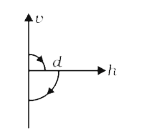
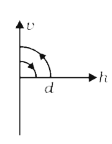
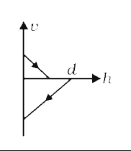
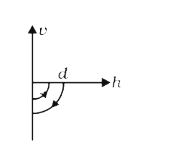
A ball is dropped vertically from `a` height `d` above the ground . It hits the ground and bounces up vertically to a height ` (d)//(2). Neglecting subsequent motion and air resistance , its velocity `v` varies with the height `h` above the ground as

A

B

C

D

Text Solution

Verified by Experts

The correct Answer is:

A

For the given condition initial height h = d and velocity of the ball is zero. When the ball moves downwards its velocity increases and it will be maximum when the ball hits the ground and just after the collision it becomes half and in opposite direction. As the ball moves upward its velocity again decreases and becomes zero at height d/2. This explanation matches with graph (a).Alternate solution
We know for uniformly accelerated / decelerated motion ` v^(2) =u^(2) +-2gh `
Before hitting the ground, the velocity v is given by (quadratic equation and hence parabolic path) Downwards direction means negative velocity. After collision, the direction becomes positive and velocity decreases
` (##VMC_PHY_XI_WOR_BOK_01_C02_E05_006_S01.png" width="80%"> As the direction is reversed and speed is decreased and hence graph (a) represents these conditions correctly.
Promotional Banner

Similar Questions

Explore conceptually related problems

A ball is dropped vertically from a height d above the ground. It hits the ground and bounces up vertically to a height d/2. Neglecting the subsequent motion and the air resistance, how its velocity v varies with the height h above the ground?

A ball is dropped vertically from a height d above the ground. It hits the ground and bounes up vertically to a height d//2 . Neglecting subsequent motion and air resistance, its speed v varies with the height h above the ground as

A ball is dropped from a height h above ground. Neglect the air resistance, its velocity (v) varies with its height (y) above the ground as :-

A ball is dropped from a height h above ground,Neglect the air resistance,its velocity (v) varies with its height y above the ground as

A ball is dropped from a height H above the ground. It hits the ground and bounces up vertically to a height (H)/(2) where it is caught. Taking origin at the point from where the ball was dropped, plot the variation of its displacement vs velocity. Take vertically downward direction as positive.

A ball is thrown upwards with a speed u from a height h above the ground.The time taken by the ball to hit the ground is

A ball is dropped from a height 64m above the ground and every time it hits the ground it rises to a height equal to half of the previous height.The height attained after it hits the ground for the 16h time is

A body is thrown vertically upward from a point A 125 m above the ground. It goes up to a maximum height of 250 m above the ground and passes through A on its downward journey. The velocity of the body when it is at a height of 70 m above the ground is (g=10 m//s^(2))
