

Home
Class 12
CHEMISTRY
Statement (A) Among the oxides of nitrog...

Statement (A) Among the oxides of nitrogen, NO and `NO_(2)` are paramagnetic .
Statement (B) NO is paramagnetic in the gaseous state and diamagnetic in liquid state. The correct answer is

A

(A) is correct (B) is not correct

B

Both (A) and (B) are not correct

C

(A) is not correct, (B) is correct

D

Both (A) and (B) are correct

Text Solution

Verified by Experts

The correct Answer is:
D

Statement (A) Among the oxides of nitrogen , NO and ` NO_(2)` are paramagnetic is the correct statement as N-atom contains unpaired electrons in its structure .
Structure of NO `to : overset(*)N = underset(* *)overset(* *) (O)` Structure of ` NO_(2) to (##ARH_5Y_SP_06_05_19_01_E03_029_S01.png" width="80%">
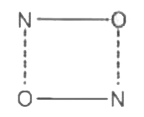
Statement (B) NO is paramagnetic in gaseous state and diamagnetic in liquid -state is also the correct statement as No in liquid state exists as dimer with no unpaired electron in the structune .

Hence, option (d) is the correct answer .
Promotional Banner

Topper's Solved these Questions

  • TS EAMCET 2019 (4 MAY SHIFT 2)

    TS EAMCET PREVIOUS YEAR PAPERS|Exercise CHEMISTRY|40 Videos

Similar Questions

Explore conceptually related problems

NO is paramagnetic in gaseous state but diamagnetic in liquid and solid states - Why ?

S_(2) molecule in vapour state is paramagnetic due to the presence of unpaired electrons is

In the oxidation of nitrition to nitrate by H_(2)O_(2) the change in oxidation state of nitrogen chnges

Statement (i) : Water vapour is gaseous state of water. Statement (Ii): Water vapour in the clouds cools down and it becomes water again.

In gaseous state , the correct basic strength among the following is

Consider the following two statements A and B and identify the correct choice in the given answers A. Paramagnetism is explained by domain theory. B. Susceptibility of a diamagnetic substance is independent of temperature.

List -I " " List -II (Bonds) A. CO_(2)" "1. 1, paramagnetic B. O_(2)" "2. 1, diamagnetic C. B_(2)" "3. 2, paramagnetic D. Li_(2)" "4. 2, diamagnetic " 5. 3, diamangetic

Statement(A): Sulphur vapour is paramagnetic . Statement (B): Reaction of dil. HCl with finely divided forms FeCl_3 and H_2 gas.

When NH_(4)NO_(3) is gently heated, an oxide of Nitrogen is formed. What is the oxidation state of Nitrogen in this oxide ?

TS EAMCET PREVIOUS YEAR PAPERS-TS EAMCET 2019 (6 MAY SHIFT 1)-CHEMISTRY
  1. The correct order of rates of C-Br bond ionisation of the following br...

    Text Solution

    |

  2. If an element having atomic number 96 crystallises in cubic lattice wi...

    Text Solution

    |

  3. The vapour pressure of pure C""Cl(4) (molar mass =154gmol^(-1)) and Sn...

    Text Solution

    |

  4. A camphor sample melts at 176^(@)C.K(f) for camphor is 40 K kg mol^(-1...

    Text Solution

    |

  5. If 'A' is the reactant and 'P' is the product, which one of the follow...

    Text Solution

    |

  6. The first order decomposition of H(2)O(2) in an appropriate medium is ...

    Text Solution

    |

  7. Which of the following statements is/are not correct? Adsorption is ...

    Text Solution

    |

  8. Which one of the following is used to produce Al by electrolysis?

    Text Solution

    |

  9. Statement (A) Among the oxides of nitrogen, NO and NO(2) are paramagne...

    Text Solution

    |

  10. The products formed during the reaction of carbon with conc. H(2)SO(4)...

    Text Solution

    |

  11. How many protons will be consumed when dichromate ion oxidises Fe^(2+)...

    Text Solution

    |

  12. Which one of the following is tris (ethane-1, 2-diammine) cobalt (III)...

    Text Solution

    |

  13. Which of the following polymer is formed due to the co-polymerisation ...

    Text Solution

    |

  14. Find the reagent that oxidises glucose into saccharic acid?

    Text Solution

    |

  15. Which one among the following is an antioxidant?

    Text Solution

    |

  16. Find the reactants which on heating with alcoholic KOH produces the co...

    Text Solution

    |

  17. The major product (P) formed in the below reaction is

    Text Solution

    |

  18. Identify X, Y and Z respectively from the following reactions :

    Text Solution

    |

  19. Identify the structure of Z in the following reaction sequence Phtha...

    Text Solution

    |

  20. The major products P and Q formed in the following reactions of benzon...

    Text Solution

    |