Home
Class 11
PHYSICS
Four forces act along the sides of a...

Four forces act along the sides of a smoth square frma ABCD in the order `A to B, B to C, C to D` and `D to A`. If the magnetiude of the force are `F_(1), F_(2), F_(3)` and `F_(4)` respectively, find the force acting on the frame . Assume `F_(1)= 1 N, F_(2) = 2 N, F_(3)= 3 N and F_(4) = N`

Text Solution

Verified by Experts
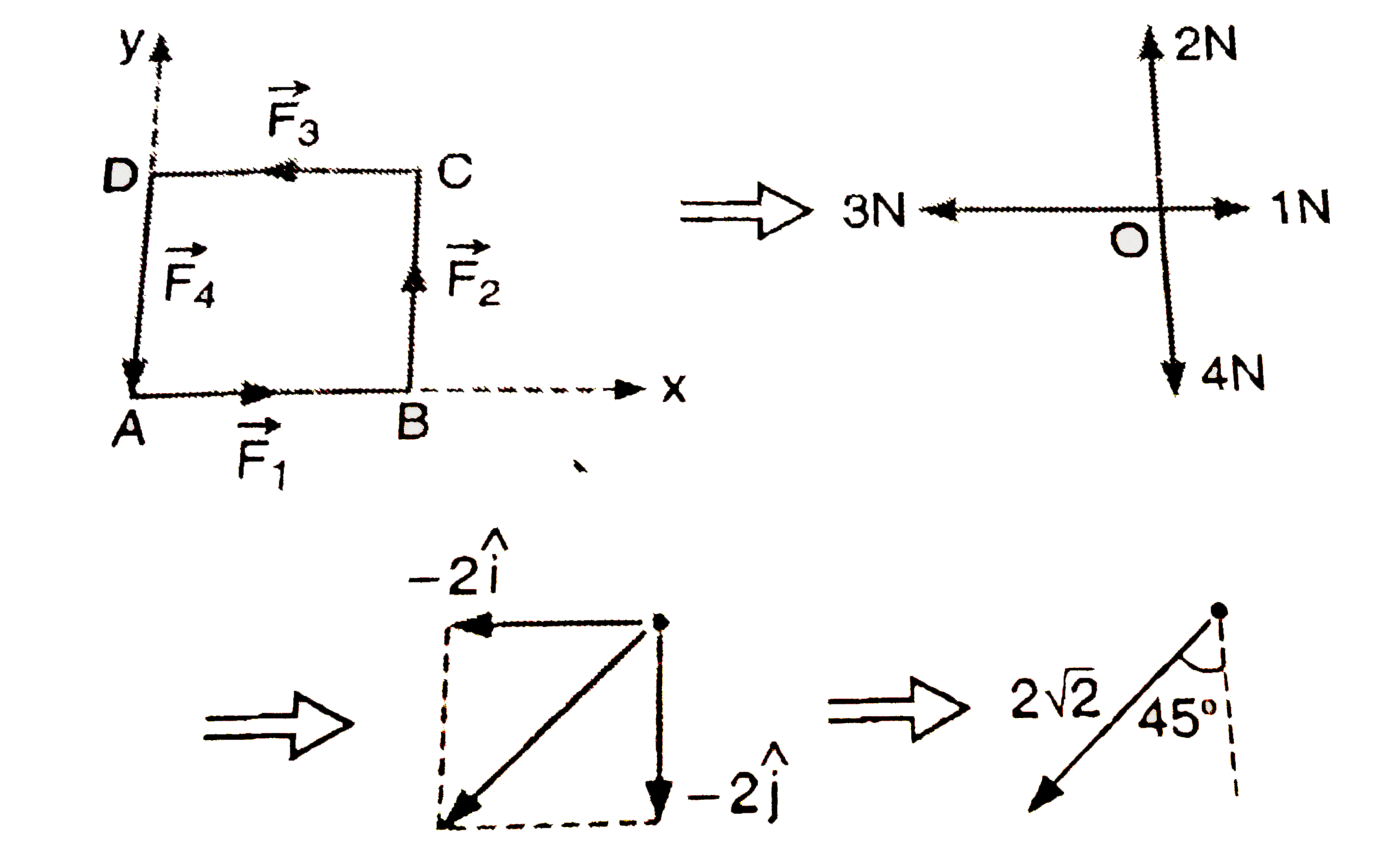
Let us consider x-y coordination system . The resultant of all the forces is
`vecF= vecF_(1) + vecF_(2) + vecF_(3) +vecF_(4)`
After bringing the tails of all the vectors to a point O and
substituting `vecF_(1) = 1 hati N`, `vecF_(2) = 2hatjN, vecF_(3) = - 3hati N` and
`vecF_(4) = - 4hatj N` we have
`" "vecF = - 2 (hati + hatj)N`

Henece the magntiude of `vecF`, that is , ` |vecF|= 2sqrt(2)` is directed in 3rd quadrant , as shown in the Fig. 3.39
Promotional Banner

Topper's Solved these Questions

  • VECTORS

    GRB PUBLICATION|Exercise PROBLEMS FOR PARCTICE|23 Videos
  • VECTORS

    GRB PUBLICATION|Exercise OBJECTIVE QUESTIONS|120 Videos
  • UNITS AND DIMENSIONS

    GRB PUBLICATION|Exercise Link Compression|6 Videos

Similar Questions

Explore conceptually related problems

Fig shows three forces F_(1), F_(2) and F_(3) acting on a rod pivoted at its end. Find the torque of each force about pivot.

Two forces F_(1)=1N and F_(2)=2N act along the lines x=0 and y=0, respectively. Then find the resultant of forces.

Let us consider two forces F_(1) " and " F_(2) acting on a body of mass 2 kg as shown in the figure. F_(1)=10N , F_(2)= 2N , what will be the acceleration?

Two forces vec(F_(1)) and vec(F_(2)) are acting at right angles to each other , find their resultant ?

Two forces of mangitude F_(1) and F_(2) are acting on an object.The magnitude of the net force F_(n e t ) on the object will be in the range.

Two forces F_(1) " and " F_(2) are acting on a rod abc as shown in figure.

A smooth track in the form of a quarter-circle of radius 6 m lies in the vertical plane. A ring of weight 4(N) moves from P_(1) and P_(2) under the action of forces F_(1) , F_2 and F_3 . is always towards P_(2) under the action of forces F_(1),F_(2) and F_(3) Force F_(1) is always towards P_(2) and is always (20) N in maghitude, force F_(2) always acts hotizontally and is always (30 N) in magnitude, force F_(3) always acts tangentially to the track and is of magnitude (15-10 s) N , where s is in metre. If the particle has speed 4 m//s at P_(1) ,what will its speed be at P_(2) ?

In the figure, the blocks A,B and C of mass m each have accelerations a_(1),a_(2) and a_(3) respectively. F_(1) and F_(2) are external forces of magnitude 2mg and mg respectively.

