Home
Class 11
PHYSICS
Find the components of a vector vecR alo...

Find the components of a vector `vecR` along two straight lines stiuated at both sides of the vector`vecR` making angles `alpha` and `beta` with it.

Text Solution

Verified by Experts

Since the components `vecA and vecB` of the given
vector`vecR` are choose in the given directions, `vecR` is the resultant of
`vecA` and `vecB`, then , `vecR = vecA + vecB`. Hence, R is repersented by the
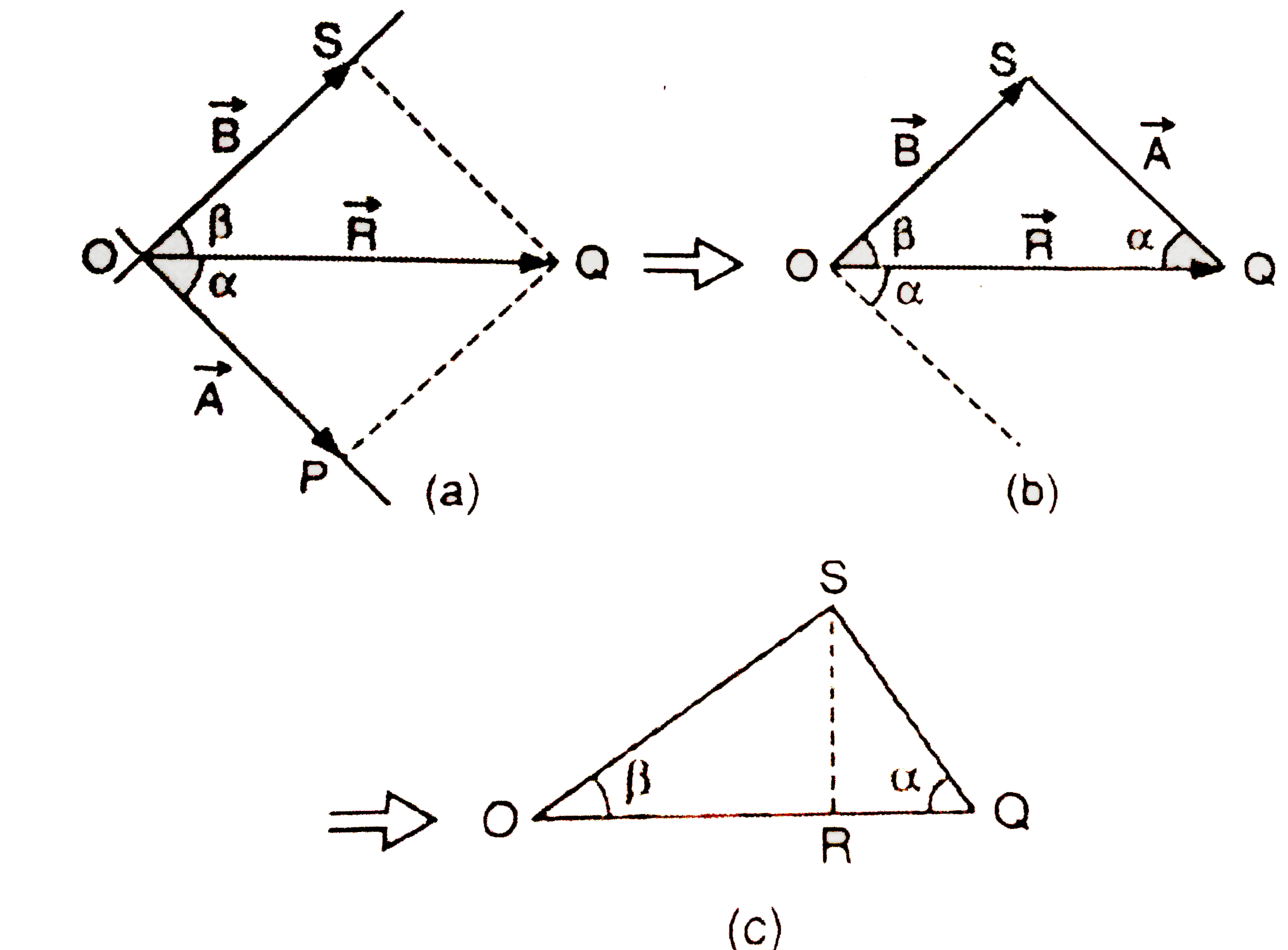
diagonal OQ of the square ` OPQS` where the component vectors `vecA`
and `vecB` respresented by the adjacent sides OP and OS
respectivcely according to the parallelogram law of vectors.
Then we convert the parallelorgam OSQP to the vectors triangle
OSQ which represents the vectos `vecR, vecA and vecB` as shown in the
Fig. 3.40 (a). By converting to a scalar triangle OSQ as shown in the Fig. 3.40 (c), we can write
`OQ = OS cos beta + SQ cos alpha" " ....(i)`
and `SR = OS sin beta = SQ sin alpha " "......(ii)`
Solving the Eqs. (i) and (ii), we have
`QS = |vecA| = (OQ sin beta)/(sin (alpha + beta))= ( R sin beta)/( sin( alpha + beta))`
and `OS = |vecB| = (R sin alpha)/(sin (alpha + beta))`
Alternate solution
Using Lami,s theorm, we have
`(|vecA|)/(sin beta)= (|vecB|)/( sin alpha) = (|vecR|)/(sin { 180^(@) - (alpha-beta)})`
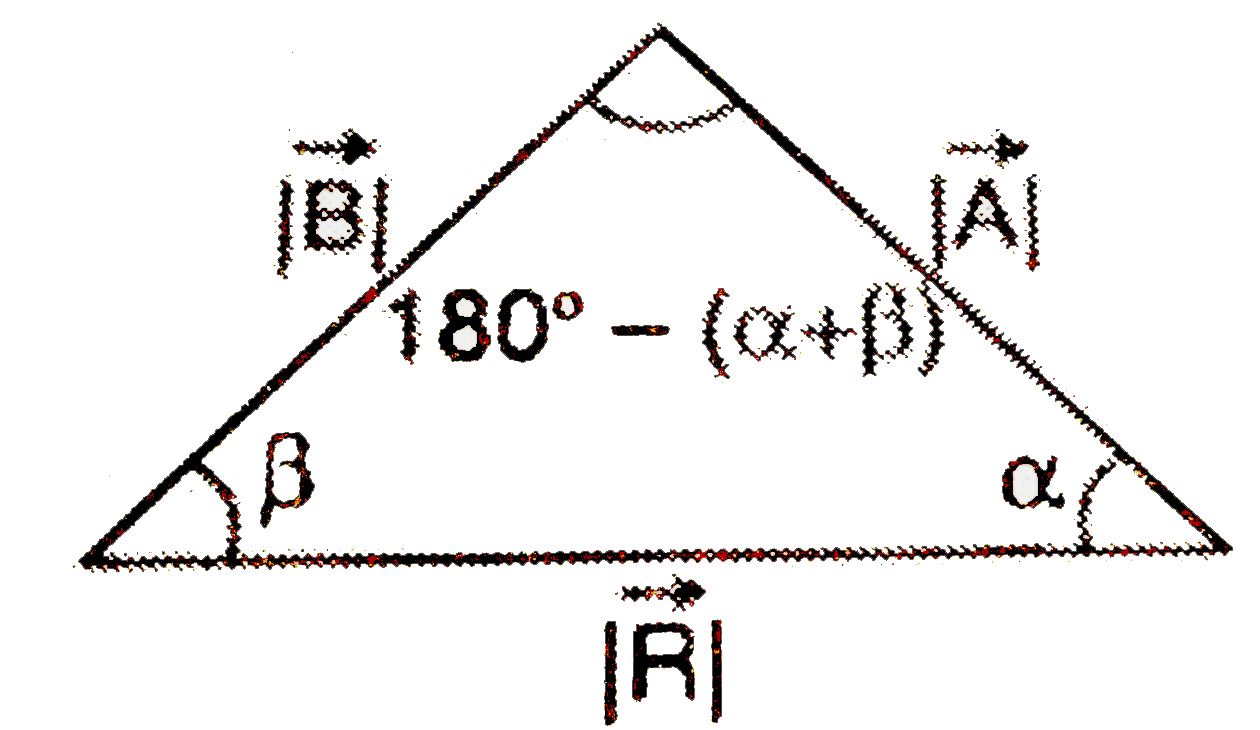
This yields `|vecA|= (|vecR| sin beta)/(sin (alpha + beta)) and |vecB| = (|vecR| sin alpha)/(sin (alpha+ beta))`

Promotional Banner

Topper's Solved these Questions

  • VECTORS

    GRB PUBLICATION|Exercise PROBLEMS FOR PARCTICE|23 Videos
  • VECTORS

    GRB PUBLICATION|Exercise OBJECTIVE QUESTIONS|120 Videos
  • UNITS AND DIMENSIONS

    GRB PUBLICATION|Exercise Link Compression|6 Videos

Similar Questions

Explore conceptually related problems

Find the equation of the straight lines passing through the origin making an angle alpha with the straight line y=mx+c .

Suppose that vec p,vecqand vecr are three non- coplaner in R^(3) ,Let the components of a vector vecs along vecp , vec q and vecr be 4,3, and 5, respectively , if the components this vector vec s along (-vecp+vec q +vecr),(vecp-vecq+vecr) and (-vecp-vecq+vecr) are x, y and z , respectively , then the value of 2x+y+z is

There vectors vecP, vecQ and vecR are such that vecP+vecQ+vecR=0 Vectors vecP and vecQ are equal in , magnitude . The magnitude of vector vecR is sqrt2 times the magnitude of either vecP or vecQ . Calculate the angle between these vectors .

Find the direction ratios and the direction cosines of the vector vecr= hati + hatj+hatk .

The angle between two vector A and B is theta . Vector R is the resultant of the two vectors. If R makes an angle (theta)/(2) with A, then

Find the ratio of the magnetic potential due to the magnetic dipole at two equidisatant points.One of them along a line making an angle of 30^(@) with the magnetic dipole moment vector of 60^(@) with the magnetic diopole vector.

There are two vectors vecA=3hati+hatj and vecB=hatj+2hatk . For these two vectors- (a) Find the component of vecA along vecB in vector form. (b) If vecA & vecB are the adjacent sides of a parallalogram then find the magnitude of its area. (c) Find a unit vector which is perpendicular to both vecA & vecB .
