Home
Class 11
PHYSICS
A projectile of mass m is fired with a v...

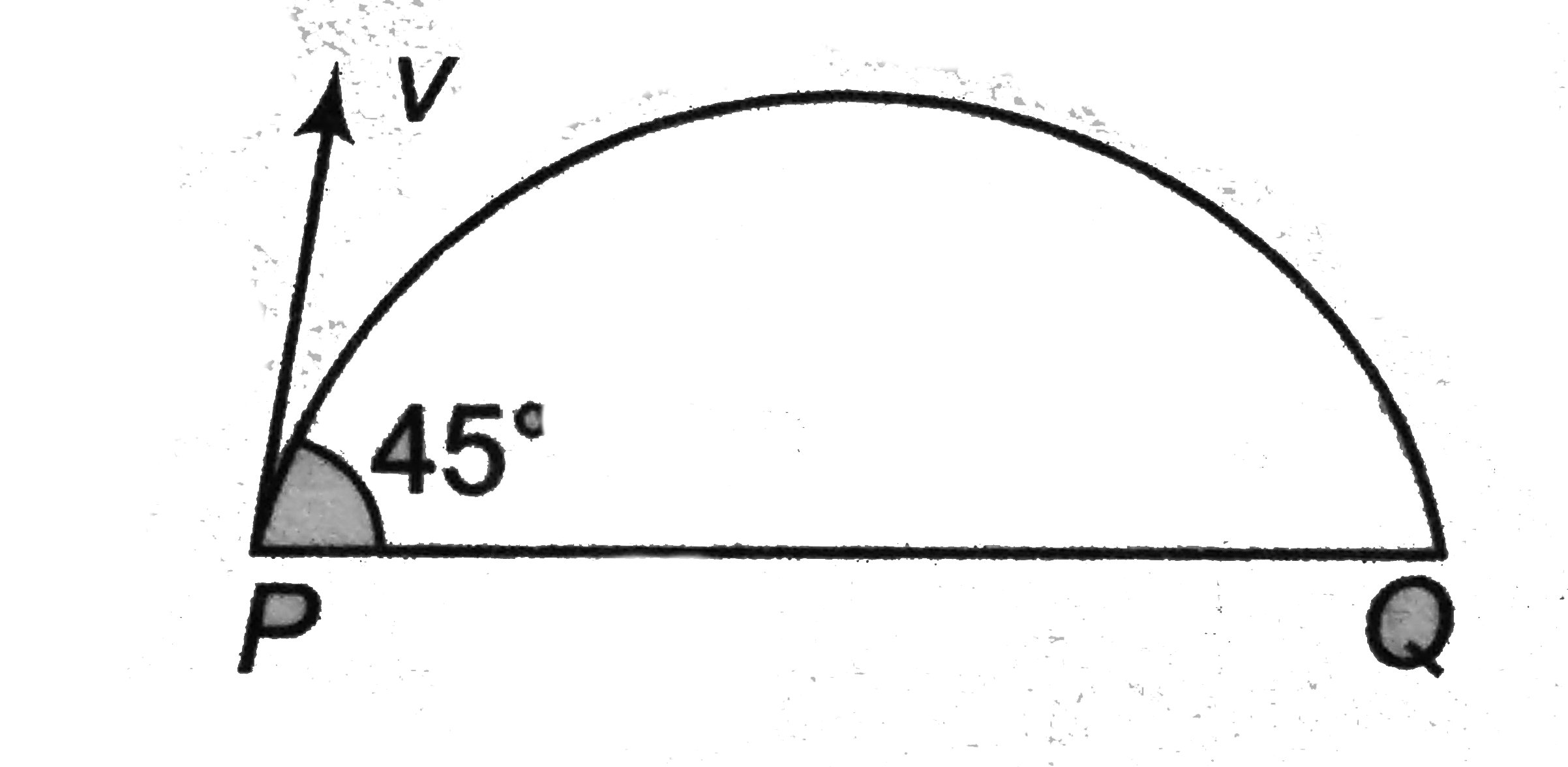
A projectile of mass `m` is fired with a velocity `v` from point P at an angle `45^@`. Neglecting air resistance, the magnitude of the change in momentum leaving the point P and arriving at Q is

A

`(mv)/(sqrt(2))`

B

2mv

C

`sqrt(2)mv`

D

`(sqrt(2))/(mv)`

Text Solution

Verified by Experts

The correct Answer is:

C
Promotional Banner

Topper's Solved these Questions

  • VECTORS

    GRB PUBLICATION|Exercise MORE THAN ONE CHOICE IS CORRECT|15 Videos
  • VECTORS

    GRB PUBLICATION|Exercise ASSERTION- REASON|1 Videos
  • VECTORS

    GRB PUBLICATION|Exercise PROBLEMS FOR PARCTICE|23 Videos
  • UNITS AND DIMENSIONS

    GRB PUBLICATION|Exercise Link Compression|6 Videos

Similar Questions

Explore conceptually related problems

A projectile of a mass m is fired with velocity v from point a as shown in figure neglecting air resistance, what is the change in momentum when leaving from P and arriving at Q?

A projectile is fired with initial momentum p at an angle 45^(@) from a point P as shown in figure. Neglecting air resistance, the magnitude of change in momentum between leaving P and arriving at Q is:

A projectile of mass m is thrown with a velocity v making an angle 60^(@) with the horizontal. Neglecting air resistance , the change in momentum from the departure A to its arrival at B is

A projectile of mass (m) is thrown with velocity (u) from the ground at an angle of 60^(@) with the horizontal. What is the magnitude of change in momentum between leaving and arriving back at the ground ?

A particle of mass m is projected with a velocity v making an angle of 45^@ with the horizontal. The magnitude of the angular momentum of the projectile abut the point of projection when the particle is at its maximum height h is.

A particle of mass m strikes elastically on a wall with velocity v, at an angle of 60^(@) from the wall then magnitude of change in momentum of ball along the wall is

A projectile os shot in air with velocity (v) at an angle theta with the horizontal. Neglecting the air resistance, what are the vertical acceleration and horizontal acceleration at the highest of its fligh ?

GRB PUBLICATION-VECTORS-OBJECTIVE QUESTIONS
  1. The resultant of two forces , one double the other in magnitude is pe...

    Text Solution

    |

  2. The value of n so that vectors 2hati+3hatj-2hatk, 5hati+nhatj+hatk and...

    Text Solution

    |

  3. A projectile of mass m is fired with a velocity v from point P at an a...

    Text Solution

    |

  4. Magnitudes of four pairs of displacement vectors are given. Which ...

    Text Solution

    |

  5. Two forces of magnitudes 30, 60 and P newton acting at a point a...

    Text Solution

    |

  6. A force F=ahati+bhatj+chatk is acted upon a body of mass m. If the bod...

    Text Solution

    |

  7. Let vecF be a force acting on a particle having positon vector vecr. L...

    Text Solution

    |

  8. If |vecA xx vecB| = sqrt(3) vecA .vecB then the value of |vecA xx ve...

    Text Solution

    |

  9. vecA, vecB and vecC are vectosrs each having a unit magneitude. If ...

    Text Solution

    |

  10. Three forces act on a body. The body will certainly have an accele...

    Text Solution

    |

  11. If the sum and difference of two vectors are at right angles, show tha...

    Text Solution

    |

  12. Vectors vecA and vecB are mutually perpendicular . Component of vecA...

    Text Solution

    |

  13. For a particle in uniform circular motion , the acceleration vec(a) a...

    Text Solution

    |

  14. A particle is given successive displacments. Which of the followin...

    Text Solution

    |

  15. An expression which cannot be defined meaningfully among vectors is :

    Text Solution

    |

  16. ABCDEF is a regular hexagon, Fig. 2 (c ) .65. What is the value of ...

    Text Solution

    |

  17. In the regular hexagon shown in Fig. 3.51, vecAB + vecBC + vecCD+ ve...

    Text Solution

    |

  18. In the regular hexagon shown in fig.3.51, vecAO+vecBO + vecCO+vecDO +...

    Text Solution

    |

  19. For vectors vecA and vecB, (vecA + vecB). (vecA xx vecB) will be :

    Text Solution

    |

  20. Minimum number of two coplanar vectors of equal magnitude whose v...

    Text Solution

    |
