A
B
C
D
Text Solution
Verified by Experts
The correct Answer is:



Topper's Solved these Questions
Similar Questions
Explore conceptually related problems
CAREER POINT-MOCK TEST 5-Part (C) (MATHS)
- Total number of integral values of 'a' so that x^(2)-(a+1)x+a-1=0 has ...
Text Solution
|
- If a,b,c,d are such unequal real numbers that (a^(2)+b^(2)+c^(2))p^(2)...
Text Solution
|
- If (x) donotes the greates integer lex, then the value of int(4)^(10)...
Text Solution
|
- The area of the portion of the circle x^(2)+y^(2)=1 which lies inside ...
Text Solution
|
- Solution of the differential equation x dy -y dx = 0 represents-
Text Solution
|
- k=lim(xtooo)[(sum(k=1)^(1000)(x+k)^(m))/(x^(m)+10^(1000))] (mgt101) is...
Text Solution
|
- if roots of ax^(2)+bx+c=0 where epsiR^(+), are two positive consecutiv...
Text Solution
|
- If cos^(-1)(cosx)=sqrt(1sin2x)AAxepsi(0,2pi), then no. of solution =
Text Solution
|
- For a what value (s) of a, will the two points (1,a,1) and (-3,0,a) li...
Text Solution
|
- The number of integer values of x for which the inequality "log "(10) ...
Text Solution
|
- If three vectors (sec^(2)A) hati+hatj+hatk, hati+(sec^(2)B)hatj+hatk,...
Text Solution
|
- Maximum value of the expression (10x^(12))/(x^(24)+2x^(12)+3x^(16)+...
Text Solution
|
- if f be a differentiable function such that f(x) =x^(2)int(0)^(x)e^(-t...
Text Solution
|
- For what values of a, m and b, Lagrange's mean value theerorem is appl...
Text Solution
|
- The value of x for which f(x)=(sin.({x})/({x})+cos.({x})/({x})) is max...
Text Solution
|
- If l^r(x) means logloglog.......x being repeated r times, then int [ (...
Text Solution
|
- Consider the non-empty set consisting of children in a family and a r...
Text Solution
|
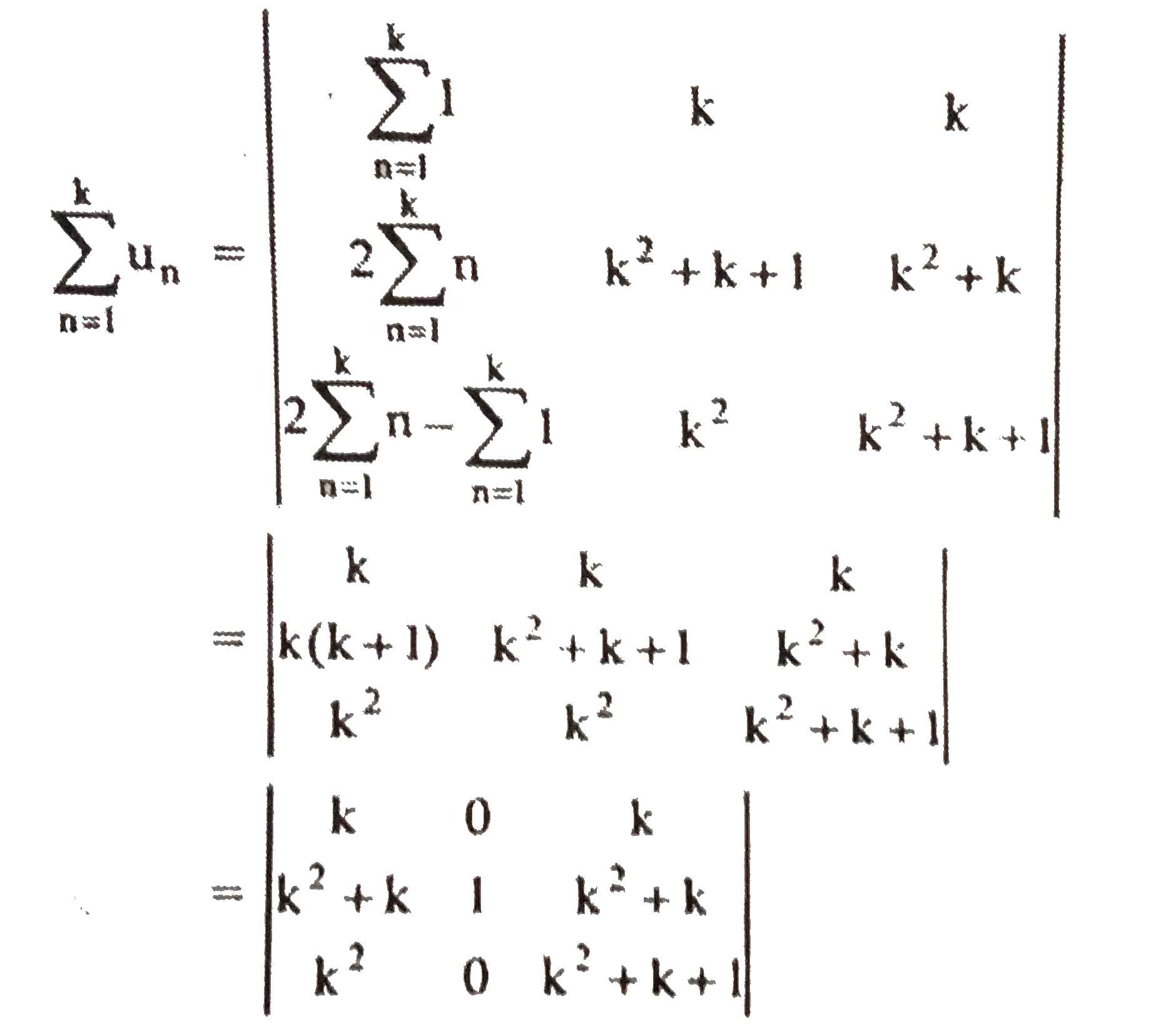
- u(n) = |{:(1,,k,,k),(2n,,k^(2)+k+1,,k^(2)+k),(2n-1,,k^(2),,k^(2)+k+1):...
Text Solution
|
- Let (p) x be a polynomial of degree 4 having extemum at x= 1,2 and lim...
Text Solution
|
- The mean of 50 observation is 36. if two observation 30 and 42 are to ...
Text Solution
|