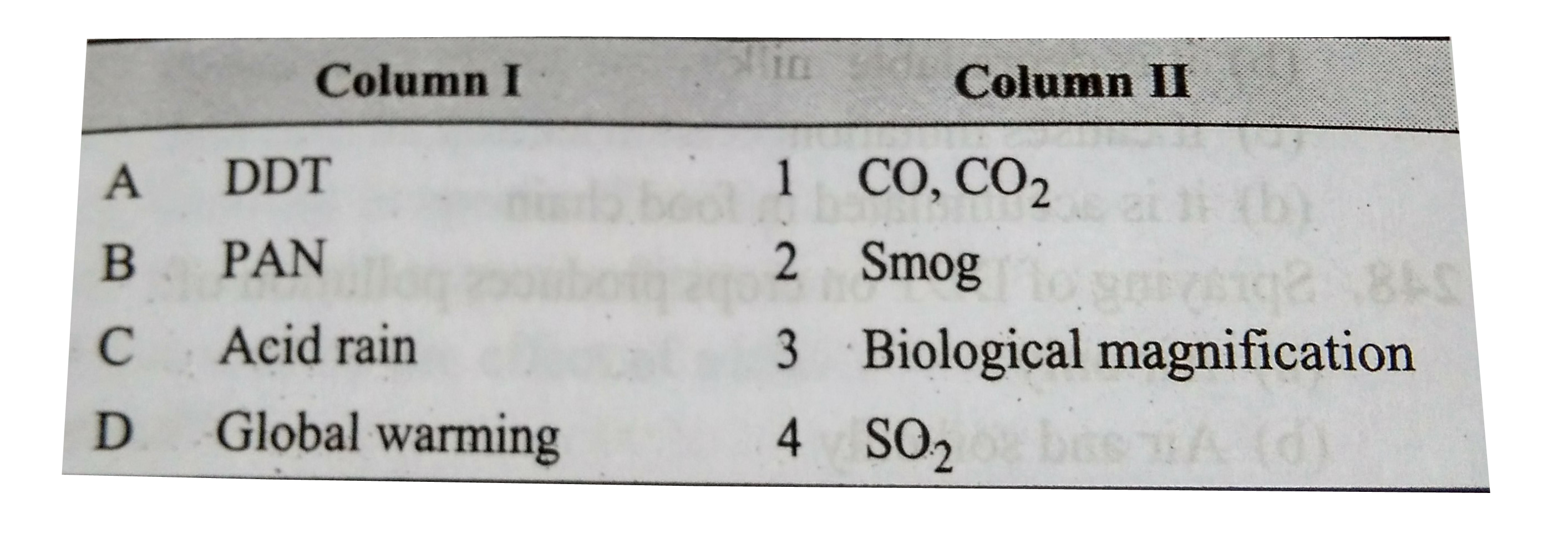
A
B
C
D
Text Solution
Verified by Experts
The correct Answer is:



Topper's Solved these Questions
ENVIRONMENTAL ISSUES
GRB PUBLICATION|Exercise NCERT Corner (Exemplar Problems)|33 VideosENVIRONMENTAL ISSUES
GRB PUBLICATION|Exercise Assertion & Reason Type Questions|30 VideosECOSYSTEM
GRB PUBLICATION|Exercise EXEMPLAR PROBLEMS|41 VideosGENE EXPRESSION AND REGULATION
GRB PUBLICATION|Exercise NCERT Corner(Exemplar Problems)|46 Videos
Similar Questions
Explore conceptually related problems
GRB PUBLICATION-ENVIRONMENTAL ISSUES-Assertion & Reason Type Questions
- Match the following and choose the correct combination from the option...
Text Solution
|
- (A) : A habitat is the actual location in the environmental where an o...
Text Solution
|
- (A) : A niche is the evolutionary result of a species adaptations to i...
Text Solution
|
- (A) : Dormancy in animals through a dry season is called hibernation. ...
Text Solution
|
- (A) : Freshwater animals cannot live long in sea water. (R) : They w...
Text Solution
|
- (A) : Light is an important abiotic factor. (R) : Life is not possib...
Text Solution
|
- (A) : The spectral quality of solar radiation is important for life. ...
Text Solution
|
- (A) : Plants can make use of only capillary water. (R) : It is prese...
Text Solution
|
- (A) : Interspecific competition is a potent force in organic evolution...
Text Solution
|
- (A) : Brood parasitism is a social parasitism among birds. (R) : Koe...
Text Solution
|
- (A) : Decomposition is largely an oxygen requiring process. (R) : D...
Text Solution
|
- (A) : The series of organisms eating one another form the food chain. ...
Text Solution
|
- (A) : The successful establishment of a species in a bare area is call...
Text Solution
|
- (A) : Food chains are interconnected at various trophic levels to form...
Text Solution
|
- (A) : The concept of ecological pyramid was developed by Arthur Tansle...
Text Solution
|
- (A) : Nutreints are never lost from the ecosystems (R) : They are re...
Text Solution
|
- (A) : The availability of light on land is closely linked with that of...
Text Solution
|
- (A) : The success of mammals is largely due to their ability to mainta...
Text Solution
|
- (A) : Small animals have a larger surface area relative to their volum...
Text Solution
|
- (A) : Many desert plants keep their stomata closed during day time. ...
Text Solution
|
- (A) : Mycorrhizae represent an intimate mutualistic relation between a...
Text Solution
|