Text Solution
Verified by Experts



Topper's Solved these Questions
CHEMICAL BONDING AND MOLECULAR STRUCTURE
DINESH PUBLICATION|Exercise ADDITIONAL IMPORTANT QUASTIONS|41 VideosCHEMICAL BONDING AND MOLECULAR STRUCTURE
DINESH PUBLICATION|Exercise H.O.T.S. CONCEPTUAL QUESTIONS|11 VideosCHEMICAL BONDING AND MOLECULAR STRUCTURE
DINESH PUBLICATION|Exercise COMPREHENSION|4 VideosCARBOXYLIC ACIDS AND THEIR DERIVATIVES
DINESH PUBLICATION|Exercise Unit test|20 VideosCLASSIFICATION OF ELEMENTS AND PERIODICITY IN PROPERTIES
DINESH PUBLICATION|Exercise All Questions|310 Videos
Similar Questions
Explore conceptually related problems
DINESH PUBLICATION-CHEMICAL BONDING AND MOLECULAR STRUCTURE -BORD EXAMINATIONS
- Define octet rule. Write its significance and limitations.
Text Solution
|
- Write the favourable factors for the formation of ionic bond.
Text Solution
|
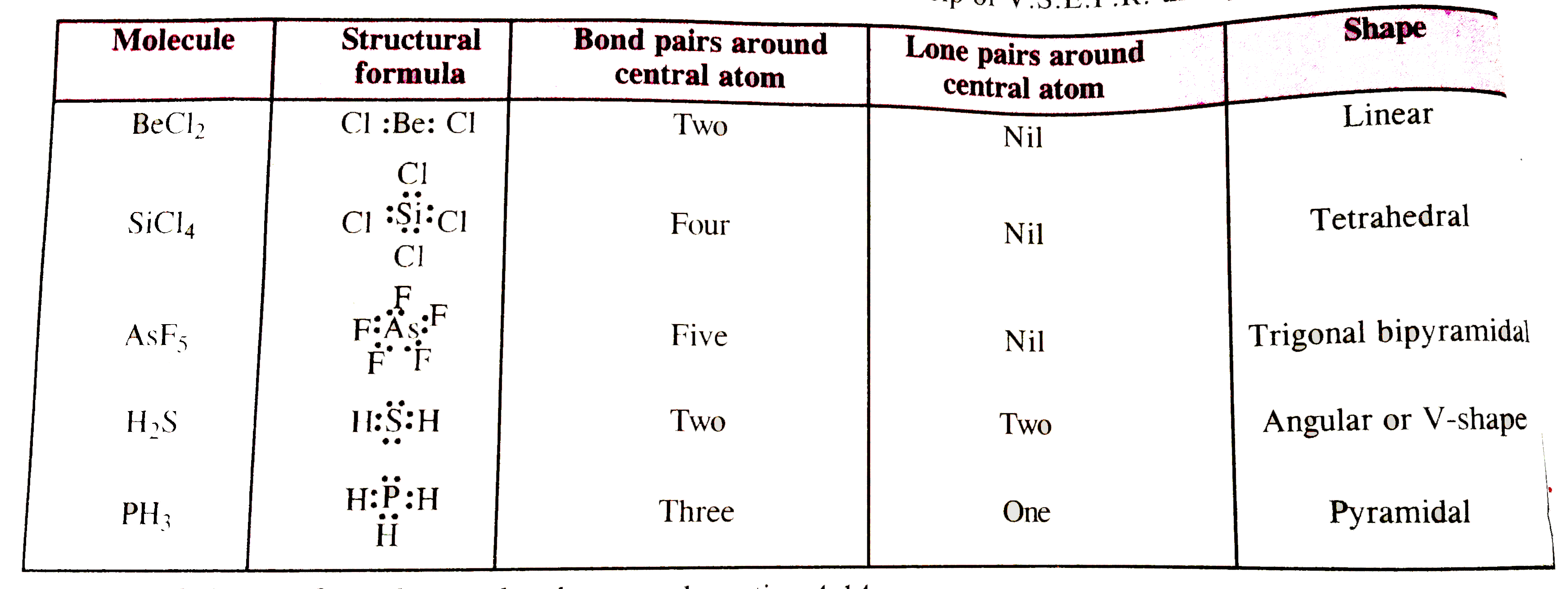
- Discuss the shape of the following molecules using the VSEPR model: ...
Text Solution
|
- Although geometries of NH(3) and H(2)O molecules are distorted tetrahe...
Text Solution
|
- How do you express the bond strength in terms of bond order?
Text Solution
|
- EXPLAIN BOND PARAMETERS- BOND LENGTH,BOND ORDER AND BOND STRENGTH
Text Solution
|
- Explain the important aspects of resonance with respect to the CO(3)^(...
Text Solution
|
- H(3)PO(3) can be represented by structure (a) and (b) shown below. Can...
Text Solution
|
- Write the resonance structures for SO(3),NO(2)^(ө), and NO(3)^(ө).
Text Solution
|
- Using Lewis dot symbols, show electron transfer between the following ...
Text Solution
|
- Although both CO(2) and H(2)O are triatomic molecules, the shape of H(...
Text Solution
|
- a) Discuss the significance/applications of dipole moment. b) Repres...
Text Solution
|
- ELECTRONEGATIVITY & ELECTRON GAIN ENTHALPY
Text Solution
|
- Explain with the help of suitable example polar covalent bond.
Text Solution
|
- Arrange the bonds in order of increasing ionic character in the molecu...
Text Solution
|
- The skeletal structure of CH(3)COOH as shown below is correct but some...
Text Solution
|
- Apart from tetrahedral geometry, another possible geometry for CH(4) i...
Text Solution
|
- Explain why BeH(2) molecule has a zero dipole moment although the Be-H...
Text Solution
|
- Both NH(3) and NF(3) have identical shapes and same state of hybridisa...
Text Solution
|
- What is meant by hybridisation of atomic orbitals? Describe the shape ...
Text Solution
|