Text Solution
Verified by Experts



Topper's Solved these Questions
CHEMICAL BONDING AND MOLECULAR STRUCTURE
DINESH PUBLICATION|Exercise ADDITIONAL IMPORTANT QUASTIONS|41 VideosCHEMICAL BONDING AND MOLECULAR STRUCTURE
DINESH PUBLICATION|Exercise H.O.T.S. CONCEPTUAL QUESTIONS|11 VideosCHEMICAL BONDING AND MOLECULAR STRUCTURE
DINESH PUBLICATION|Exercise COMPREHENSION|4 VideosCARBOXYLIC ACIDS AND THEIR DERIVATIVES
DINESH PUBLICATION|Exercise Unit test|20 VideosCLASSIFICATION OF ELEMENTS AND PERIODICITY IN PROPERTIES
DINESH PUBLICATION|Exercise All Questions|310 Videos
Similar Questions
Explore conceptually related problems
DINESH PUBLICATION-CHEMICAL BONDING AND MOLECULAR STRUCTURE -BORD EXAMINATIONS
- Apart from tetrahedral geometry, another possible geometry for CH(4) i...
Text Solution
|
- Explain why BeH(2) molecule has a zero dipole moment although the Be-H...
Text Solution
|
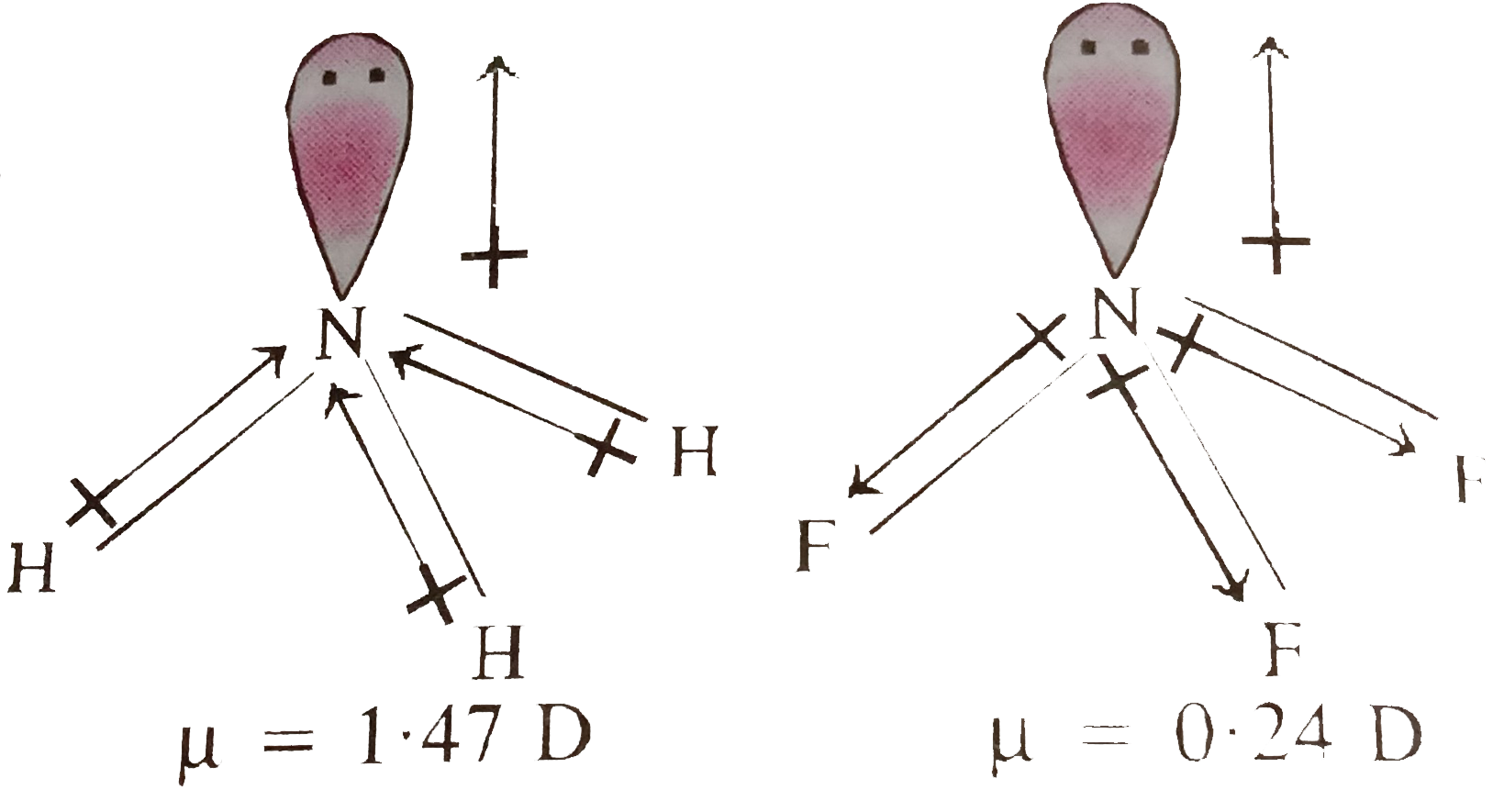
- Both NH(3) and NF(3) have identical shapes and same state of hybridisa...
Text Solution
|
- What is meant by hybridisation of atomic orbitals? Describe the shape ...
Text Solution
|
- Describe the change in hybridisation (if any) of the Al atom in the fo...
Text Solution
|
- Is there any change in hybridisation of the B and N atom as a result o...
Text Solution
|
- Draw diagrams showing the formation of a double bond and a triple bond...
Text Solution
|
- what is the total number of sigma and pi bonds in the following molecu...
Text Solution
|
- Considering X-axis as the internucler axis, which out of the following...
Text Solution
|
- Which hybrid orbitals are used by the carbon atoms in the following mo...
Text Solution
|
- What do you understand by bond pairs and lone pairs of electrons? Illu...
Text Solution
|
- Distinguish between a sigma and a pi bond.
Text Solution
|
- Explain the formation of H(2) molecule on the basis of valance bond th...
Text Solution
|
- Write the important conditions required for the linear combination of ...
Text Solution
|
- Use molecular orbital theory to explain why the Be(2) molecules do not...
Text Solution
|
- Compare the relative stability of the following species and indicate t...
Text Solution
|
- Write the singificance of plus and inus signs in representing the opit...
Text Solution
|
- Describe the hybridisation in case of PCl(2). Why are the axial bonds ...
Text Solution
|
- Define hydrogen bond. Is it weaker or stronger than the van der Waals ...
Text Solution
|
- What is meant by the term bond order ? Calculate the bond order ? Calc...
Text Solution
|