Home
Class 12
CHEMISTRY
A tertiary alcohol [H] upon acid catalys...

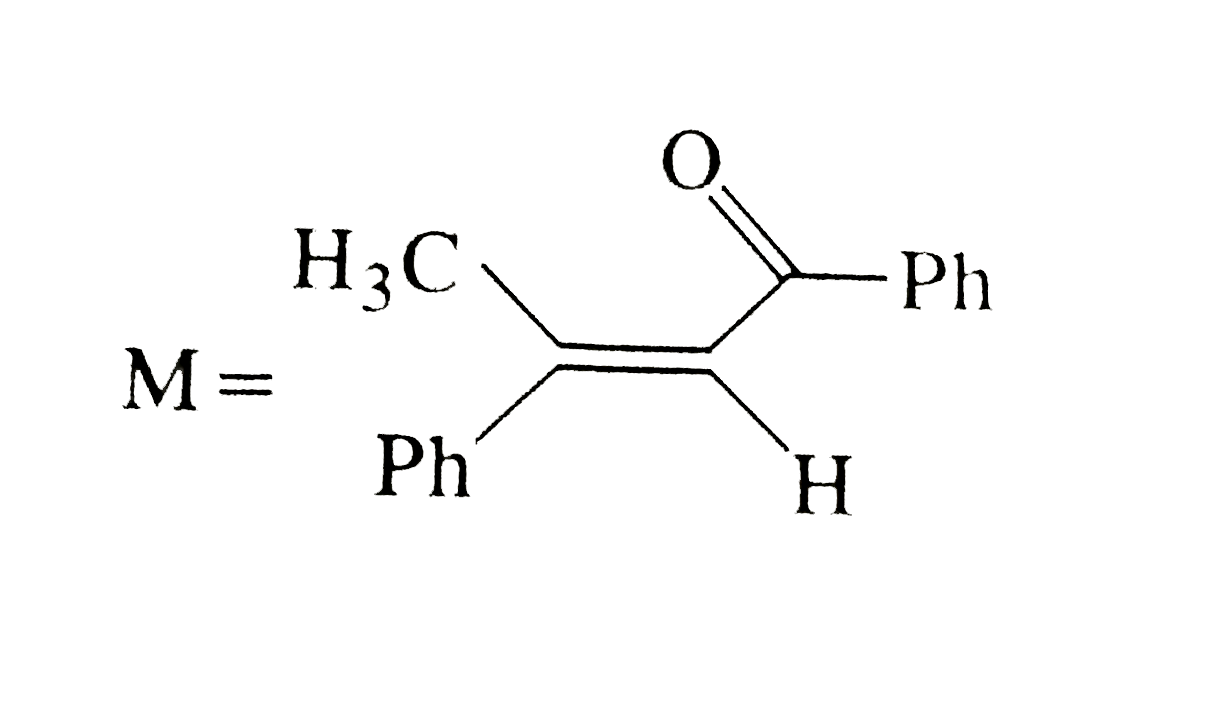
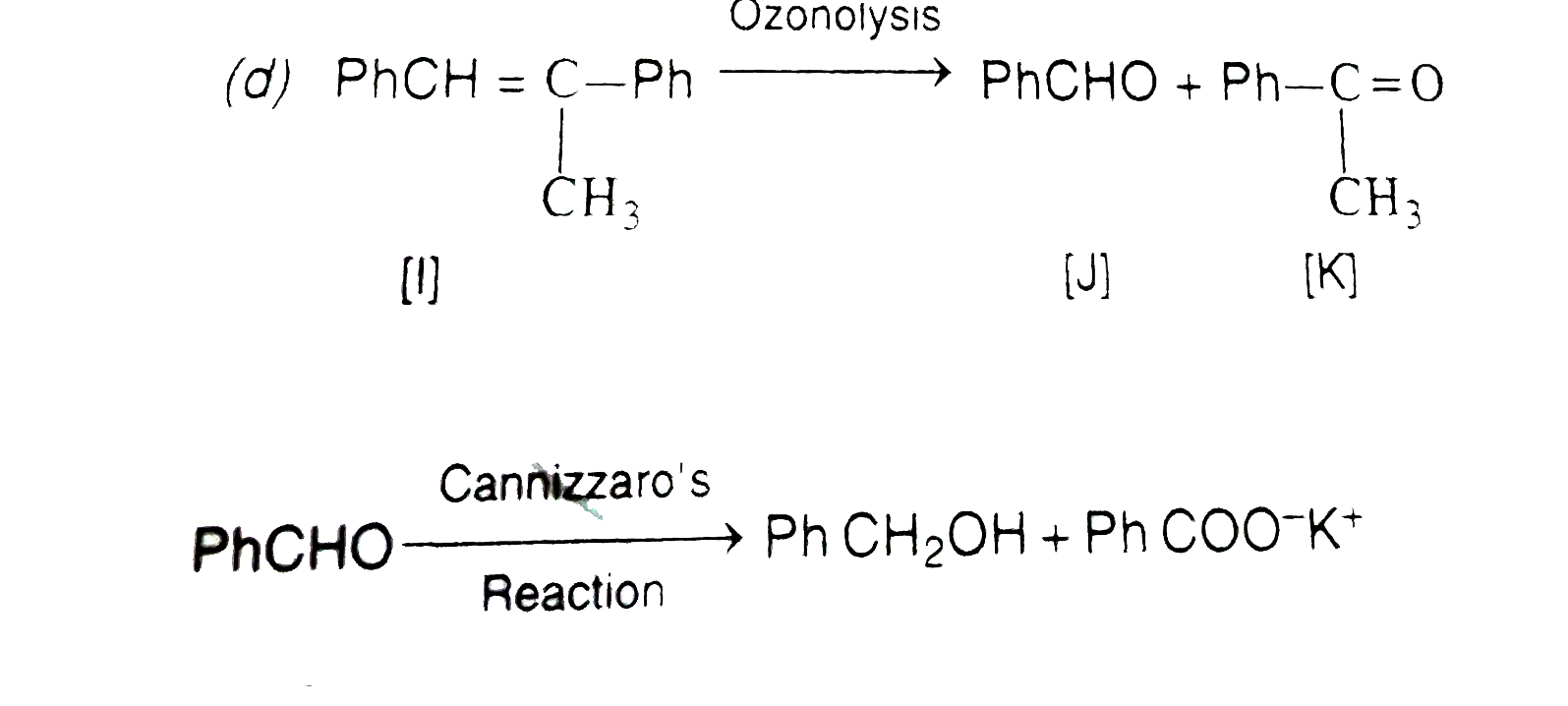
A tertiary alcohol [H] upon acid catalysed dehydration gives a product [I]. Ozonolysis of [I] leads to compounds [J] to [K]. The compound [J] upon reactions with KOH gives benzyl alcohol a compound [L] wheras [K} on reaction with KOH gives only [M]. The compund [M] has the formula.

The structure of compounds `[J], [K]` and `[L]` are respectively :

A

`PhCOCH_(3), PhCH_(2)COCH_(3)` and `PhCH_(2)COO^(-)K^(+)`

B

`PhCHO, PhCH_(2)CHO` and `PhCH_(2)COO^(-)K^(+)`

C

`PhCOCH_(3),PhCH_(2)CHO_(2)` and `CH_(3)COO^(-)K^(+)`

D

`PhCHO,PhCOCH_(3)` and `PhCOO^(-)K^(+)`.

Text Solution

Verified by Experts

The correct Answer is:
D

Promotional Banner

Topper's Solved these Questions

  • ALDEHYDES AND KETONES

    DINESH PUBLICATION|Exercise Comprehension 6|2 Videos
  • ALDEHYDES AND KETONES

    DINESH PUBLICATION|Exercise Comprehension 7|2 Videos
  • ALDEHYDES AND KETONES

    DINESH PUBLICATION|Exercise Comprehension 4|3 Videos
  • ALCOHOLS AND PHENOLS

    DINESH PUBLICATION|Exercise Matrix|9 Videos
  • ALKALI EARTH METALS

    DINESH PUBLICATION|Exercise Unit test-12|5 Videos

Similar Questions

Explore conceptually related problems

A tertiary alcohol (H) upon acid-catalysed dehydration gives a product (I). Ozonolysis of (I) leads to compounds (J) and (K). Compound (J) upon reaction with KOH gives benzyl alcohol and a compound (L), whereas (K) on reaction with KOH gives only (M). The structurer of compound (I) is:

A tertiary alcohol (H) upon acid-catalysed dehydration gives a product (I). Ozonolysis of (I) leads to compounds (J) and (K). Compound (J) upon reaction with KOH gives benzyl alcohol and a compound (L), whereas (K) on reaction with KOH gives only (M). Compound (H) is formed by the reaction of:

A tertiary alcohol (H) upon acid-catalysed dehydration gives a product (I). Ozonolysis of (I) leads to compounds (J) and (K). Compound (J) upon reaction with KOH gives benzyl alcohol and a compound (L), whereas (K) on reaction with KOH gives only (M). The structures of compounds (J), (K), and (L), respectively, are:

In the following sequence, product I,J and L are formedK represents a reagent. The structure of compound J and K, respectively are

