Home
Class 12
CHEMISTRY
Which of the following will be most read...

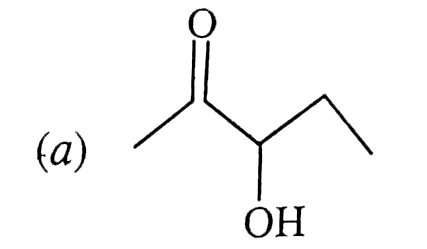
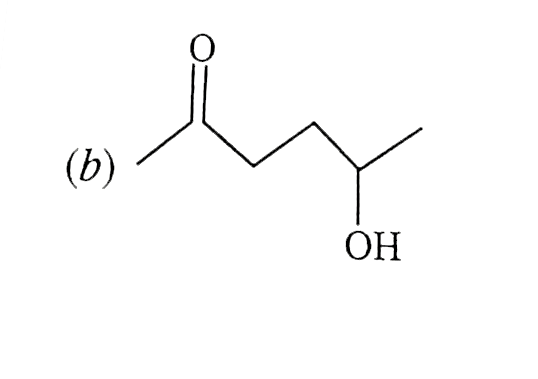
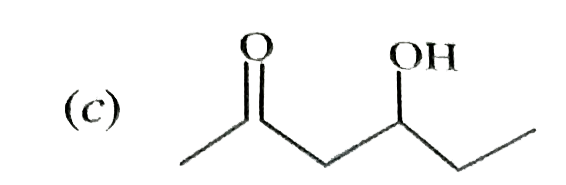
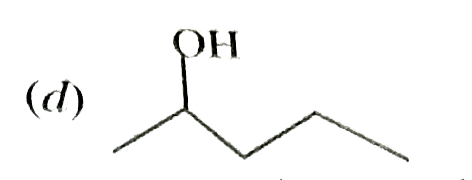
Which of the following will be most readily dehydrated in acidic conditions ?

A

B

C

D

Text Solution

AI Generated Solution

The correct Answer is:

To determine which alcohol will be most readily dehydrated under acidic conditions, we need to analyze the stability of the carbocations formed during the dehydration process. Dehydration involves the removal of a water molecule (H2O) from the alcohol, resulting in the formation of an alkene. The stability of the carbocation intermediate plays a crucial role in the dehydration reaction. ### Step-by-Step Solution: 1. **Identify the Alcohols**: We need to identify the structures of the alcohols provided in the options. Each alcohol has a hydroxyl group (–OH) that will be involved in the dehydration reaction. 2. **Understand Dehydration**: Dehydration is the process of removing a water molecule from the alcohol. In acidic conditions, the hydroxyl group (–OH) can be protonated to form a better leaving group (water) and facilitate the formation of a carbocation. 3. **Formation of Carbocations**: When the alcohol is dehydrated, the following steps occur: - The lone pair of electrons on the oxygen atom of the –OH group donates to a proton (H⁺) from the acid, forming an oxonium ion (–OH2⁺). - Water (H2O) is then eliminated, leading to the formation of a carbocation. 4. **Evaluate Carbocation Stability**: The stability of the carbocation formed after dehydration is crucial: - **Tertiary Carbocations** are the most stable due to hyperconjugation and inductive effects. - **Secondary Carbocations** are less stable than tertiary but more stable than primary. - **Primary Carbocations** are the least stable. 5. **Analyze Each Option**: - **Option 1**: Forms a primary carbocation, which is not stable. - **Option 2**: Forms a secondary carbocation, which is more stable than primary but less stable than tertiary. - **Option 3**: Forms a tertiary carbocation, which is the most stable and will dehydrate readily. - **Option 4**: Forms a secondary or primary carbocation depending on the structure, which is less stable than tertiary. 6. **Conclusion**: The alcohol that forms the most stable carbocation will dehydrate most readily. Based on the analysis, **Option 3**, which forms a tertiary carbocation, will be the most readily dehydrated in acidic conditions. ### Final Answer: **Option 3** will be the most readily dehydrated in acidic conditions.

To determine which alcohol will be most readily dehydrated under acidic conditions, we need to analyze the stability of the carbocations formed during the dehydration process. Dehydration involves the removal of a water molecule (H2O) from the alcohol, resulting in the formation of an alkene. The stability of the carbocation intermediate plays a crucial role in the dehydration reaction. ### Step-by-Step Solution: 1. **Identify the Alcohols**: We need to identify the structures of the alcohols provided in the options. Each alcohol has a hydroxyl group (–OH) that will be involved in the dehydration reaction. 2. **Understand Dehydration**: Dehydration is the process of removing a water molecule from the alcohol. In acidic conditions, the hydroxyl group (–OH) can be protonated to form a better leaving group (water) and facilitate the formation of a carbocation. ...
Promotional Banner

Topper's Solved these Questions

  • ALCOHOLS AND PHENOLS

    DINESH PUBLICATION|Exercise Comprehension|12 Videos
  • ALCOHOLS AND PHENOLS

    DINESH PUBLICATION|Exercise Straight Objective Type|24 Videos
  • ALCOHOLS AND PHENOLS

    DINESH PUBLICATION|Exercise PHENOLS|34 Videos
  • ALDEHYDES AND KETONES

    DINESH PUBLICATION|Exercise Interger|5 Videos

Similar Questions

Explore conceptually related problems

Which one of the following will most readily be dehydrated in acidic condition?

DINESH PUBLICATION-ALCOHOLS AND PHENOLS-MCQB
  1. In the following reaction H(3)C-underset(CH(3))underset(|)overset(CH...

    Text Solution

    |

  2. What amount of bromine will be required to convert 2g of phenol into 2...

    Text Solution

    |

  3. Which of the following will be most readily dehydrated in acidic condi...

    Text Solution

    |

  4. Among the following sets of reactants which one produces anisole?

    Text Solution

    |

  5. An ether solution of PhCH(3) (I), PhNH(2) (II) and PhOH (III) is extra...

    Text Solution

    |

  6. Reaction of phenol with chloroform in presence of dilute sodium hydrox...

    Text Solution

    |

  7. Which of the following is not the product of hydration of

    Text Solution

    |

  8. Dehydration of which one of the following alcohols produces an alkene ...

    Text Solution

    |

  9. X, Y and Z are

    Text Solution

    |

  10. Out of the following compounds which produce CO(2) gas when treated wi...

    Text Solution

    |

  11. Out of following compounds, which will give iodoform test ? (i) Isopro...

    Text Solution

    |

  12. Which of the following reagents would distinguish cis cyclopenta-1,2- ...

    Text Solution

    |

  13. Which one of the following -compounds does not react with nitrous acid...

    Text Solution

    |

  14. Which of the following compounds contain at least one secondary alcoho...

    Text Solution

    |

  15. Which one is the most acidic compound?

    Text Solution

    |

  16. Identify the major product P, Q and R in the following sequence of rea...

    Text Solution

    |

  17. In the reaction the electrophile involved is

    Text Solution

    |

  18. The finalproduct of the reaction,

    Text Solution

    |

  19. In Reimer-Timann reaction, the reagent used is

    Text Solution

    |

  20. Arrange the following gem diols in decreasing order of stability :

    Text Solution

    |
