Home
Class 11
CHEMISTRY
The rate constant for the first order de...

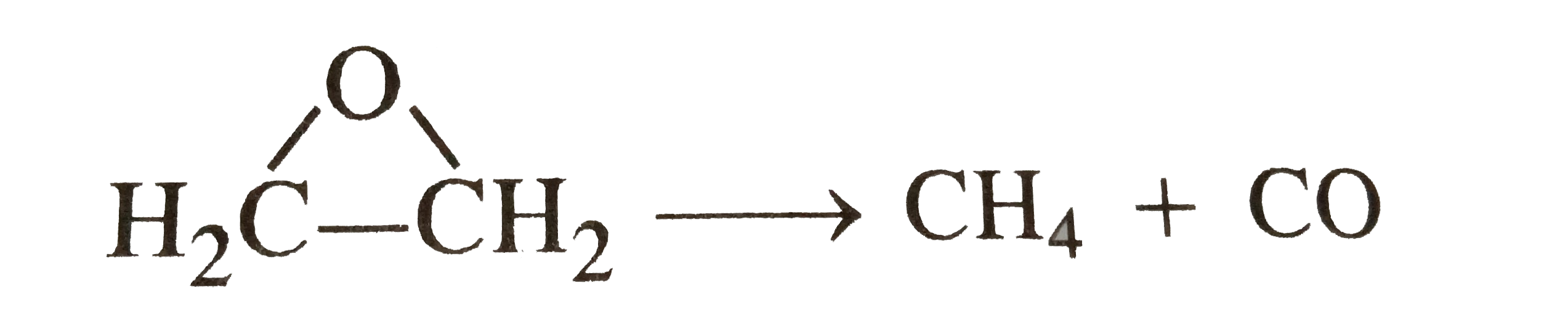
The rate constant for the first order decomposition of ethylene oxide into `CH_(4)` and CO,

may be describe by
`log k("in" s^(-1))=14.34-(1.25xx10^(4)K)/T`
The activation energy of the reaction is

A

`4.8xx10^(-5) kJ "mol"^(-1)`

B

`4.8xx10^(5) kJ "mol"^(-1)`

C

`2.39xx10^(2) kJ "mol"^(-1)`

D

`2.39xx10^(5) kJ "mol"^(-1)`

Text Solution

Verified by Experts

The correct Answer is:

C

`log k=logA=(E_(a))/(2.303RT)`
`log k=14.34-(12.5xx10^(4)K)/(T)`
From (i) and (ii)
`(E_(a))/(2.303R)=12.5xx10^(4)K`
`E_(a)=(12.5xx10^(4)K)xx(2.303)xx(8.314JK^(-1)"mol"^(-1))`
`=2.39xx10^(3)"kJ mol"^(-1)`.
Promotional Banner

Topper's Solved these Questions

  • RATES OF REACTIONS AND CHEMICAL KINETICS

    DINESH PUBLICATION|Exercise Assertion or Reason|20 Videos
  • PHYSICAL AND CHEMICAL EQUILIBRIA

    DINESH PUBLICATION|Exercise ULTIMATE PREPARATORY PACKAGE|13 Videos
  • REDOX REACTIONS

    DINESH PUBLICATION|Exercise Reasoning Type Questions|4 Videos

Similar Questions

Explore conceptually related problems

Rate constant for the decomposition of ethylene oxide into CH_(4) and CO may be described be the equation. logk(s)^(-1)=14.34-(1.25xx10^(4))/(T) (a) What is the energy of activation of this reaction ? (b) What is the value of k at 670K ?

The rate constant for the first order decompoistion of a certain reaction is described by the equation log k (s^(-1)) = 14.34 - (1.25 xx 10^(4)K)/(T) (a) What is the energy of activation for the reaction? (b) At what temperature will its half-life periof be 256 min ?

The rate constant for the decompoistion of a certain reaction is described by the equation: log k(s^(-1)) = 14 - (1.25 xx 10^(4) K)/(T) Energy of activation (in kcal ) is

The rate constant for the decompoistion of a certain reaction is described by the equation: log k(s^(-1)) = 14 - (1.25 xx 10^(4) K)/(T) Pre-exponential factor for this reaction is

The rate constant for the decompoistion of a certain reaction is described by the equation: log k(s^(-1)) = 14 - (1.25 xx 10^(4) K)/(T) A two-step mechanism has been suggested for the reaction of nitric oxide and bromine: NO(g) + Br_(2)(g) overset(k_(1))rarr NOBr_(2)(g) NOBr_(2)(g)+NO(g) overset(k_(2))rarr 2NOBr(g) The observed rate law is, rate = k[NO]^(2)[Br_(2)] . Hence, the rate-determining step is

The rate constant for the decompoistion of a certain reaction is described by the equation: log k(s^(-1)) = 14 - (1.25 xx 10^(4) K)/(T) What is the effect on the rate of reaction at 127^(@)C , if in the presence of catalyst, energy of activation is lowered by 10 kJ mol^(-1) ?

DINESH PUBLICATION-RATES OF REACTIONS AND CHEMICAL KINETICS-Ultimate Preparatory Package
  1. A certain reaction A+B rarr C is first order with respect to each reac...

    Text Solution

    |

  2. The decomposition of N(2)O into N(2) and O in the presence of gaseous ...

    Text Solution

    |

  3. The rate constant for the first order decomposition of ethylene oxide ...

    Text Solution

    |

  4. A substance X decomposes in solution following the first order kinetic...

    Text Solution

    |

  5. In a second order reaction, first order in each reactant A and B, whic...

    Text Solution

    |

  6. For a first order reaction, the ratio of time for the completion of 99...

    Text Solution

    |

  7. For the reaction R rarr P when concentration of R is made double the r...

    Text Solution

    |

  8. The chemical reaction 2O(3) overset(k(1))rarr 3O(2) proceeds as follow...

    Text Solution

    |

  9. The concentration of a reactant in solution falls from (i) 0.5 M to 0....

    Text Solution

    |

  10. In a particular reaction t(1//2) was found to increase 16 times when i...

    Text Solution

    |

  11. For a zero order reaction a graph of conc. (along Y axis) and time (al...

    Text Solution

    |

  12. The rate constant of a zero order reaction is 0.2 mol dm^(-3) "min"^(-...

    Text Solution

    |

  13. For a hypothetical reaction R rarr P the rate constant is 2944.06 s^(-...

    Text Solution

    |

  14. For a zero order reaction a plot of rate (along Y-axis) and concentra...

    Text Solution

    |

  15. At 373 k, the following reaction A(g)rarr2B(g)+C(g) is found to be of...

    Text Solution

    |

  16. A reaction has a rate constant of 0.25 "mol"^(-1) L s^(-1) if the init...

    Text Solution

    |

  17. In a reversible reaction the rate of the backward reaction is

    Text Solution

    |

  18. Hydrolysis of amyl acetate was carried out separately in the presence ...

    Text Solution

    |

  19. When number of reactants are very large the method used to find the or...

    Text Solution

    |

  20. Which of the following is not used to find the order of reaction ?

    Text Solution

    |
