Home
Class 12
PHYSICS
For a block of mass m to slide without f...

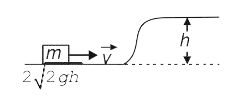
For a block of mass m to slide without friction up the rise of height h shown, it must have a minimum initial speed of:

A

`1//2 sqrt(gh)`

B

`sqrt(gh//2)`

C

`sqrt(2gh)`

D

`2sqrt((m)/(2gh))`

Text Solution

Verified by Experts

The correct Answer is:

C

Applying energy conservation , `" "1/2 mv^2 = mgh implies v = sqrt(2 gh)`.
Promotional Banner

Similar Questions

Explore conceptually related problems

A small body of mass m slide without friction from the top of a hemispherical cup of radius r as shown in figure. If leaves the surface to the cup at vertial distance h below the highest point then

A bullet of mass m moving with velocity upsilon_(1) strikes a suspended wooden block of mass M as shown in the figure and sticks to it. If the block rises to a height y. the initial of the bullet is

A block of mass m sliding down an inclined at constant speed is initial at a height h shown the ground as shown in the figure above . The coefficient of kinetic friction between the mass and the inclined is mu . If the mass constinues to slide down the inclined at a constant speed how much energy is displaced by friction by the time the mass reaches the bottom of the incline?

A man wants to slide down a block of mass m which is kept on a fixed inclined plane of inclination 30^(@) as shown in the figure .Initially the block is not sliding . To just start sliding the man pushed the block down the inclined with a force F . Now , the block starts accelerating. To move it downwards with conatant speed the man starts pulling the block with same force. Surface are such that ratio of maximum static friction to kinetic friction is 2 Now, answer the following questions. What minimum force is required to move it up the incline with constant speed?

Two blocks of mass 2m and m slide down the slope AB having same friction coefficient Then:

A man wants to slide down a block of mass m which is kept on a fixed inclined plane of inclination 30^(@) as shown in the figure .Initially the block is not sliding . To just start sliding the man pushed the block down the inclined with a force F . Now , the block starts accelerating. To move it downwards with conatant speed the man starts pulling the block with same force. Surface are such that ratio of maximum static friction to kinetic friction is 2 Now, answer the following questions. What is the value of mu _(s) , the coefficient of static friction?

A man wants to slide down a block of mass m which is kept on a fixed inclined plane of inclination 30^(@) as shown in the figure .Initially the block is not sliding . To just start sliding the man pushed the block down the inclined with a force F . Now , the block starts accelerating. To move it downwards with conatant speed the man starts pulling the block with same force. Surface are such that ratio of maximum static friction to kinetic friction is 2 Now, answer the following questions. If the man continues pushing the block by force F its acceleration would be

A man wants to slide down a block of mass m which is kept on a fixed inclined plane of inclination 30^(@) as shown in the figure .Initially the block is not sliding . To just start sliding the man pushed the block down the inclined with a force F . Now , the block starts accelerating. To move it downwards with conatant speed the man starts pulling the block with same force. Surface are such that ratio of maximum static friction to kinetic friction is 2 Now, answer the following questions. If the man wants to move the block up the inclined , what minimum force is required to start the motion?
