Home
Class 12
PHYSICS
A block of mass m is attached to four un...

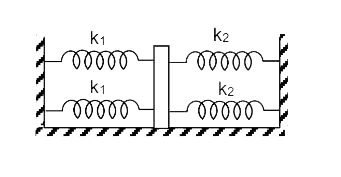
A block of mass m is attached to four unstretched massless springs of spring constant `k_1 and k_2` as shown in figure. The block is displaced towards right through distance x and is released. Speed of block when displacement of block is x/2 from mean position is :

A

`sqrt(2(k_1 + k_2)x/m)`

B

`sqrt((3(k_1+ k_2)x^2)/(2m))`

C

`sqrt(((k_1k_2))/(3(k_1 + k_2)m))`

D

`sqrt(((k_1 + k_2)x)/((k_1 + k_2)m))`

Text Solution

Verified by Experts

The correct Answer is:

B

Loss in EPE = gain in KE `implies 2 {1/2 (k_1 + k_2)(x^2 - (x/2)^2)} = 1/2 mv^2 " "implies`
`v = sqrt((3(k_1 + k_2)x^2)/(2m)` .
Promotional Banner

Similar Questions

Explore conceptually related problems

A block of mass m is attached to two unstretched springs of spring constants k_1 and k_2 as shown in figure. The block is displaced towards right through a distance x and is released. Find the speed of the block as it psses through the mean position shown.

A block of mass m is attached to two unstretched springs of springs constant k_(1) and k_(2) as shown in figure. The block is displaced towards right through a distance x and is released. Find the speed of the block as it passes through the mean position shown.

A block of mass m is attached to two unstretched springs of spring constant k , each as shown. The block is displaced towards right through a distance x and is released The speed of the block as it passes through the mean position will be

A block of mass m = 2 kg is attached to two unstretched spring of force constant k_(1)=100 N//m and k_(2)=125 N//m The block is displaced towards left through a distance of 10 cm and released. Find the speed of the block as it passes through the mean position.

A block of mass m is connected to another .block of mass M by a massless spring of spring constant k. A constant force f starts action as shown in figure, then:

A small block of mass m is kept on a bigger block of mass M which is attached to a vertical spring of spring constant k as shown in the figure. The system oscilates verticaly. a.Find the resultant force on the smaller block when it is displaced through a distance x above its equilibrium position. b. find the normal force on the smaller blok at this position. When is this force smallest smaller block at this position. When is this force smallest in magnitude? c. What can be the maximum amplitude with which the two blocks may oscillate together?

A block of mass m is connected with two ideal pullies and a massless spring of spring constant K as shown in figure. The block is slightly displaced from its equilibrium position. If the time period of oscillation is mupisqrt(m/K) . Then find the value of mu .

Both the springs shown in figure are untretched. If the block is displaced by a distance x and released, what will be the initial acceleration?
