Home
Class 12
PHYSICS
A mass m moves with a velocity v and col...

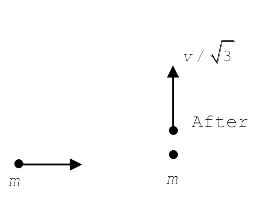
A mass m moves with a velocity v and collides inelastically with another identical mass. After collision the 1st mass moves with velocity `v/(sqrt3)` in a direction perpendicular to the initial direction of motion. Find the speed of the second mass after collision

A

`(2v)/(sqrt3)`

B

`v/(sqrt3)`

C

`v`

D

`sqrt(3)v`

Text Solution

Verified by Experts

The correct Answer is:
A

Let initial and final direction of motion of `1^(st)` particle be x and y axis respectively and `v_x and v_y` are components of velocity of `2^(nd)` particle.
`implies ` Along x-axis : mv = mvx and along y-axis : `0 = (mv)/(sqrt3) + mv_y`,
`implies " "v_x = v v_(y) = -v/(sqrt3) " "implies " speed " = sqrt(v^2 + ((v)/(sqrt3))^2) = (2v)/(sqrt3)` .
Promotional Banner

Similar Questions

Explore conceptually related problems

A mass ‘m’ moves with a velocity ‘v’ and collides inelastically with another identical mass at rest. After collision the 1st mass moves with velocity (v)/(sqrt(3)) in a direction perpendicular to the initial direction of motion. Find the speed of the 2^(nd) mass after collision :

A sphere of mass m moves with a velocity 2v and collides inelastically with another identical sphere of mass m. After collision the first mass moves with velocity v in a direction perpendicular to the initial direction of motion . Find the speed of the second sphere after collision .

A ball of mass m moving with velocity v collides head on elastically with another identical ball moving with velocity - V. After collision

A ball of mass M moving with a velocity v collides perfectly inelastically with another ball of same mass but moving with a velocity v in the opposite direction. After collision

A ball of mass 1 kg moving with a velocity of "0.4 ms"^(-1) collides with another stationary ball. After the collision, the first ball moves with a velocity of 0.3ms^(1) in a direction making an angle of 90^(@) with its initial direction. The momentum of the second ball after the collision will be (in kg ms^(-1) )

A particle of mass m moving with velocity u collides elastically head on with a particle of mass 2m at rest. After collision the heavier particle moves with velocity?

A ball of mass m moving with velocity v collides elastically with another ball of identical mass coming from the opposite direction with velocity 2v. Their velocities after collisions are-

On a frictionless surface,a block of mass M moving at speed v collides elastically with another block of same mass M which is initially at rest.After collision the first block moves at an angle theta to its initial direction and has a speed (v)/(3) .The second block's speed after the collision is ?

