Home
Class 12
PHYSICS
A thin rod of length L is lying along th...

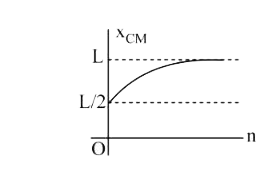
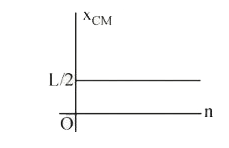
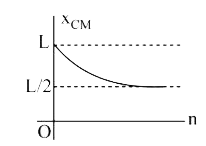
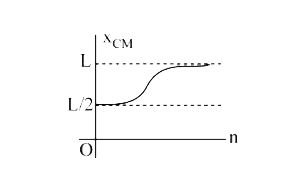
A thin rod of length L is lying along the x-axis with its ends at x = 0 and x = L. Its linear density (mass/length) varies with x as `k((x)/(L))^n` where n can be zero or any positive number. If the position `X_(CM)` of the centre of mass of the rod is plotted against n, which of the following graphs best approximates the dependence of `X_(CM)` on n?

A

B

C

D

Text Solution

AI Generated Solution

The correct Answer is:

To find the position of the center of mass \( X_{CM} \) of the thin rod with a varying linear density, we will follow these steps: ### Step 1: Define the linear density The linear density of the rod is given by: \[ \lambda(x) = k \left( \frac{x}{L} \right)^n \] where \( k \) is a constant, \( L \) is the length of the rod, and \( n \) can be 0 or any positive number. ### Step 2: Express the mass element The mass element \( dm \) of a small segment of the rod of length \( dx \) at position \( x \) is given by: \[ dm = \lambda(x) \, dx = k \left( \frac{x}{L} \right)^n \, dx \] ### Step 3: Calculate the total mass of the rod The total mass \( M \) of the rod can be calculated by integrating \( dm \) from 0 to \( L \): \[ M = \int_0^L dm = \int_0^L k \left( \frac{x}{L} \right)^n \, dx \] This simplifies to: \[ M = k \int_0^L \left( \frac{x^n}{L^n} \right) \, dx = \frac{k}{L^n} \int_0^L x^n \, dx \] The integral \( \int_0^L x^n \, dx \) evaluates to: \[ \int_0^L x^n \, dx = \frac{L^{n+1}}{n+1} \] Thus, the total mass becomes: \[ M = \frac{k}{L^n} \cdot \frac{L^{n+1}}{n+1} = \frac{kL}{n+1} \] ### Step 4: Calculate the center of mass \( X_{CM} \) The center of mass \( X_{CM} \) is given by: \[ X_{CM} = \frac{1}{M} \int_0^L x \, dm = \frac{1}{M} \int_0^L x \cdot k \left( \frac{x}{L} \right)^n \, dx \] This can be simplified to: \[ X_{CM} = \frac{1}{M} \cdot k \int_0^L \frac{x^{n+1}}{L^n} \, dx = \frac{1}{M} \cdot \frac{k}{L^n} \cdot \frac{L^{n+2}}{n+2} \] Substituting \( M \) from the previous step: \[ X_{CM} = \frac{1}{\frac{kL}{n+1}} \cdot \frac{kL^{n+2}}{(n+2)L^n} = \frac{L^{n+2}}{L(n+1)(n+2)} = \frac{L(n+1)}{(n+2)} \] ### Step 5: Analyze the behavior of \( X_{CM} \) with respect to \( n \) The expression for the center of mass is: \[ X_{CM} = \frac{L(n+1)}{(n+2)} \] As \( n \) increases, the ratio \( \frac{n+1}{n+2} \) approaches 1, meaning \( X_{CM} \) approaches \( L \). ### Step 6: Graphical representation - For \( n = 0 \): \( X_{CM} = \frac{L(1)}{(2)} = \frac{L}{2} \) - As \( n \) increases, \( X_{CM} \) approaches \( L \). Thus, the graph of \( X_{CM} \) against \( n \) will start at \( \frac{L}{2} \) when \( n = 0 \) and will asymptotically approach \( L \) as \( n \) increases. ### Final Answer The graph that best represents the dependence of \( X_{CM} \) on \( n \) will start at \( \frac{L}{2} \) and approach \( L \) as \( n \) increases.

To find the position of the center of mass \( X_{CM} \) of the thin rod with a varying linear density, we will follow these steps: ### Step 1: Define the linear density The linear density of the rod is given by: \[ \lambda(x) = k \left( \frac{x}{L} \right)^n \] where \( k \) is a constant, \( L \) is the length of the rod, and \( n \) can be 0 or any positive number. ...
Promotional Banner

Similar Questions

Explore conceptually related problems

A thin rod of length 6 m is lying along the x-axis with its ends at x = 0 and x = 6m . It linear density (mass/length) varies with x as kx^(4) . Find the position of centre of mass of rod in meters.

A thin rod of length 6 m is lying along the x-axis with its ends at x=0 and x=6m. Its linear density *mass/length ) varies with x as kx^(4) . Find the position of centre of mass of rod in meters.

A rod of length L is placed along the x-axis between x = 0 and x = L. The linear density (mass/length) lamda of the rod varies with the distance x from the origin as lamda = Rx. Here, R is a positive constant. Find the position of centre of mass of this rod.

A rod of length L is placed along the x-axis between x = 0 and x = L. The linear density (mass/ length) lambda of the rod varies with the distance x from the origin as lambda = Rx . Here, R is a positive constant. Find the position of centre of mass of this rod.

A rod of length L is placed along the x-axis between x=0 and x=L . The linear mass density (mass/length) rho of the rod varies with the distance x from the origin as rho=a+bx . Here, a and b are constants. Find the position of centre of mass of this rod.

A rod of length L is placed along the x-axis between x=0 and x=L. The linear mass density is lambda such that lambda=a+bx . Find the mass of the rod.

A rod of length L is placed along the X-axis between x=0 and x=L . The linear density (mass/length) rho of the rod varies with the distance x from the origin as rhoj=a+bx. a. Find the SI units of a and b. b. Find the mass of the rod in terms of a,b, and L.

The mass per unit length of a non- uniform rod OP of length L varies as m=k(x)/(L) where k is a constant and x is the distance of any point on the rod from end 0 .The distance of the centre of mass of the rod from end 0 is

If linear density of a rod of length 3m varies as lamda=2+x , then the position of the centre of mass of the rod is P/7m . Find the value of P.
