Home
Class 12
PHYSICS
A force F=-K(yhati+xhatj) (where K is a ...

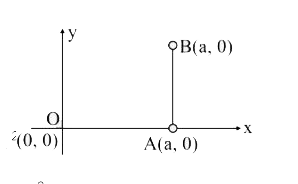
A force `F=-K(yhati+xhatj)` (where K is a positive constant) acts on a particle moving in the x-y plane. Starting from the origin, the particle is taken along the positive x-axis to the point `(a, 0)`, and then parallel to the y-axis to the point `(a, a)`. The total work done by the force F on the particle is

A

`-2 K a^2`

B

`2 Ka^2`

C

`-Ka^2`

D

`Ka^2`

Text Solution

Verified by Experts

The correct Answer is:
C

`w = int f_x dx + int f_y dy = -k int ydx - k int xdy`
From 0 to A, `dy = 0, y = 0`
So, `W_(QA) = 0`
From A to B : `dx = 0, x = a, W_(AB) = -ka int_(0)^a dy = -ka^2`
Hence, total work done `W_T = W_(OA) + W_(AB) = 0 - ka^2 = -ka^2`
Promotional Banner

Similar Questions

Explore conceptually related problems

A force vec(F) = - K (y hat(i) + x hat(j)) (where K is a positive constant) acts on a particle moving in the x - y plane. Starting from the origin, the particle is taken along the positive x-axis to the point (a, 0) and then parallel to the y-axis to the point (a, a) . The total work.done by the force F on the particle is:

A force vec((F)) = - K(yhat(i) + x hat(j)) (where K is a positive constant) acts on a particle moving in the X-Y plane. Starting from the origin, the particle is taken along the positive X-axis to the point (a, 0) and then parallel to the Y-axis to the point (a,a). The total done by the force vec(F) . of the particle is

A force vecF(yhatl+xhatJ), where K is a positive constant, acts on a particle moving in the XY-Plane. Starting from the origin, the particle is taken along the positive X-axis to a point (a,0) and then parallel to the y-axis to the point (a,a). Calculate the total work done by the force on the particle.

A force F = -K(y hatI + x hatj) (where K is a posive constant ) acts on a particle moving in the xy plane . Starting form the original , the partical is taken along in the positive x axis to the point (x,0) and then partical to they axis the point (x,0) . The total work done by the force F on the particls is

A force vecF=(4hati+5hatj)N acts on a particle moving in XY plane. Starting from origin, the particle first goes along x-axis to the point (5.0) m and then parallel to the Y-axis to the point (5,4 m. The total work done by the force on the particle is

A force vecF=k[yhati+xhatj] where k is a positive constant acts on a particle moving in x-y plane starting from the point (3, 5), the particle is taken along a straight line to (5, 7). The work done by the force is :

A force vec F = (3 vec i + 4vec j)N , acts on a particle moving in x-y plane. Starting from origin, the particle first goes along x-axis to thepoint (4,0)m and then parallel to the y -axis to the point(4, 3)m. The total work done by the force on the particle is (##NAR_NEET_PHY_XI_P2_C06_E09_014_Q01.png" width="80%">

A single force acts on a particle situated on the negative x-axis. The torque about the origin is in the positive z-direction. The force is

A force F acting on a particle varies with the position x as shown in figure. Find the work done by this force in displacing the particle from

