Home
Class 12
PHYSICS
A small block of mass 1 kg is a circula...

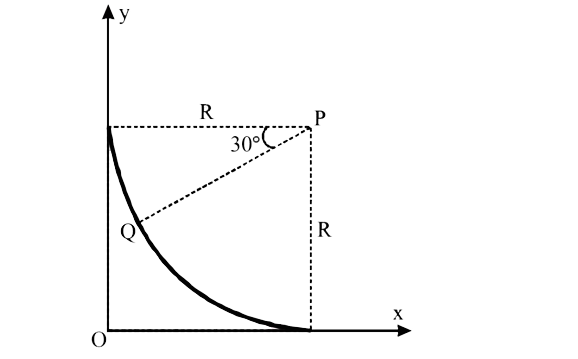
A small block of mass `1` kg is a circular are of ratius `40` m . The block sides along the track without topping and a frictionnal force acts on it in the direction opposite in the instrmens velocity . The work done in evercoming the friction up to the point `Q` as shown is the figure below is `150 J`
(Take the acceleration due to gravity `g = 10 ms^(-2))`

The magnitude of the normal reaction that acts on the block at the point `Q` is

A

7.5 N

B

8.6 N

C

11.5 N

D

22.5 N

Text Solution

Verified by Experts

The correct Answer is:

A

`N - mg cos 60^@ = (m v^2)/R , N = 5 + 5/2 = 7.5 N`.
Promotional Banner

Similar Questions

Explore conceptually related problems

A small block of mass 1 kg is a circular are of ratius 40 m . The block sides along the track without topping and a frictionnal force acts on it in the direction opposite in the instrmens velocity . The work done in evercoming the friction up to the point Q as shown is the figure below is 150 J (Take the acceleration due to gravity g = 10 ms^(-2)) The speed of the block when it reaches the point Q is

The frictional force acting on 1 kg block is

The acceleration of the 10 kg mass block shown in the figure is : -

As shown in the figure , the friction force acting on the block is

If the mass of block is 1 kg and a force of 10 / sqrt3 N is applied horizontally on the block as shown in the figure . The frictional force acting on the block is :

A block of mass 6 kg is kept on rough surface as shown in figure. Find acceleration and friction force acting on the block. (Take g=10m//s^(2) )

In the figure shown, block of mass 2 kg is very long. Force of friction on 1 kg block is

A block of mass 2kg slipped up a slant plane requires 300J of work. If height of slant is 10m the work done against friction is :

A small block of mass 1 kg is kept on a rough inclined wedge of inclination 45^@ fixed in an elevator. The elevator goes up with a uniform velocity v=2 m//s and the block done not slide on the wedge. Find the work done by the of friction on the block in 1s . (g=10 m//s^(2))

A small cube of mass m slides down a circular path of radius R cut into a large block of mass M. M rests on a table and both blocks move without friction. The blocks initially are at rest and m starts from the top of the path. Find the velocity v of the cube as it leaves the block.
