Home
Class 12
PHYSICS
Particles P and Q of mass 20g and 40g re...

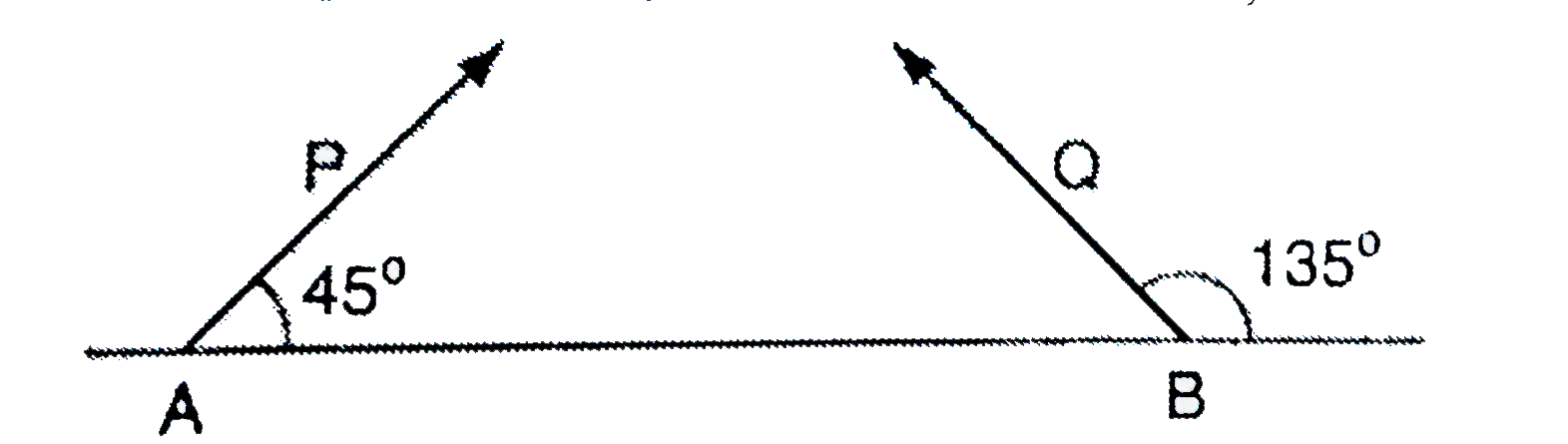
Particles P and Q of mass 20g and 40g respectively are simu ltaneously proejected from points A and B on the ground. The initial velocities of P and Q make `45^(@)` and `135^(@)` angles respectivley with the horizontal AB as shown in the Fig. 5.44 Each particle has an initial speed of 49m/s . the separation AB is 249m. both particles travel in the same vertical plane and undergo a collision. After collision P retraces its path. Determine the position of q when it hits the grou.d How much time after the collision does the particle Q take to reach the ground? (Take g`=9.8m//s^(2)`)

Text Solution

Verified by Experts

The correct Answer is:
3.53

The horizontal velocities of both the particle are the same and since both are projected simultaneously, these particle will meet exactly in the middle of AB (horizontally). Since
`R = (u^2 sin 2 theta)/(g) = 245 m`

`implies`The collision takes place at the maximum height where the velocities of both the particles will be in the horizontal direction.
`H = (u^2 sin^2 theta)/(2g) = ((49)^2 xx sin^2 45)/(2 xx 9.8) = 61.25 m`
Applying conservation of linear momentum in the horizontal direction with the information that P retraces its path, therefore its momentum will be the same in magnitude but different in direction.
Linear momentum of system before collision = Linear momentum of system after collision.
`m_pvecv_p + m_Q vecv_Q = m_pvecv_p + m_Q vecv_Q`
Here we have `m_p = 20 gm = m ("say") and m_Q = 40 gm = 2m ("say")`,
`m u_x + 2m -(u_x) = m(-u_x) + 2m vecv_Q`
Which gives `vecv_Q = 0`
Since `v_Q = 0`, therefore the particle Q falls down vertically so it falls down on the mid-point of AB. Now considering vertical motion of Q
Using `S_y - u_y t + 1/2 a_yt^2`
Here `u_y = 0,s_y = –61.25 m and a_y = – 9.8 m//s^2" " implies " " -61.25 = 0.t - 1/2 9.8 t^2`.
Which gives t = 3.53 sec.
Promotional Banner

