Home
Class 12
PHYSICS
A uniform solid cylinder of density 0.8g...

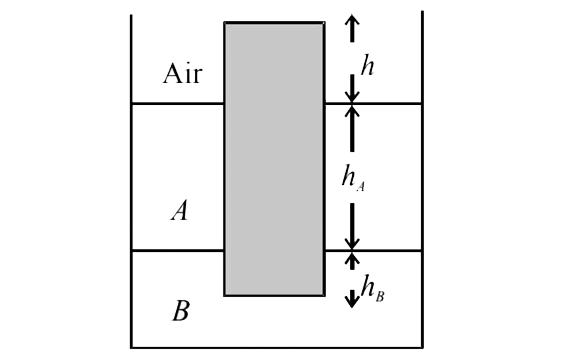
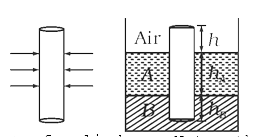
A uniform solid cylinder of density `0.8g//cm^3` floats in equilibrium in a combination of two non-mixing liquids A and B with its axis vertical.
The densities of the liquids A and B are `0.7g//cm^3` and `1.2g//cm^3`, respectively. The height of liquid A is `h_A=1.2cm.` The length of the part of the cylinder immersed in liquid B is `h_B=0.8cm`.

(a) Find the total force exerted by liquid A on the cylinder.
(b) Find h, the length of the part of the cylinder in air.
(c) The cylinder is depressed in such a way that its top surface is just below the upper surface of liquid A and is then released. Find the acceleration of the cylinder immediately after it is released.

Text Solution

Verified by Experts

The correct Answer is:
(i) 0 (ii) 0.25 (iii) ` (10)/(6) `

(i) 0 (ii) 0.25 (iii) ` (10)/(6) `
(i) Liquid A is applying the hydrostatic force on cylinder from all the sides. So, net force is zero.
(ii) In equilibrium weight of cylinder = Net upthrust on the cylinder let s be the area of cross-section of the cylinder, then weight ` = (s) (h + h_A+ h _B) rho _ ("cylinder") g ` and upthrust on the cylinder= upthrust due to liquid A + upthrust due to liquid B = ` sh _A rho _ A g + sh _B rho _B g `
Equation these two, ` s(h+ h_A + h _B) rho _("cylinder") g = sg (h_A rho A + h_B rho _B ) `
or ` (h+ h _A + h_B ) rho _("cylinder" ) = h_A rho_A + h_B rho _B `
Substituting,
` h_A= 1.2 cm, h_B = 0.8 cm and rho _A = 0.7 g //cm ^3 , rho _B = 1.2 g// cm ^3 and rho _("cylinder") = 0.8 g//cm ^3`
In the above equation , we get h = 0.25 cm
(iii) Net upward force = extra upthrust ` = shrho _B g `
` therefore ` Net acceleration ` a = ("force")/("mass of cylinder")`
or ` a = (shrho _B g)/( s (h + h_A + h _B) rho _("cylinder") ) or a = (sh rho _B g )/( (h + h _A + h _B) rho_("cylinder")) `
Substituting the values of ` h, h_Ah_B, rho _B and rho _("cylinder")`, We get ` a = (g)/(6) ` (upwards )
Promotional Banner

