Home
Class 12
PHYSICS
A rod of length l and cross-section are...

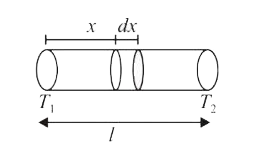
A rod of length l and cross-section area A has a variable thermal conductivity given by K = `alpha` T, where `alpha` is a positive constant and T is temperature in kelvin. Two ends of the rod are maintained at temperature `T_(1)` and `T_(2)` `(T_(1)gtT_(2))`. Heat current flowing through the rod will be

A

`(Aalpha(T_(1)^(2)-T_(2)^(2)))/(1)`

B

`(Aalpha(T_(1)^(2)+T_(2)^(2)))/(1)`

C

`(Aalpha(T_(1)^(2)+T_(2)^(2)))/(31)`

D

`(Aalpha(T_(1)^(2)-T_(2)^(2)))/(21)`

Text Solution

Verified by Experts

The correct Answer is:
D

H through the rod will be same as through the element
So `H=(-KA)/(dX)dT,Hdx=-KAdT`
or , `int_(0)^(l)Hdx=int_(T_(1))^(T_(2))-alphaTAdT`
`Hl=(-alphaA)(T_(2)^(2)-T_(1)^(2))/(2),H=(alphaA(T_(1)^(2)-T_(2)^(2)))/(2l)`
Promotional Banner

Similar Questions

Explore conceptually related problems

A rod of length l and cross sectional area A has a variable conductivity given by K=alphaT , where alpha is a positive constant T is temperatures in Kelvin. Two ends of the rod are maintained at temperatures T_1 and T_2(T_1gtT_2) . Heat current flowing through the rod will be

A rod of length L with sides fully insulated is made of a material whose thermal conductivity K varies with temperature as K=(alpha)/(T) where alpha is constant. The ends of rod are at temperature T_(1) and T_(2)(T_(2)gtT_(1)) Find the rate of heat flow per unit area of rod .

Two bars of same length and same cross-sectional area but of different thermal conductivites K_(1) and K_(2) are joined end to end as shown in the figure. One end of the compound bar it is at temperature T_(1) and the opposite end at temperature T_(2) (where T_(1) gt T_(2) ). The temperature of the junction is

A metal rod of area of cross section A has length L and coefficient of thermal conductivity K the thermal resistance of the rod is .

Two bodies of masses m_(1) and m_(2) and specific heat capacities S_(1) and S_(2) are connected by a rod of length l, cross-ssection area A, thermal conductivity K and negligible heat capacity. The whole system is thermally insulated. At time t=0 , the temperature of the fisrt body is T_(1) and the temperature of the second body is T_(2)(T_(2)gtT_(1)) . Find the temperature difference between the two bodies at time t.

A tapering rod of length L has cross sectional radii of a and b(lt a) at its two ends. Its thermal conductivity is k. The end with radius a is maintained at a higher temperature T_(1) and the other end is maintained at a lower temperature T_(2) . The curved surface is insulated. (i) At which of the two points – 1 and 2 – shown in the figure will the temperature gradient be higher? (ii) Calculate the thermal resistance of the rod.

" A metal rod of area of cross section A has length L and coefficient of thermal conductivity K The thermal resistance of the rod is "

Two rods of same length and cross section are joined along the length. Thermal conductivities of first and second rod are K_(1) and K_(2) . The temperature of the free ends of the first and seconds rods are maintained at theta_(1) and theta_(2) respectively. The temperature of the common junction is

A rof of length l with thermally insulated lateral surface consists of material whose heat conductivity coefficient varies with temperature as x = alpha//T , where alpha is a constant. The ends of the rod are kept at temperatures T_1 and T_2 . Find the function T (x) , where x is the distance from the end whose temperature is T_1 , and the heat flow density.

Two ends of a rod of uniform cross sectional area are kept at temperature 3T_(0) and T_(0) as shown. Thermal conductivity of rod varies as k=alphaT , (where alpha is a constant and T is absolute temperature). In steady state, the temperature of the middle section of the rod is

