Home
Class 12
PHYSICS
Two long straight parallel wires, carryi...

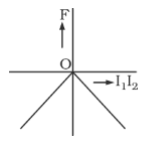
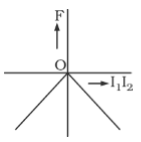
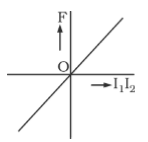
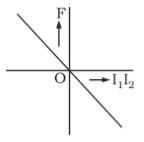
Two long straight parallel wires, carrying (adjustable) currents `I_(1)` and `I_(2)` are kept at a distance d apart. If the force F between the two wires is taken as positive when the wire repel each other and negative when the wires attract each other, the graph showing the dependence of F, on the product `I_(1)I_(2)` would be:

A

B

C

D

Text Solution

AI Generated Solution

The correct Answer is:

To solve the problem, we need to analyze the relationship between the currents in the two parallel wires and the force exerted between them. Here’s a step-by-step breakdown of the solution: ### Step 1: Understanding the Force Between the Wires The force per unit length \( F/L \) between two long parallel wires carrying currents \( I_1 \) and \( I_2 \) is given by the formula: \[ \frac{F}{L} = \frac{\mu_0 I_1 I_2}{2 \pi d} \] where \( \mu_0 \) is the permeability of free space, and \( d \) is the distance between the wires. ### Step 2: Analyzing the Direction of Force - If both currents \( I_1 \) and \( I_2 \) are in the same direction (parallel), the wires will repel each other, resulting in a negative force \( F \). - If the currents are in opposite directions (anti-parallel), the wires will attract each other, resulting in a positive force \( F \). ### Step 3: Considering the Product \( I_1 I_2 \) - When \( I_1 > 0 \) and \( I_2 > 0 \) (both currents positive), the force \( F \) is negative (repulsion). - When \( I_1 < 0 \) and \( I_2 < 0 \) (both currents negative), the force \( F \) is also negative (repulsion). - When \( I_1 > 0 \) and \( I_2 < 0 \) (one current positive and the other negative), the force \( F \) is positive (attraction). - When \( I_1 < 0 \) and \( I_2 > 0 \) (one current negative and the other positive), the force \( F \) is also positive (attraction). ### Step 4: Graphing the Relationship From the above analysis, we can summarize: - When \( I_1 I_2 > 0 \) (both currents have the same sign), \( F < 0 \) (negative force). - When \( I_1 I_2 < 0 \) (currents have opposite signs), \( F > 0 \) (positive force). ### Step 5: Conclusion on the Graph The graph of \( F \) versus \( I_1 I_2 \) will show: - A negative value for \( F \) when \( I_1 I_2 \) is positive. - A positive value for \( F \) when \( I_1 I_2 \) is negative. Thus, the graph will cross the origin and will be a straight line with a negative slope. ### Final Answer The correct option for the graph showing the dependence of \( F \) on the product \( I_1 I_2 \) is option D. ---

To solve the problem, we need to analyze the relationship between the currents in the two parallel wires and the force exerted between them. Here’s a step-by-step breakdown of the solution: ### Step 1: Understanding the Force Between the Wires The force per unit length \( F/L \) between two long parallel wires carrying currents \( I_1 \) and \( I_2 \) is given by the formula: \[ \frac{F}{L} = \frac{\mu_0 I_1 I_2}{2 \pi d} \] where \( \mu_0 \) is the permeability of free space, and \( d \) is the distance between the wires. ...
Promotional Banner
