Home
Class 12
CHEMISTRY
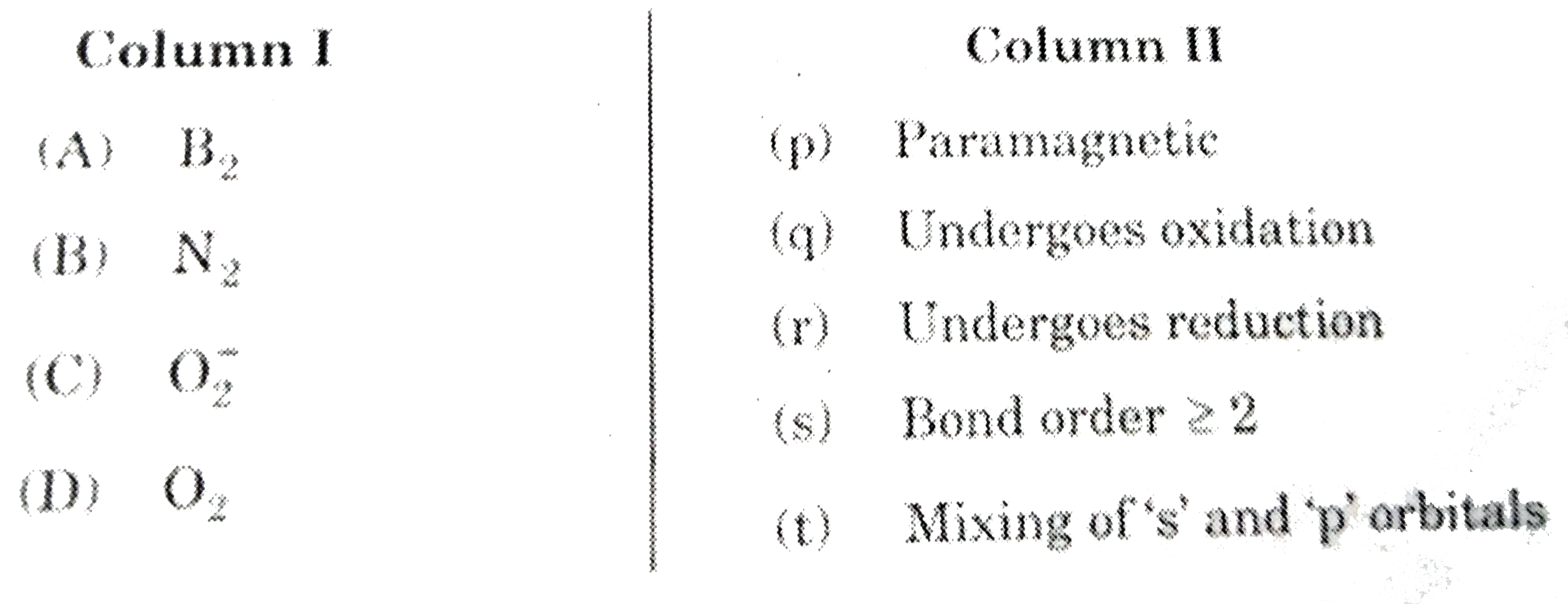
Match each of the diatomic molecules in ...

Match each of the diatomic molecules in Column I with its property/properties in Column II.

Text Solution

Verified by Experts

The correct Answer is:

`A to p, q, r, t; B to q, r, s, t; C to p, q, r; A to p, q, r, s`

(A) `B_(2) : sigma1s^(2)overset(***)sigma1s^(2)sigma2s^(2)overset(***)sigma2s^(2)|(pi2p_(y)^(1)),(pi2p_(z)^(1))|` paramagnetic. Bond order `=(6-4)/(2)=1`
Bond is formed by mixing of s and p orbitals. `B_(2)` undergoes both oxidation & reduction as
`B_(2)+O_(2) overset("Heat")to B_(2)O_(3)" (Oxidation) "B_(2)+H_(2) to B_(2)H_(6) ` (Reduction)
(B) `N_(2) : sigma1s^(2)overset(***)sigma1s^(2)sigma2s^(2)overset(***)sigma2s^(2)sigma2p_(x)^(2)|(pi2p_(y)^(2)),(pi2p_(z)^(2))|` diamagnetic. Bond order `=(10-4)/(2)=3 gt 2`
`N_(2)` undergoes both oxidation and reduction as
`N_(2)+O_(2) overset(Delta)to NO , N_(2) +3H_(2) overset("Catalyst") to NH_(3)`
In `N_(2)`, bonds are formed by mixing of s and p orbitals.
(C) `O_(2)^(-) : sigma1s^(2)overset(***)sigma1s^(2)sigma2s^(2)overset(***)sigma2s^(2)sigma2p_(x)^(2)|(pi2p_(y)^(2)),(pi2p_(z)^(2))||(overset(***)pi2p_(y)^(2)),(overset(***)pi2p_(z)^(1))|overset(***)sigma2p_(x)^(0)`
Paramagnetic with bond order `=1.5.O_(2)^(-)` undergoes both oxidation and reduction
(D) `O_(2) : sigma1s^(2)overset(***)sigma1s^(2)sigma2s^(2)overset(***)sigma2s^(2)sigma2p_(x)^(2)|(pi2p_(y)^(2)),(pi2p_(z)^(2))||(overset(***)pi2p_(y)^(1)),(overset(***)pi2p_(z)^(1))|overset(***)sigma2p_(x)^(0)`
Paramagnetic with bond order = 2. `O_(2)` undergoes reduction and oxidation
Promotional Banner

Similar Questions

Explore conceptually related problems

Match the elements in column I with its unique properties in column II

Match the statements in Column I with the properties in Column II. A

Match the molecule in Column I with the characteristic in Column II

Match the shape of molecules in Column I with the type of hybridisation in Column II.

Match the element in Column I with the properties mentioned in Column II

Match the compouns //ions Column I with their properties // reactions in Column II.

Match the complexes in Column-I with their properties listed in Column-II
