Home
Class 12
CHEMISTRY
Assuming DeltaH^(@) and S^(@) do not cha...

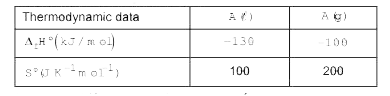
Assuming `DeltaH^(@)` and `S^(@)` do not change with temperature. Calculate, the boiling point of liquid A using the thermodynamic data given below.

A

300 K

B

130 K

C

150 K

D

50 K

Text Solution

Verified by Experts

The correct Answer is:

A

`A(l) to A(g)` at boiling point
`DeltaH = -100 -(-130) = 30 kJ//mol, DeltaS = 200 -100 = 100 kJ//mol`
For equilibrium `DeltaG = 0 rArr T_(b) =(DeltaH)/(DeltaS) = 300K`
Promotional Banner

Similar Questions

Explore conceptually related problems

Assuming DeltaH^(@) and S^(@) do not change with temperature. Calculate, the boiling point of liquid A uing the thermodynamic data given below: {:(undersetunderset(S^(@)(JK^(-1)mol^(-1)))(DeltaH^(@)(kJ//mol))("Thermodynamic data"),|,undersetunderset(100)(-130)(A(l)),|,underset underset(200)(-100)A(g)):}

In conversion of limestone to lime , CaCO_3(s) rarrCaO(s)+CO_2(g) the values of DeltaH^@ and DeltaS^@ are +179.1 KJ/mol , 160.2J/K respectively at 298 K and 1 bar. Assuming that DeltaH^@ and DeltaS^@ do not change with temperature , temperature above which conversion of limestone to lime will be spontaneous is

The temperature of a liquid at its boiling point does not change. What is this due to ?

Calculate operating surplus with the help of data given below :

Assume DeltaH^(@) and DeltaS^(@) to be independent of temperature, at what temperature with the reaction given below becomes spontaneous? N_(2)(g) + O_(2)(g) to 2NO(g) DeltaH^(@) = 180.8 kJ mol^(-1)

Sulphur exists is more than one solid form. The stable form at room temperature is rhombic sulphur. But above room temperature the following reaction occurs. S ("rhomic") rarrS("monoclinic") If DeltaH^(Theta) =- 276.144J at 298 K and 1atm and DeltaG^(Theta) = 75.312J a. Calculate DeltaS^(Theta) at 298K . b. Assume that DeltaH^(Theta) and DeltaS^(Theta) do not vary significantly with temperature, calculate T_(eq) , the temperature at which rhombic and monoclinic sulphur exist in equilibrium with each other.

1 mole of liquid A and 9 moles of liquid B are mixed to form a solution. If "P"_("B")^(@)=400"mm" of Hg and "P"_("A")^(@)=20 "mm" of Hg at a temperature 'T' and normal boiling point of liquid B is 300K then answer the questions that follow. Given data: "K"_("b")=2.7"K kg mol"^(-1), Molar mass of B=100 If 'A' is assumed to be perfectly non volatile then what will be normal boiling point of the solution.

Two liquids (A) and (B) can be separated by the method of fractional distillation. The boiling point of liquid (A) is less than boiling point of liquid (B). Which of the liquids do you expect to come out first in the distillate ? Explain.

Calculate the mean and variance from the data given below:
