Home
Class 12
CHEMISTRY
Consider the following reaction equilibr...

Consider the following reaction equilibrium
`N_(2)(g) + 3H_(2)(g) hArr 2NH_(3)(g)`
Initially, 1 mole of `N_(2)` and 3 moles of `H_(2)` are taken in a 2 L flask. At equilibrium state if, the number of moles of `N_(2)` is 0.6, what is the total number of moles of all gases present in the flask ?

A

0.8

B

1.6

C

3.2

D

6.4

Text Solution

Verified by Experts

The correct Answer is:
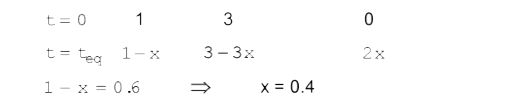
C

`N_(2)(g) + 3H_(2)(g) rarr 2NH_(3)(g)`
`1-x = 0.6 implies x = 0.4`
Total moles = 4 - 2x = 3.2
Promotional Banner

Similar Questions

Explore conceptually related problems

Consider the following reaction equilibrium N_(2)(g) + 3H_(2)(g) hArr 2NH_(3)(g) Initially, 1 mole of N_(2) and 3 moles of H_(2) are taken in a 2 flask. At equilibrium state if, the number of moles of N_(2) is 0.6, what is the total number of moles of all gases present in the flask ?

One mole of H_(2) and 2 moles of I_(2) are taken initially in a two litre vessel. The number of moles of H_(2) at equilibrium is 0.2. Then the number of moles of I_(2) and HI at equilibrium is

For the equilibrium H_(2)(g)+CO_(2)(g)hArr hArr H_(2)O(g)+CO(g), K_(c)=16 at 1000 K. If 1.0 mole of CO_(2) and 1.0 mole of H_(2) are taken in a l L flask, the final equilibrium concentration of CO at 1000 K will be

N_(2) + 3H_(2)hArr2NH_(3) 1mole N_(2) and 3 moles H_(2) are present at start in 1 L flask. At equilibrium NH_(3) formed required 100 mL of 5 M HC1 for neutralisation hence K_(c) is

The equilibrium of the reaction N_(2)(g)+3H_(2)(g) hArr 2NH_(3)(g) will be shifted to the right when:

For a reaction, 2SO_(2(g))+O_(2(g))hArr2SO_(3(g)) , 1.5 moles of SO_(2) and 1 mole of O_(2) are taken in a 2 L vessel. At equilibrium the concentration of SO_(3) was found to be 0.35 mol L^(-1) The K_(c) for the reaction would be

For N_(2)+3H_(2)hArr 2NH_(3) , 1 mole N_(2) and 3 mol H_(2) are at 4 atm. Equilibrium pressure is found to be 3 atm. Hence, K_(p) is

Increased pressure shifts the equilibrium of the reaction: N_(2)(g)+3H_(2)(g)harr2NH_(3)(g) so as to

