Home
Class 12
CHEMISTRY
The degree of dissociation of I(2) "mole...

The degree of dissociation of `I_(2)` "mole"cule at `1000^(@)C` and under `1.0 atm` is `40%` by volume. If the dissociation is reduced to `20%` at the same temperature, the total equilibrium pressure on the gas will be:

A

1.57 atm

B

2.57 atm

C

3.57 atm

D

4.57 atm

Text Solution

Verified by Experts

The correct Answer is:
D

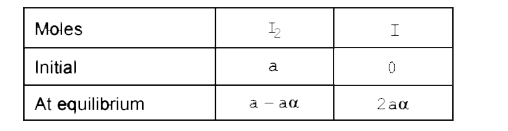
`I_(2)(g) rarr 2I(g)`
`implies n_(T) = a + a alpha`
`K_(p) = p_(I)^(2)/p_(I_(2)) = (2alpha/1+alpha P)^(2)/((1-alpha/1+alpha)p) = 4alpha^(2)p/(1-alpha^(2))`
Given: `alpha = 0.4` at P = 1.0 atm
`Let P_(n ew)` be the pressure when `alpha = 0.2`
`implies K_(p) = 4 xx 0.16/0.84 = 4 xx 0.4/0.96 P_(n ew) implies P_(new) = 4 xx 0.96/0.84 = 4.57 atm`
Promotional Banner

Similar Questions

Explore conceptually related problems

the degree of dissociation of PCI_(5) at a certain temperature and under one atmosphere pressure is 0.2. Calculate the pressure at which it is half dissociated at the same temperature.

The degree of dissociation of N_(2)O_(4) into NO_(2) at 1 atm 40^(@)C is 0.310 . Calculate its K_(p) at 40^(@)C . Also report the degree of dissociation at 10 atm pressure at same temperature.

The degree of dissociation of PCl_(5) at 1 atm pressure is 0.2 . Calculate the pressure at which PCl_(5) is dissociated to 50% ?

The degree of dissociation of PCl_(5) ata certain temperature and atmospheric pressure is 0*2 . Calculate the pressure at which it will be half (50 %) dissociated at the same temperature .

Find the percentage dissociation of ammonia into N_(2) "and' H_(2) if the dissociation is carried out at constant pressure and the volume at equilibrium is 20% greater than initial volume. (Initially. Equal moles of NH_(3) "and" N_(2) are present with no hydrogen)

At temperature T k PCI_5 is 50% dissociated at an equilibrium pressure of 4 atm. At what pressure it would dissociate to the extent of 80% at the same temperature ?

