Home
Class 11
PHYSICS
A ball of mass mm, moving with a speed 2...

A ball of mass m`m`, moving with a speed `2upsilon_(0)`, collides inelasticaly `(egt0)` with an identical ball at rest. Show that `(a)` For head - on collision, both the balls move forward.
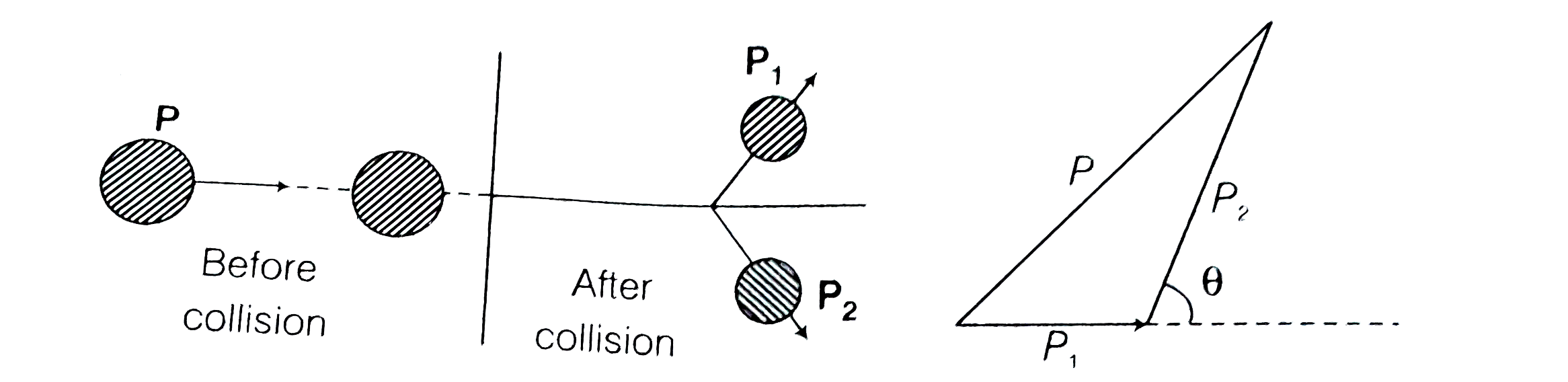
(b) For a genergcollision, the angle between the two velocities of scattered balls is less that `90^(@)`.

Text Solution

Verified by Experts
(a) Let `v_(1) and v_(2)` are velocities of the two balls after collision. Now by the principle of conservation of linear momentum,
`2mv_(0)=mv_(1)+mv_(2)`
`or 2v_(0)=v_(1)+v_(2)`
`and e=(v_(2)-v_(1))/(2v_(0))`
`Rightarrow v_(2)=v_(1)+2v_(0)e`
`therefore `2v_(1)=2v_(0)-2ev_(0)`
`therefore v_(1)=v_(0)(1-e)`
Since, `e lt 1 Rightarrow v_(1)` has the same sign as `v_(0)` therefore, the ball moves on after collision
(b) Consider the diagram below for a general collision

By principal of conservation of linear momentum, `P=P_(1)+P_(2)`
For inelastic collision some KE is lost, hence `(p^(2))/(2m) lt (p_(1)^(2))/(2m)+(p_(2)^(2))/(2m)`
Thus p, `p_(1) and p_(2)` are releated as shown in the figure
`theta` is acute (less than `90^(@))(p^(2)=p_(1)^(2)+p_(2)^(2)) "would given" `theta=90^(@)`
Promotional Banner

Similar Questions

Explore conceptually related problems

A billiard ball moving with a speed of 5 m//s collides with an identical ball, originally at rest. If the first ball stop dead after collision, then the second ball will move forward with a speed of:

A ball of mass m moving with velocity v collides head on elastically with another identical ball moving with velocity - V. After collision

A ball of mass m moving with a speed 2v_0 collides head-on with an identical ball at rest. If e is the coefficient of restitution, then what will be the ratio of velocity of two balls after collision?

A ball of mass M moving with speed v collides perfectly inelastically with another ball of mass m at rest. The magnitude of impulse imparted to the first ball is

A ball of mass m is moving with velocity u and collides head on with another identical body at rest . What is the maximum possible loss of kinetic energy due to collision ?

A ball of mass m moving at a speed v makes a head on inelastic collision with an identical ball at rest. The kinetic energy of the balls after the collision is 3/4th of the original. Find the coefficient of restitution.

A ball of mass m moving with a velocity v undergoes an oblique elastic collision with another ball of the same mass m but at rest. After the collision if the two balls move with the same speeds , the angle between their directions of motion will be:

