Home
Class 11
PHYSICS
We would like to make a vessel whose vo...

We would like to make a vessel whose volume does not change with temperature . We can use brass and iron `(beta_(brass) = 6 xx10^(-5) // K and beta_(iron) = 3.55 xx 10^(-5)//K)` at create a volume of 100 c c. How do you think you can achieve this.

Text Solution

Verified by Experts
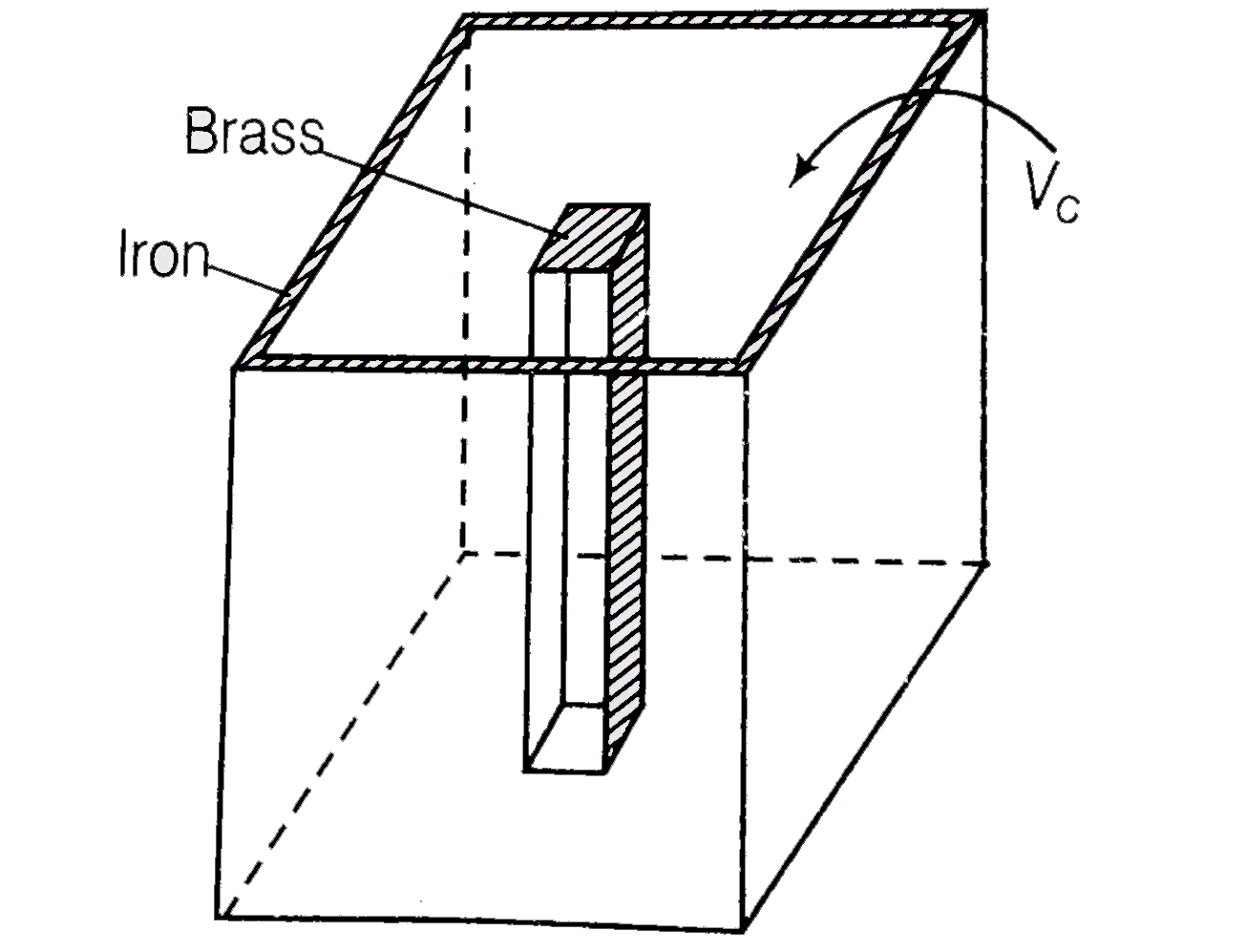
In the previous problem the difference in the length was constant.
In this problem the difference in volume is constant.
The situation is shown in the diagram.

Let `V_(io), V_(bo)` be the volume of iron and brass vessel at `0^(@)C`
`V_(i), V_(b)` be the volume of iron and brass vessel at `Delta theta^(@)C`,
`gamma_(i), gamma_(b)` be the coefficient, of volume expansion of iron and brass.
As per question, `V_(io)-V_(bo) = 100 c c = V_(i) - V_(b)` ...(i)
Now, `V_(i) = V_(io) (1+gamma_(i)Delta theta)`
`V_(b) = V_(bo) (1+gamma_(b) Delta theta)`
`V_(i) - V_(b) = (V_(io)- V_(bo)) + Delta theta (V_(io) gamma_(i)-V_(bo)-gamma_(b))`
Since, `V_(i)-V_(b)` = constant.
So, `V_(io) gamma_(i) = V_(bo) gamma_(b)`
`rArr (V_(io))/(V_(bo)) = (gamma_(b))/(gamma_(i)) = ((3)/(2)beta_(B))/((3)/(2)beta_(i))= (beta_(b))/(beta_(i)) =(6 xx 10^(-5))/(3.55 xx 10^(-5)) = (6)/(3.55)`
`(V_(io))/(V_(bo)) = (6)/(3.55)` ...(ii)
Solving Eqs. (i) and (ii), we get
`V_(io) = 244.9 c c`
`V_(bo) = 144.9 c c`
Promotional Banner

Topper's Solved these Questions

  • THERMAL PROPERTIES OF MATTER

    NCERT EXEMPLAR|Exercise Very short Answer type Questions|15 Videos
  • SYSTEM OF PARTICLES AND ROTATIONAL MOTION

    NCERT EXEMPLAR|Exercise very short answer type questions|18 Videos
  • THERMODYNAMICS

    NCERT EXEMPLAR|Exercise LONG ANSWER TYPE QUESTIONS|5 Videos

Similar Questions

Explore conceptually related problems

We would like to make a vessel whose volume does not change with temperature (take a hing from the problem aobve). We can use brass and iron (beta_(brass) = 6 xx10^(-5) // K and beta_(iron) = 3.55 xx 10^(-5)//K) ot create a volume of 100 c c. How do you think you can achieve this.

We would like to perpare a scale whose length does not change with temperature. It is proposed to prepare a unit scale f this type whose length remains, say 10 cm. We can use a bimetallic strip made of brass and iron each of different length (both components) would change in such a way that differnece between theri lenght rermain constant. If alpha_(iron) = 1.2 xx 10^(-5)//K and alpha_(brass) = 1.8 xx 10^(-5)//K, what should we take as lenght of each strip ?

What is the percentage change in length of 1m iron rod it its temperature changes by 100^(@)C. alpha for iron is 2 xx 10^(-5)//"^(@)C .

The approximate number of air molecules in a 1 m^3 volume at room temperature (300 K) and atmospheric pressure is (Use R = 8.2 xx 10^(-5 ) m^3 atm/mol K and N_A =6.02 xx 10^(23) mol^(-1) )

What length of brass and iron at 0^(0)C must be used if the difference between their lengths is always 0.2m ? The values of alpha for brass and iron and 18 xx 10^(-6)//0 C and 12 xx 10^(-6)//0 C respectively,

Consider a brass rod and a steel rod (80 cm longer than brass rod) at 0^(@)C . It is observed that on increasing temperatures of the two rods by same amount difference in lengths of the two rods does not change. Given that the thermal coefficient of linear expansion for steel and brass are 11xx10^(-6).^(@)C^(-1) and 19xx10^(-6).^(@)C^(-1) respectively. The sum of lengths of the two rods at 0^(@)C is

A glass vessel is filled up to 3/5th of its volume by mercury. If the volume expansivities of glass and mercury be 9xx 10^(-6)//^(@)C and 18xx10^(-5)//^(@)C respectively, then the coefficient of apparent expansion of mercury is

Ends of two wires A and B, having resistivity rho_(A)=3xx10^(5)Omegam and rho_(B)=6xx10^(-5) omega m of same cross section ara are pointed together to form a single wire. If the resistance of the joined wire does not change with temperature, then find the ratio of their lengths given that temperatue coefficient of resistitivy of wires A and B are alpha=4xx10^(-5)//^(@)C and alpha=-4xx10^(6)//^(@)C . Assume that mechanical dimensions do not change with temperature.

An iron rod and another of brass, both at 27^@C differ in length by 10^-3 m. The coefficient of linear expansion for iron is 1.1xx10^(-5)//^(@)C and for brass is 1.9xx10^(-5)//^(@)C . The temperature at which both these rods will have the same length is

