Home
Class 12
PHYSICS
A particle is confined to move along the...

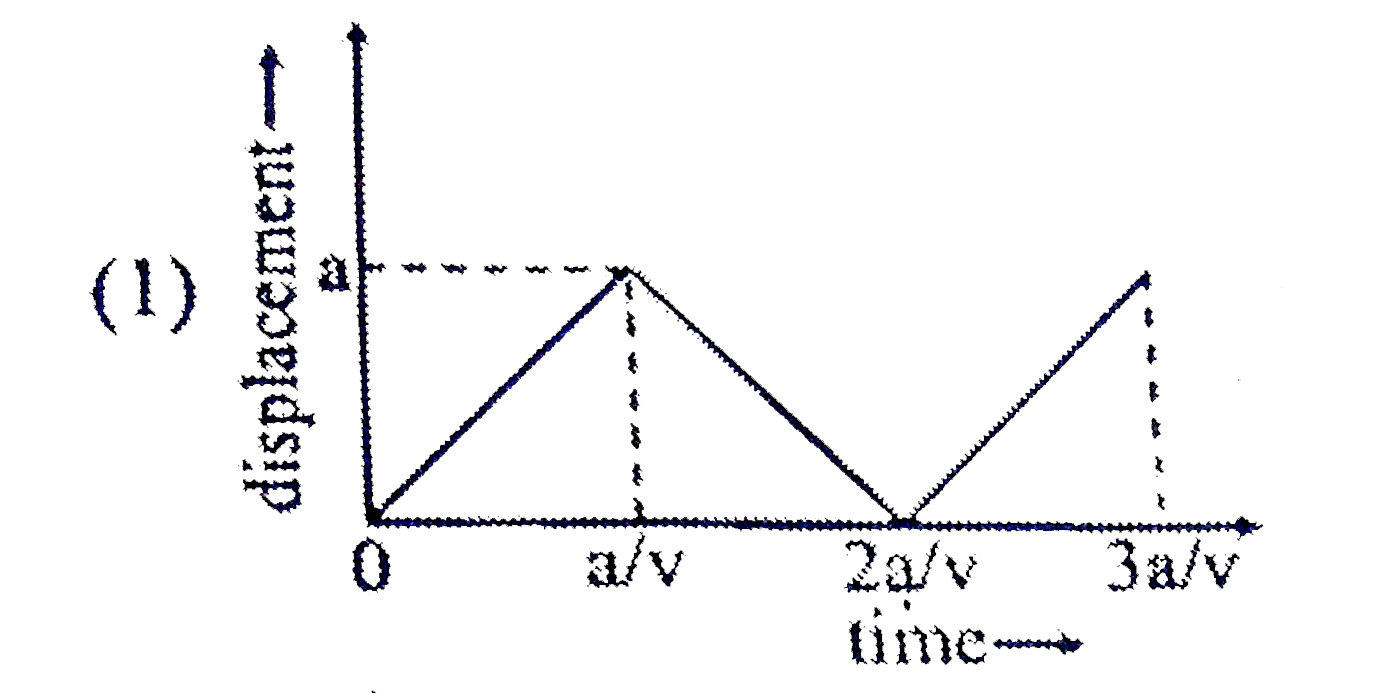
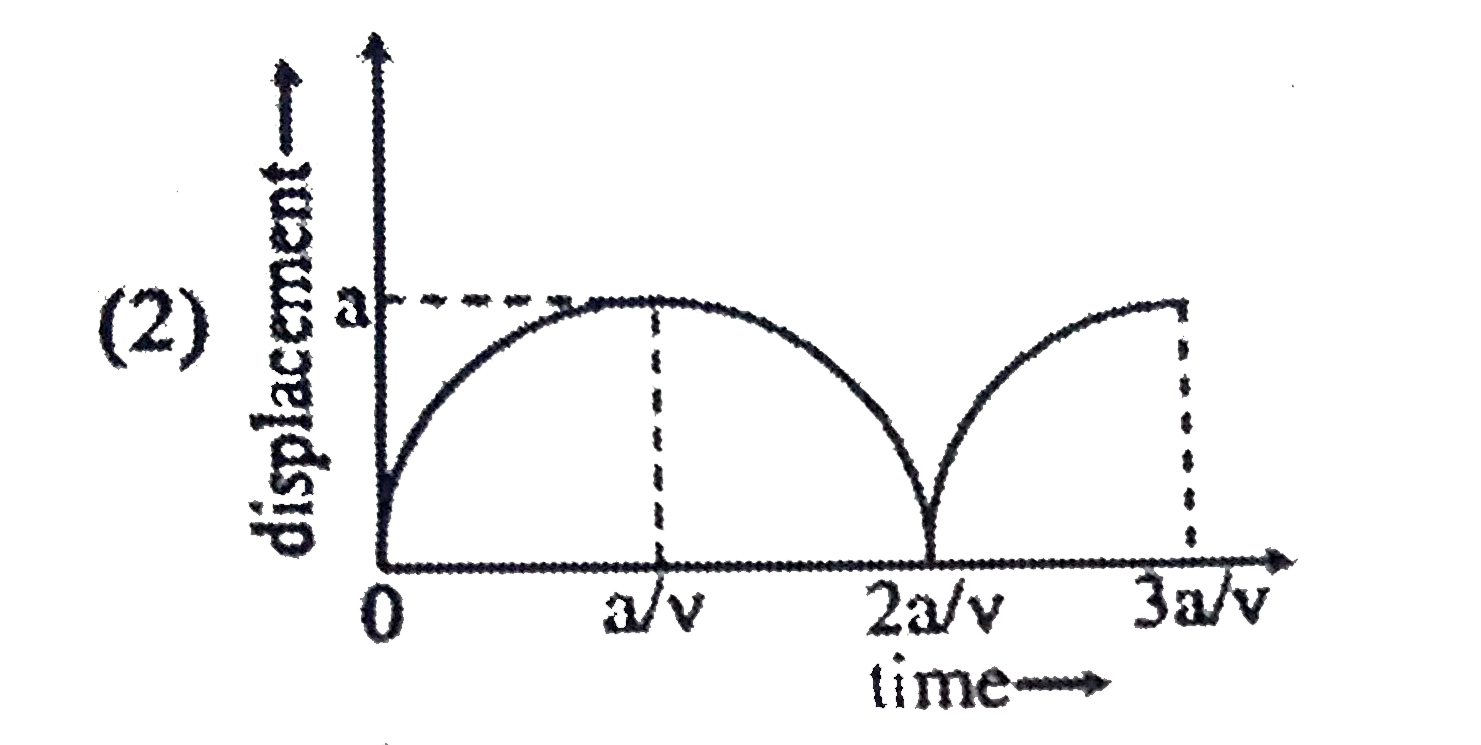
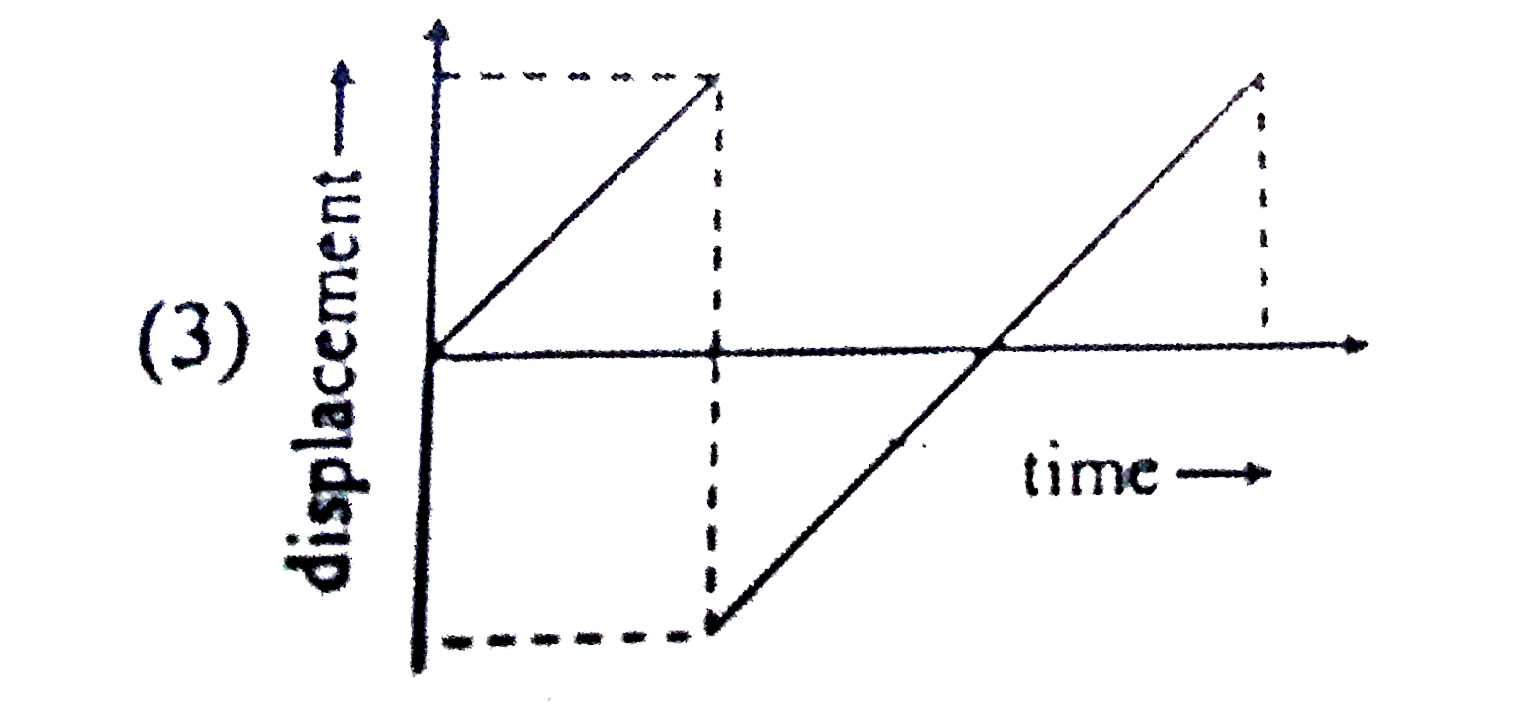
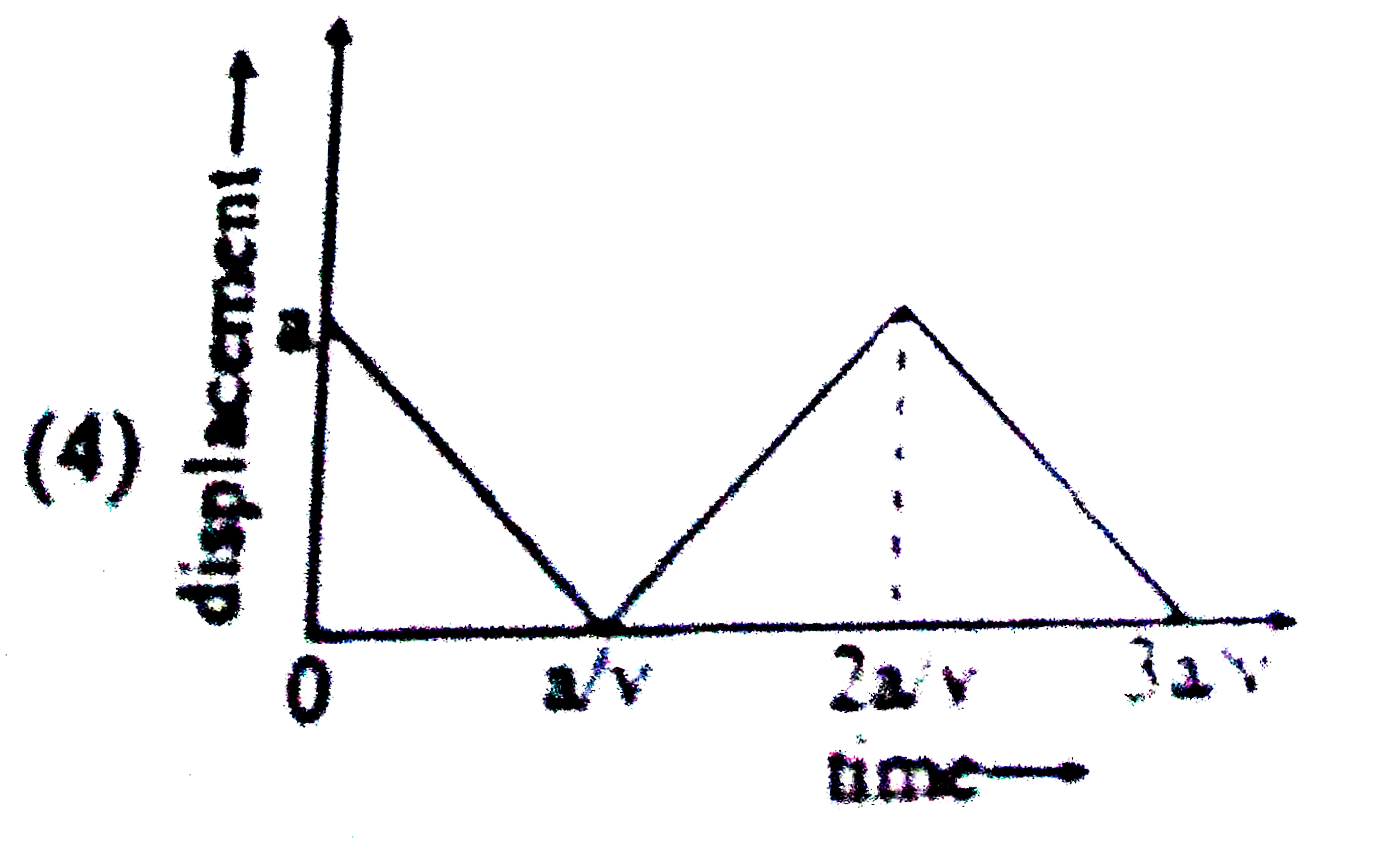
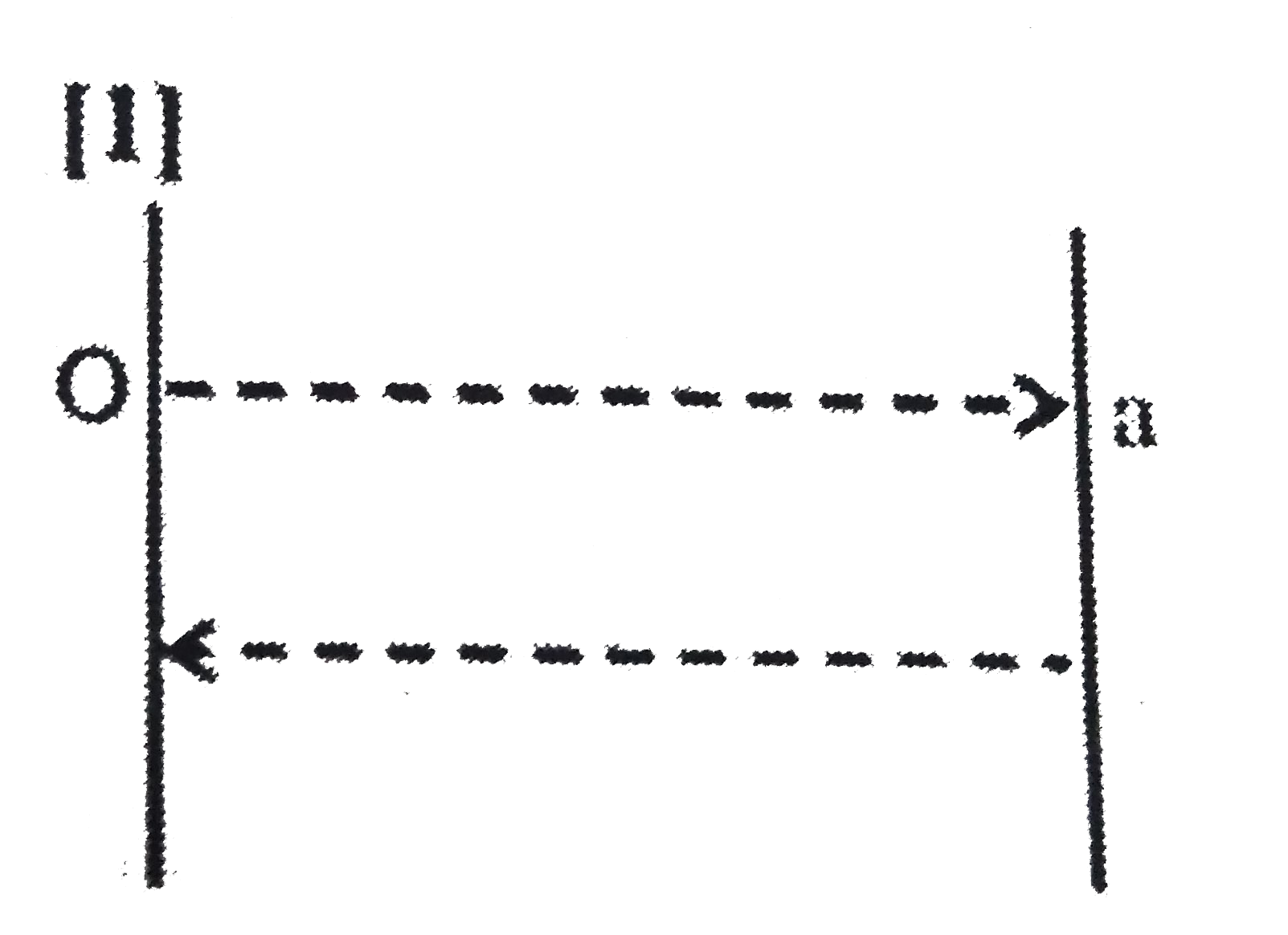
A particle is confined to move along the x-axis between reflecting walls at x = 0 and x = a . Between these two limits it moves freely at constant velocity v . If the walls are perfectly reflecting , then its displacement time graph is -

A

B

C

D

Text Solution

Verified by Experts

The correct Answer is:
A


When it move 0 to a
`v = (x_(2) - x_(1))/(t) = (a-0)/(t) x_("max") = a `
x = vt , v = const so `x prop t " " ...... (i) `
when it move 'a' to 0
`v = x_(2) - x_(1) = (0 - a)/(t) x_("min") = 0 `
v' = -v constant , `(dx)/(dt) = -v " " ......(ii)`
so both of condition will be satisfy through option (1).
Promotional Banner

Topper's Solved these Questions

  • MOCK TEST 1

    CAREER POINT|Exercise PART (B) - CHEMISTRY|29 Videos
  • MAJOR TEST

    CAREER POINT|Exercise PHYSICS|30 Videos
  • MOCK TEST 10

    CAREER POINT|Exercise PART (B) - CHEMISTRY|30 Videos

Similar Questions

Explore conceptually related problems

A particle is moving along x -axis. Its velocity v with x co-ordinate is varying as v=sqrt(x) . Then

A particle is moving along the x-axis and its position-time graph is shown. Determine the sign of acceleration.

A particle constrained to move along the x-axis in a potential V=k"x"^(2) is subjected to an external time dependent force vec(f)(t) here k is a constant, x the distance from the origin, and t the time. At some time T, when the particle has zero velocity at x = 0, the external force is removed. Choose the incorrect options – (1) Particle executes SHM (2) Particle moves along +x direction (3) Particle moves along – x direction (4) Particle remains at rest

A partical is moving along the x-axis and its velocity-time graph is shown in following diagrams. Sketch displacement-time graph.

A particle is moving along the x-axis and its velocity-time graph ia as shown in the following diagrems. Sketch the displacement-time graph.

A particle starts moving with constant, velocity v=(m)/(s) , from position x=5m The position time graph will be

Particles A and B are moving with constant velocities along x and y axis respectively, the graph of separation between them with time is

A particle located at x = 0 at time t = 0 , starts moving along with the positive x-direction with a velocity 'v' that varies as v = a sqrt(x) . The displacement of the particle varies with time as

CAREER POINT-MOCK TEST 1-PART (B) - CHEMISTRY
  1. A particle is confined to move along the x-axis between reflecting wal...

    Text Solution

    |

  2. Which method of purificationis represented by the following equations ...

    Text Solution

    |

  3. A fire work gave brick red colour . It probably contained a salt of -

    Text Solution

    |

  4. About H(2)SO(4) , which of the following statements is incorrect ?

    Text Solution

    |

  5. The property of halogen acids , that indicated incorrect is -

    Text Solution

    |

  6. Which of the following will be the major product when 3 - phenylpropen...

    Text Solution

    |

  7. The major product formed in the reaction is - CH(3)CHClCH(2)CH(2)OH ...

    Text Solution

    |

  8. Consider the following sequence of reactions . The final product ...

    Text Solution

    |

  9. For the redox reaction , MnO(4)^(-) + C(2)O(4)^(-2) + H^(+) to Mn^...

    Text Solution

    |

  10. The density of gas A is twice that of B at the same temperature the mo...

    Text Solution

    |

  11. I(2)(s)|I^(-)(0.1M) half cell is connected to a H^(+) (aq)|H(2)(1 bar)...

    Text Solution

    |

  12. Which of the following statement is/are correct ? I . The ligand th...

    Text Solution

    |

  13. A six coordination complex of formula CrCl(3)*6H(2)O has green colour....

    Text Solution

    |

  14. Which one of the following ions exhibit highest magnetic moment ?

    Text Solution

    |

  15. Which of the following gaseous molecule is non-linear ?

    Text Solution

    |

  16. Select incorrect order

    Text Solution

    |

  17. In psi(321), the sum of angular momentum, spherical nodes and angular ...

    Text Solution

    |

  18. A solid is formed and it has three types of atoms X, Y and Z, X forms ...

    Text Solution

    |

  19. The heat of formation of NH(3)(g) is -46 " kJ mol"^(-1). The DeltaH (i...

    Text Solution

    |

  20. NH(4)HS(s)hArrNH(3)(g)+H(2)S(g) The3 equilibrium pressure at 25^(@)C ...

    Text Solution

    |

  21. Calculate depression of freezing point for 0.56 molal aq. Solution of ...

    Text Solution

    |

