Home
Class 12
PHYSICS
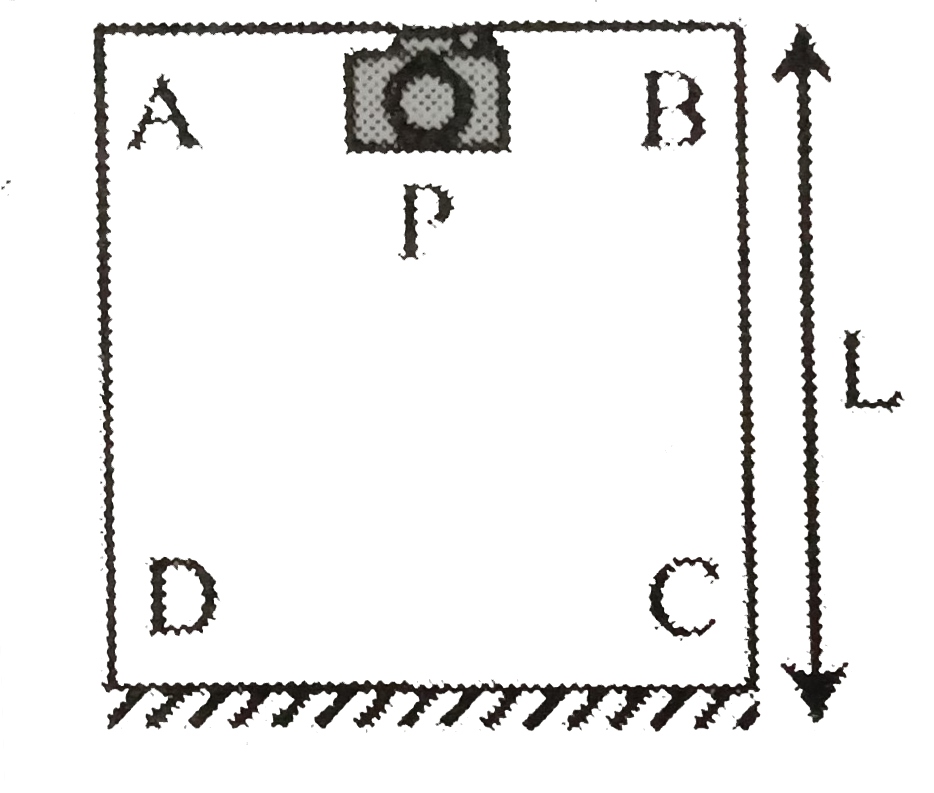
Adjoining figure shows cubical room ABCD...

Adjoining figure shows cubical room ABCD, with the wall CD as a plane mirror. Each side of the room is L metres in length. A camera P is placed at the mid-point of the wall AB. At what distance should the camera be focused to photograph and object placed at A ?

A

`(L)/(2)`

B

L

C

2L

D

More than 2L

Text Solution

Verified by Experts

The correct Answer is:
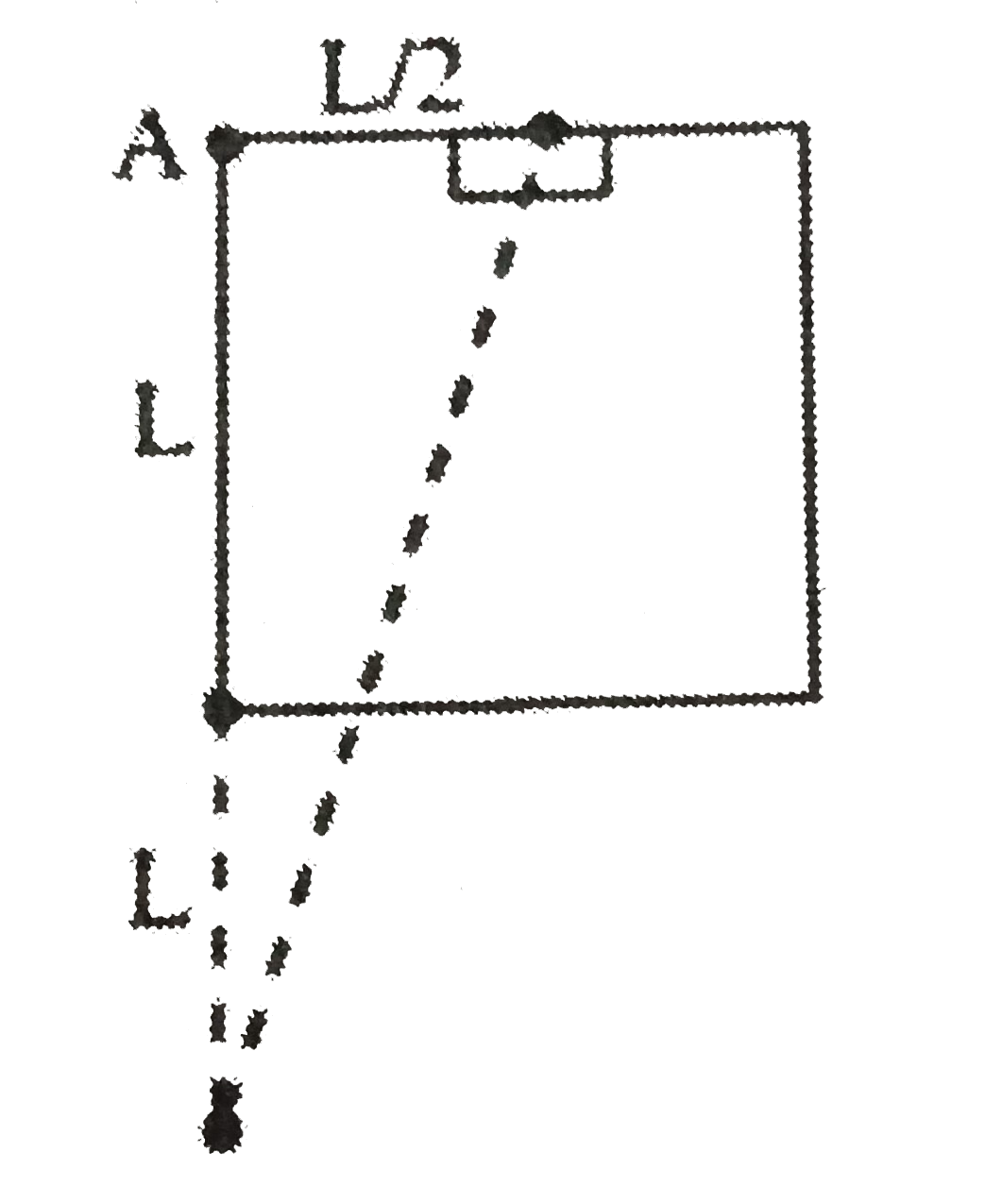
D


`sqrt(((L)/(2))^(2)+(2L)^(2))rArr"move than 2L"`
Promotional Banner

Topper's Solved these Questions

  • MOCK TEST 2

    CAREER POINT|Exercise PART (B)-CHEMISTRY|29 Videos
  • MOCK TEST 10

    CAREER POINT|Exercise PART (B) - CHEMISTRY|30 Videos
  • MOCK TEST 3

    CAREER POINT|Exercise CHEMISTRY|30 Videos

Similar Questions

Explore conceptually related problems

Figure shows a cubical room ABCD with the wall CD as a plane mirror. Each side of the room is 3 m . We place a camera at the midpoint of the wall AB . At what distance should the camera be focussed to photograph an object placed at A.

A concave mirror of focal length 10 cm is placed at a distance of 35 cm from a wall. How far from the wall should an object be placed to get its image on the wall ?

A concave mirror of focal length 10 cm is placed at a distance of 35 cm from a wall. How far from the wall should an object be placed to get its image on the wall ?

A concave mirror of focal length 20 cm is placed at a distance of 50 cm from a wall. How far from the wall should an object be placed to form its real image on the wall ?

Two concave mirrors of equal focal lengths are placed facing each other with their principal axes coinciding. An object O is to be placed at the mid-point between mirrors. What should be the separation between mirrors so that only one image is formed?

A camera fitted with a lens of focal length 50 mm is being used to photograph a flower that is 5 cm in diameter. The flower is placed 20 cm in front of the camera lens. a) At what distance from the film should the lens be adjusted to obtain a sharp image of the flower? b) What would be the diameter of the image of the flower of the film? c) What is the nature of camer lens?

An object is at a distance of a=36 cm from a lens with a focal length f=30 cm. A flat mirror turned through 45^(@) with respect to the optic axis of the lens is placed behind at a distance of l = 1m . At what distance h from the optic axis should the bottom of a tray filled with water upto depth 20 cm be placed to obtain a sharp image of the object at the bottom ?

A point object O is placed at a distance of 62 cm in front of a concave mirror of focal length f = 20 cm . A glass slab of refractive index mu = (3)/(2) and thickness 6 cm is inserted between the object and the mirror. Let’s define final image as image formed after the light ray originating from O passes through the slab, gets reflected from the mirror and then again passes through the slab. At what distance d from the mirror, the face AB of the slab can be placed so that the final image is formed inside the slab itself?

A convex mirror of focal length 10cm is shown in figure. A linear object AB=5cm is placed along the optical axis. Point B is at distance 25cm from the pole of mirror. The size of image of AB is

CAREER POINT-MOCK TEST 2-PART (B)-CHEMISTRY
  1. Adjoining figure shows cubical room ABCD, with the wall CD as a plane ...

    Text Solution

    |

  2. Sodium thiosulphate, Na(2)S(2)O(3).5H(2)O is used in photography to

    Text Solution

    |

  3. The cyanide ion CN and N(2) are isoelectronic, but in contrast to CN^(...

    Text Solution

    |

  4. Ferric ion forms a prussian blue coloured solution with K(4)[Fe(CN)(6)...

    Text Solution

    |

  5. Under what conditoin of temperature and pressur the formation of atom...

    Text Solution

    |

  6. The reaction of (S)-2 bromobutane with OH^(-) to produce (R )-butane-2...

    Text Solution

    |

  7. 4 mole of a mixture of Mohr's salt and Fe(2)(SO(4))(3) requires 500mL...

    Text Solution

    |

  8. Total charge required for the oxidation of two moles Mn3O4 into MnO4^...

    Text Solution

    |

  9. Calculate standard free energy change for the reaction 2Ag+2H^(+)rarrH...

    Text Solution

    |

  10. Which one of the following ionic species will impart colour to an aque...

    Text Solution

    |

  11. Select incorrect order :

    Text Solution

    |

  12. In which of the following processes energy is absorbed ?

    Text Solution

    |

  13. An element (atomic mass = 100 g//mol) having bcc structure has unit ce...

    Text Solution

    |

  14. Select the correct statement -

    Text Solution

    |

  15. Element X crystallizes in 12 co - ordination fcc lattice. On applyng h...

    Text Solution

    |

  16. Which of the following is correct option for the free expansion of an ...

    Text Solution

    |

  17. Which of the following is correct ?

    Text Solution

    |

  18. On increasing the temperature , the rate of a reaction:

    Text Solution

    |

  19. The molality of 15 % by wt solution of H2SO4 is

    Text Solution

    |

  20. Rate of reaction (r ) is plotted against temperature (T) for an enzyme...

    Text Solution

    |

  21. What volume of 75% alcohol by weight (d-0.80g//cm^(3)) must be used to...

    Text Solution

    |

